Healthcare Cybersecurity

Critical Flaw Identified in BD Alaris Plus Medical Syringe Pumps

A critical remotely exploitable flaw has been detected in BD Alaris Plus medical syringe pumps. The flaw would enable a threat actor to gain access to an affected medical syringe pump when it is connected to a terminal server via the serial port. If the flaw is exploited a threat actor could alter the intended function of the pump.

The flaw is an improper authentication vulnerability. The software fails to perform authentication for functionality that requires a provable user identity.

The flaw was identified by Elad Luz of CyberMDX who notified Becton, Dickinson and Company (BD), which in turn voluntarily reported the vulnerability to the National Cybersecurity & Communications Integration Center and the Industrial Control Systems Cyber Emergency Response Team (ICS-CERT). The latter issued an advisory about the vulnerability on August 23, 2018.

The vulnerability affects version 2.3.6 of Alaris Plus medical syringe pumps and prior versions, specifically the Alaris GS, Alaris GH, Alaris CC, and Alaris TIVA products. The vulnerability has been assigned a CVSS v3 score of 9.4 out of 10 and is being tracked as CVE-2018-147.

BD has explained that the vulnerability does not affect any products that are sold in the United States. All current versions of Alaris Plus pumps do not have the vulnerability. Vulnerable devices were previously sold in the European Union.

The vulnerability cannot be exploited while the device is connected to the Alaris Gateway Workstation docking station as the remote-control feature is disabled when the device is connected to the docking station.

If the device is not switched on it cannot be turned on remotely. BD also notes that were the flaw to be exploited access to PII or PHI could not be gained.

BD has explained that an attack utilizes a known vulnerability in terminal servers. Use of the device with terminal servers is not supported. To reduce the potential for the flaw to be exploited, all users have been advised to operate the affected pumps as stand-alone devices or alternatively they should be used in a segmented network environment.

The ICS-CERT advisory claims the vulnerability would only require a low level of skill to exploit, although according to BD, “To execute this attack one would need to ensure the affected device is connected to a terminal server via the serial port, have an understanding of the device communication protocol, have access to specific driver software to implement the pump protocol communication and the ability to penetrate a customer network and gain unauthorized access to terminal server devices.”

Because of the sequence of events required to exploit the vulnerability, BD said “the probability of an unauthorized breach in network security that impacts the delivery of a patient’s IV infusion is negligible.”

The post Critical Flaw Identified in BD Alaris Plus Medical Syringe Pumps appeared first on HIPAA Journal.

July 2018 Healthcare Data Breach Report

July 2018 was the worst month of 2018 for healthcare data breaches by a considerable distance. There were 33 breaches reported in July – the same number of breaches as in June – although 543.6% more records were exposed in July than the previous month.
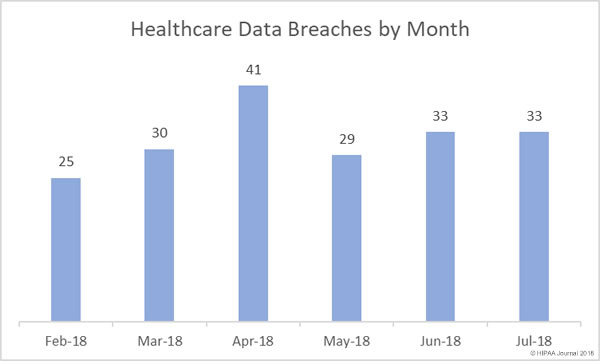
Healthcare Data Breaches by Month (Feb-July 2018)

The breaches reported in July 2018 impacted 2,292,552 patients and health plan members, which is 202,859 more records than were exposed in April, May, and July combined.
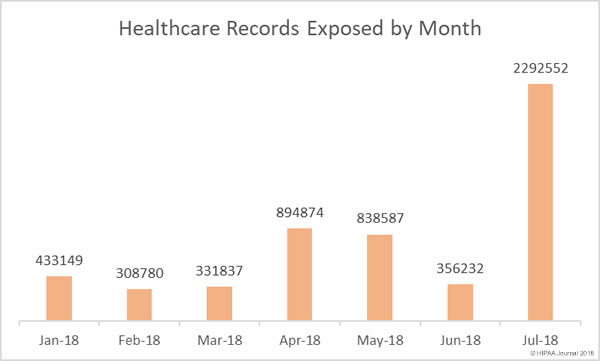
Healthcare Records Exposed by Month

A Bad Year for Patient Privacy

So far in 2018 there have been 221 data breaches of more than 500 records reported to the Department of Health and Human Services’ Office for Civil Rights. Those breaches have resulted in the protected health information of 6,112,867 individuals being exposed, stolen, or impermissibly disclosed.

To put that figure into perspective, it is 974,688 more records than were exposed in healthcare data breaches in all of 2017 and there are still five months left of 2018.

Largest Healthcare Data Breaches of 2018 (Jan-July)

Entity Name Entity Type Records Exposed Breach Type
UnityPoint Health Business Associate 1,421,107 Hacking/IT Incident
CA Department of Developmental Services Health Plan 582,174 Theft
MSK Group Healthcare Provider 566,236 Hacking/IT Incident
LifeBridge Health, Inc Healthcare Provider 538,127 Hacking/IT Incident
SSM Health St. Mary’s Hospital – Jefferson City Healthcare Provider 301,000 Improper Disposal
Oklahoma State University Center for Health Sciences Healthcare Provider 279,865 Hacking/IT Incident
Med Associates, Inc. Business Associate 276,057 Hacking/IT Incident
MedEvolve Business Associate 205,434 Unauthorized Access/Disclosure
St. Peter’s Surgery & Endoscopy Center Healthcare Provider 134,512 Hacking/IT Incident
Boys Town National Research Hospital Healthcare Provider 105,309 Hacking/IT Incident

Causes of Healthcare Data Breaches in July 2018

Unauthorized accessing of PHI by employees and impermissible disclosures of PHI are commonplace in healthcare, although in July there was a major reduction in these types of breaches, falling by 46.6% from July. There was also a significant drop in the number of incidents involving the loss or theft of unencrypted electronic devices and physical PHI, which fell 50% month over month.
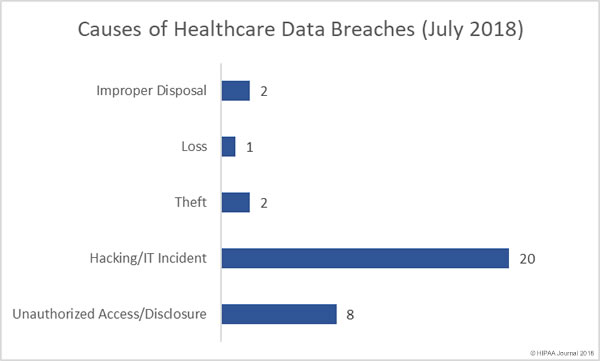
Causes of Healthcare Data Breaches July 2018

Hacking incidents, ransomware attacks and other IT incidents such as malware infections and phishing attacks significantly increased in July. There were 66.7% more hacking/IT incidents than June. Hacking/IT incidents also resulted in the exposure of more healthcare records than all other types of breaches combined.

Healthcare Records Exposed by Breach Type (July 2018)

7 of the top 15 data breaches (46.7%) in July were phishing attacks, two were ransomware attacks, three were failures to secure electronic PHI and two were improper disposal incidents involving physical PHI. The improper disposal incidents were the second biggest cause of exposed PHI, largely due to the 301,000-record breach at SSM Health. In that breach, physical records were left behind when St. Mary’s Hospital moved to a new location.

In July, more healthcare records were exposed through phishing attacks than any other breach cause. The phishing incidents resulted in the exposure and possible theft of than 1.6 million healthcare records.

Largest Healthcare Data Breaches in July 2018

In July, there were 12 healthcare data breaches of more than 10,000 records and four breaches impacted more than 100,000 individuals. There were 14 breaches of between 1,000 and 9,999 records and 7 breaches of between 500 and 999 records. Four of the ten largest healthcare data breaches of 2018 were reported in July.

The largest healthcare data breach of July, and the largest breach of 2018 to date, was a phishing attack on Iowa Health System doing business as UnityPoint Health.

The threat actor responsible for the UnityPoint Health phishing attack spoofed an executive’s email account and sent messages to UnityPoint Health employees. Several members of staff were fooled by the emails and disclosed their login credentials giving the attacker access to their email accounts. Those email accounts contained the protected health information of more than 1.4 million patients.

Four of the ten largest healthcare data breaches of 2018 were reported in July.

Entity Name Entity Type Records Exposed Breach Type
UnityPoint Health Business Associate 1,421,107 Hacking/IT Incident
SSM Health St. Mary’s Hospital – Jefferson City Healthcare Provider 301,000 Improper Disposal
MedEvolve Business Associate 205,434 Unauthorized Access/Disclosure
Boys Town National Research Hospital Healthcare Provider 105,309 Hacking/IT Incident
Blue Springs Family Care, P.C. Healthcare Provider 44,979 Hacking/IT Incident
Golden Heart Administrative Professionals Business Associate 44,600 Hacking/IT Incident
Confluence Health Healthcare Provider 33,821 Hacking/IT Incident
NorthStar Anesthesia Healthcare Provider 19,807 Hacking/IT Incident
Orlando Orthopaedic Center Healthcare Provider 19,101 Unauthorized Access/Disclosure
New England Dermatology, P.C. Healthcare Provider 16,154 Improper Disposal
MedSpring of Texas, PA Healthcare Provider 13,034 Hacking/IT Incident
Longwood Orthopedic Associates, Inc. Healthcare Provider 10,000 Unauthorized Access/Disclosure

Location of Breached PHI

Unsurprisingly, given the high number of successful phishing attacks in July, email-related breached dominated the breach reports and was the main location of breached PHI, as has been the case in March, April, May and June. There were seven network server breaches in July, which were a combination of ransomware attacks, accidental removal of security protections, malware infections, and hacking incidents.
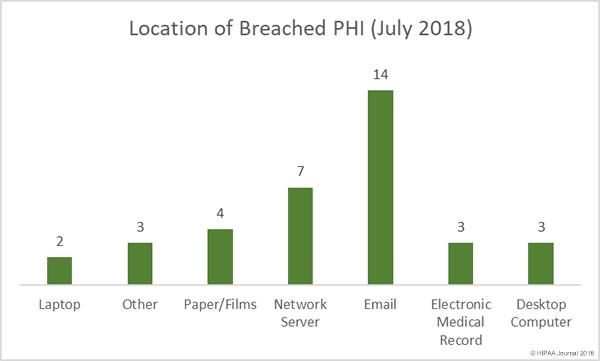
Location of Breached PHI (July 2018)

Data Breaches by Covered Entity Type

Healthcare providers were hit the hardest in July with 28 breaches reported by providers. Only two health plans reported data breaches in July. Three business associates reported breaches, although nine reported data breaches had at least some business associate involvement.
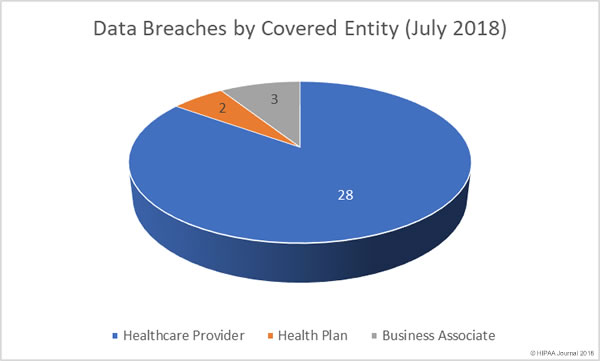
July 2018 Healthcare Data Breaches by Covered Entity

Healthcare Data Breaches by State

Healthcare organizations based in 22 states reported data breaches in July. California usually tops the list for the most data breaches each month due to the number of healthcare organizations based in the state, although in July it was Florida and Massachusetts than had the most breaches with three apiece.

Alaska, Missouri, New York, Pennsylvania, Texas, Virginia, and Washington each had two breaches reported, and there was one breach reported in each of Arkansas, California, Colorado, Idaho, Indiana, Illinois, Maryland, Michigan, Montana, Nebraska, New Jersey, New Mexico, and Tennessee.

The post July 2018 Healthcare Data Breach Report appeared first on HIPAA Journal.

Warnings Issued About Vulnerabilities in Philips PageWriter Cardiographs and IntelliVue Information Center iX

Over the past few months, several vulnerabilities have been discovered in Philips medical devices, software and systems.

This week, two further advisories have been issued by the Industrial Control Systems Cyber Emergency Team (ICS-CERT) about vulnerabilities the firm’s real-time central monitoring system, Philips IntelliVue Information Center iX, and its PageWriter cardiographs. All three of the vulnerabilities are classed as medium risk with CVSS v3 base scores ranging between 5.7 and 6.1.

CVE-1999-0103 is a denial of service vulnerability that affects the Philips IntelliVue Information Center iX version B.02. The flaw was discovered by a user of the system and was reported to Philips, which in turn reported the vulnerability to the National Cybersecurity and Communications Integration Center’s (NCCIC).

The vulnerability can be exploited remotely and does not require a high level of skill. If multiple initial UDP requests are made, it could compromise the availability of the device by causing the operating system to become unresponsive. The vulnerability has been assigned a CVSS v3 base score of 5.7.

Philips has already put mitigations in place to reduce the potential for the vulnerability to be exploited. All PIIC iX B.02 users have been advised to read the labelling, instructions for use, and service guides, which detail compensating controls. A patch will be released to correct the vulnerability by the end of September 2018.

Two vulnerabilities have been identified by Philips affecting its PageWriter TC10, TC20, TC30, TC50, TC70 Cardiographs. The flaws are present in all versions prior to May 2018.

CVE-2018-14799 is an improper input validation vulnerability. The devices do not properly sanitize data entered by users, which could result in the triggering of a buffer overflow condition. If exploited, a threat actor could access and modify device settings. The vulnerability has been assigned a CVSS v3 base score of 5.9.

CVE-2018-1480 concerns the use of hard-coded credentials. To exploit this vulnerability an attacker would need physical access to the device and would require the superuser password. With the password and physical access it would be possible to change all settings on the device and reset all existing passwords. The vulnerability has been assigned a CVSS v3 base score of 6.1.

The PageWriter vulnerabilities will be addressed by Philips via a new release, but that will not be available until the middle of 2019.

Philips notes that the WinCE5 operating system on the PageWriter TC20, TC30, TC50 and TC70 is now obsolete and is no longer supported. TC50 and TC70 can be updated to WinCE7, which users can download from InCenter.

However, TC20 and TC30 do not support WinCE7 so customers have been advised to upgrade to TC50 if they are concerned about the obsolete operating system, otherwise Philips will be issuing an update for the TC20 to a supported operating system by the end of 2019.

In the meantime, Philips suggests defense in depth, physical security controls to prevent access to the devices, controlling access to system components to protect medical devices in the system, and the use of multi-factor authentication.

The post Warnings Issued About Vulnerabilities in Philips PageWriter Cardiographs and IntelliVue Information Center iX appeared first on HIPAA Journal.

Updates to Cofense Phishing Simulation Platform Add Even More Opportunities for Automation

Cofense has announced that further updates have been made to its award-winning phishing email simulation platform, Cofense PhishMe. The updates provide even greater opportunities for automating phishing simulation campaigns to save administrators even more time.

Security awareness and anti-phishing training is now an important part of healthcare organizations’ cybersecurity programs. In addition to investing in technology to block phishing and other email-based threats, end users require training. Even layered defenses will not stop all phishing threats from reaching inboxes. Without training, end users will remain the weakest link in the security chain.

Phishing simulation exercises are an important part of the training process. They allow security teams to assess how effective their training programs have been and identify weak points in the training program. They also allow security teams to identify individuals who have failed to understand certain parts of the training program.

While phishing simulation platforms include some opportunities for automation and scheduling, creating and running phishing simulations can still be a time-consuming process.

The latest updates to the Cofense PhishMe platform incorporate even more opportunities for automation. Whereas creating a program of 12 phishing scenarios and scheduling those campaigns over the course of a year would have taken an administrator about three hours to complete, the update shaves off 91% of that time. The same 12 campaigns can be created and scheduled in 15 minutes.

This has been achieved with the use of playbooks. The playbooks can be used to create, schedule, and launch phishing templates and schedule them over the course of a year. Additionally, administrators can automate the sending of reminders to end users based on the training programs they have competed – or not completed – saving even more time. The playbooks also incorporate the lessons learned from phishing simulation campaigns conducted by 400 of Fortune 1000 companies that have used the Cofense PhishMe platform.

“At Cofense we believe in automation as a way to relieve security operators of the repetitive tasks to allow them to focus on strategic, intelligent decision-making,” said Rohyt Belani, Co-founder and CEO of Cofense. “Playbooks are meant to allow both managed services providers and our end clients the ability to choose various programs just like one does on a treadmill in a gym, so they don’t need to focus on the metaphorical tasks of having to change speed and incline but can instead focus on designing and tracking the appropriate success criteria and presenting them appropriately to senior management.”

In addition to the Cofense PhishMe updates, the Leesburg, VA-based company has also recently launched its new phishing-specific Security Orchestration, Automation and Response (SOAR) platform, has incorporated board-level reporting, and has launched mobile Cofense Reporter and more accurate Microsoft attachment tracking. These updates and the continued high-level innovation have helped the company remain the market leader in phishing defense and attack disruption.

The post Updates to Cofense Phishing Simulation Platform Add Even More Opportunities for Automation appeared first on HIPAA Journal.

Only 30% of Healthcare Organizations Have Taken Out Cybersecurity Insurance

A recent survey conducted by Ovum on behalf of analytics firm FICO has revealed there has been a major increase in companies taking out cybersecurity insurance, but the healthcare industry has been slow on the uptake.

In 2017 when the survey was last conducted, 50% of U.S. firms reported that they had not taken out a cybersecurity insurance policy. That percentage has fallen to 24% in 2018. While many businesses see the value in paying insurance premiums to cover the cost of mitigating cyberattacks and data breaches, that does not appear to be the case for healthcare companies.

Only 30% of healthcare organizations have taken out cybersecurity insurance policies. 70% have no cybersecurity insurance cover whatsoever, even though the industry is targeted by hackers. The financial services industry, which is also heavily targeted by hackers, has been quick to take advantage of cybersecurity cover. Only 10% of surveyed financial firms had no coverage for cyberattacks.

The survey was conducted on 500 companies in 11 countries including the U.S., Canada, India, and the UK. The figures for the United States were the exact average across all surveyed countries, which is a major improvement on last year when U.S. companies ranked bottom out of all 11 countries for cybersecurity insurance uptake.

One of the main problems highlighted by the survey was unfair premiums which had not been accurately calculated based on the level of risk. Only a quarter of surveyed firms said their insurers had set premiums based on an accurate analysis of their company’s risk profile. A majority believed the premiums were calculated on industry averages, inaccurate analyses, or unknown factors.

The increased risk of cyberattacks and the litigation that usually follows has spurred many companies to take out policies, but in many cases the cover provided is not comprehensive cover. Only a third of U.S. companies (32%) said their policy covered all cybersecurity risks. Even though policies have been taken out, they may not pay out in the event of a breach.

“Given the number of large-scale and very public breaches in recent years, it’s not surprising that we’ve seen a big increase in US organizations investing in it over the past 12 months, but there’s still some way to go,” said Doug Clare, vice president for cybersecurity solutions at FICO. “As the insurance market matures and the litigation and fines increase we expect more firms will also go beyond basic coverage to seek insurance that is more comprehensive.”

However, that may not tell the whole story. Maxine Holt, research director at Ovum, suggested it may be a case of companies having a risk profile that that insurers are not prepared to cover comprehensively.

The post Only 30% of Healthcare Organizations Have Taken Out Cybersecurity Insurance appeared first on HIPAA Journal.

Survey Reveals Lack of Anti-Phishing Measures at U.S. Businesses

Phishing is now the number one cyber threat faced by businesses but in spite of a high risk of phishing attacks occurring, businesses have been slow to respond to the threat and implement cybersecurity solutions to reduce the risk of email-related data breaches.

A recent survey Valimail sponsored survey has shown that anti-phishing defenses are lacking at many U.S. businesses. The survey was conducted on 650 IT/IT security professionals by the Ponemon Institute. The companies had an average of 1,000 employees with average annual email security and fraud prevention budget of $2.5 million.

The high risk of email-based attacks was made abundantly clear. 79% of respondents said that they had experienced a data breach or cyberattack in the past 12 months that certainly or likely involved email, such as a business email compromise attack or a phishing incident.

80% of respondents said they were very concerned about their organization’s ability to prevent or reduce email-based attacks and 53% of respondents admitted that preventing phishing attacks was very difficult.

Even though the risk of attack is high and breaches have been experienced, only 29% of respondents said their organization had taken significant steps to tackle the threat from phishing and email impersonation attacks. More than one fifth of firms (21%) said they had taken no steps to reduce the risk of phishing attacks.

When asked about the anti-phishing defenses that had been implemented, 69% of respondents said they had implemented anti-spam or anti-phishing filters and 56% used secure email gateway technology. Only a third of respondents (34%) said they provide anti-phishing training for employees. Even fewer (29%) have implemented Domain-Based Message Authentication and Conformance (DMARC) and Sender Policy Framework (27%) to detect and prevent email impersonation attacks.

The high number of phishing attacks and data breaches appears to have spurred many businesses to make improvements to email security. In the next 12 months, 65% of respondents said their company will be investing in anti-spam filters, 63% will be using secure email gateway technology, 47% will be using SIEM technology, and 57% will be providing anti-phishing training to employees.

Only 35% will be adopting DMARC and 23% said they planned to implement SPF. Approximately two thirds of companies would consider implementing an automated DMARC enforcement solution if it could completely stop impersonation attacks that spoof email domains and block inbound email from unknown and untrustworthy senders.

39% of respondents said their company was not spending enough on email security to stop phishing and email impersonation attacks with budget constraints a major hurdle that must be overcome.

56% of respondents said that it would likely take a serious hacking incident to get a budget increase to pay for improvements to email security. 65% said that the board would likely be swayed by concern over the loss of customers due to a security incident and 47% said concern over loss of revenue due to a security incident could result in a budget increase.

When asked how much difference a 20% increase in their email security budget would make, respondents estimated it would improve the email threat detection rate by 45% and the phishing/impersonation attack prevention rate by 33%. Without sufficient investment in email security, costly email-related data breaches are likely to continue.

The post Survey Reveals Lack of Anti-Phishing Measures at U.S. Businesses appeared first on HIPAA Journal.

Significant Vulnerabilities Identified in Maryland’s Medicaid Management Information System

The Department of Health and Human Services’ Office of Inspector General (OIG) has published the findings of an audit of Maryland’s Medicaid system.

The audit was conducted as part of the HHS OIG’s efforts to oversee states’ use of various Federal programs and to determine whether appropriate security controls had been implemented to protect its Medicaid Management Information System (MMIS) and Medicaid data.

The audit consisted of interviews with staff members, a review of supporting documentation, and use of vulnerability scanning software on network devices, servers, websites, and databases that supported its MMIS.

The audit uncovered multiple system security weaknesses that could potentially be exploited by threat actors to gain access to Medicaid data and disrupt critical Medicaid operations. Collectively, and in some cases individually, the vulnerabilities were ‘significant’ and could have compromised the integrity of the state’s Medicaid program.

Details of the vulnerabilities uncovered by auditors were not disclosed publicly, although OIG did explain that the vulnerabilities were present due to the failure to implement sufficient controls over MMIS data and information systems. While the flaws were serious, OIG did not discover any evidence to suggest the flaws had previously been exploited.

OIG has recommended Maryland make several improvements to its Medicaid program to ensure its information systems and Medicaid data are appropriately secured to a standard that meets Federal requirements.  Maryland concurred with all of the recommendations made by OIG and has submitted a plan that addresses all of the vulnerabilities that have not yet been corrected.

The audit was one of several conducted on various states over the past few months and the findings were similar to other state’s MMIS audits. While it is a concern that serious vulnerabilities exist, the audits ensure that vulnerabilities are identified and are addressed before they are exploited by threat actors, thus helping to prevent serious data breaches.

The post Significant Vulnerabilities Identified in Maryland’s Medicaid Management Information System appeared first on HIPAA Journal.

ICS-CERT Warns of Vulnerabilities in Philips IntelliSpace Cardiovascular Products

ICS-CERT has issued and advisory about two vulnerabilities that have been identified in Philips IntelliSpace Cardiovascular products, one of which has been given a high severity rating and could allow a threat actor to elevate privileges and gain full control of a vulnerable device.

The improper privilege management vulnerability (CVE-2018-14787) is present in IntelliSpace Cardiovascular cardiac image and information management software version 2.x and earlier releases and Xcelera V4.1 and earlier versions.

The vulnerability could not be exploited remotely. Local access is required, and an authenticated user would need to have write privileges. If exploited, privileges could be escalated and access gained to folders containing executables. Arbitrary code could be executed to give the attacker full control of the system. The vulnerability has been assigned a CVSS v3 severity score of 7.3.

An unquoted search path or element vulnerability (CVE-2018-14789) is present in IntelliSpace Cardiovascular Version 3.1 and earlier versions and Xcelera Version 4.1 and earlier versions. This flaw would allow an attacker to execute arbitrary code and escalate privileges. The vulnerability has been assigned a CVSS v3 severity score of 4.2 (medium).

Philips discovered the vulnerabilities and self-reported them to the National Cybersecurity and Communications Integration Center (NCCIC).

The improper privilege management vulnerability has been addressed in version 3.1 of IntelliSpace Cardiovascular software. Any user running IntelliSpace Cardiovascular version 2.x or prior versions or Xcelera V4.1 or prior versions should contact their Philips service support team to receive information on how they can upgrade to version 3.1.

Philips will be addressing the unquoted search path or element vulnerability in the next release of IntelliSpace Cardiovascular – V3.2 – which has been scheduled for release in October 2018. Until that point, interim mitigations can be implemented to reduce the potential for the vulnerability to be exploited. Philips suggests reviewing file permission policies and restricting available permissions where possible.

Several vulnerabilities have been identified in the IntelliSpace suite of products in recent months. In March 2018, ICS-CERT issued a warning about several vulnerabilities affecting all versions of iSite and IntelliSpace PACS, some of which were assigned a CVSS v3 severity score of 10 – The maximum score possible. If exploited the vulnerabilities could compromise patient confidentiality, system integrity, and/or system availability.

In February, ICS-CERT issued a warning about a slew of vulnerabilities in the IntelliSpace Portal that were assigned severity scores ranging from 3.1 to 8.1. In total, 35 vulnerabilities were detected, some of which could be exploited remotely and allowed remote code execution.

In January, a warning was issued about an insufficient session expiration vulnerability in IntelliSpace Cardiovascular that was assigned a CVSS v3 score of 6.7. Exploiting the vulnerability would require only a low skill level. If exploited, an attacker could gain access to sensitive patient information.

The post ICS-CERT Warns of Vulnerabilities in Philips IntelliSpace Cardiovascular Products appeared first on HIPAA Journal.

Microsoft ADFS Vulnerability Allows Bypassing of Multi-Factor Authentication

A vulnerability has been discovered in Microsoft’s Active Directory Federation Services (ADFS) that allows multi-factor authentication (MFA) to be bypassed with ease. The flaw is being tracked as CVE-2018-8340 and was discovered by Andrew Lee, a security researcher at Okta.

ADFS is used by many organizations to help secure accounts and ADFA is used by vendors such as SecureAuth, Okta, and RSA to add multi-factor authentication to their security offerings.

To exploit the vulnerability an attacker would need to obtain the login credentials of an employee and have a valid second factor authentication token. That token could then be used as authentication to access any other person’s account if their username and password is known.

A threat actor could easily obtain a username and a password by conducting a phishing campaign. The number of phishing attacks on healthcare organizations that have been reported recently show just how easy it is to fool employees into disclosing their login credentials. A brute force attempt on an account with a weak password would also work.

Obtaining the second factor token is a little more difficult. The second factor is often a mobile phone number or email address or a smart card PIN number. That information could also potentially be obtained through phishing or through a successful attempt to get the IT help desk to reset a user’s MFA token.

The vulnerability would be easy to exploit by an insider, since that person would already have a valid MFA token registered on the system. All that would be required to access the account of another employee would be their username and password.

The vulnerability is due to the way ADFS communicates during a login. When an attempt is made to login, the server sends an encrypted context log which contains the MFA token. However, the context log does not include the username, so no check is performed to ensure the MFA token is being used by the correct individual. If an attacker used a browser to gain access to an account using a known username/password and MFA token, and a second browser with just a username and password but no MFA token, a single MFA token could be used to gain access to both accounts.

Two-factor authentication is an important security control that can prevent unauthorized account access even if a threat actor has successfully obtained login credentials, although this vulnerability shows that the system is not infallible.

The flaw has now been fixed in Microsoft’s Patch Tuesday updates on August 14. Healthcare organizations should ensure that the patch is applied promptly to ensure their MFA controls cannot be easily bypassed.

The post Microsoft ADFS Vulnerability Allows Bypassing of Multi-Factor Authentication appeared first on HIPAA Journal.