Healthcare Cybersecurity

Summary of Healthcare Data Breaches in December 2017

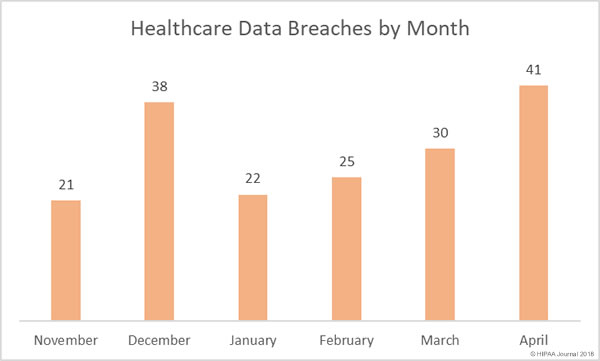
There was a sharp rise in healthcare data breaches in December, reversing a two-month downward trend. There were 38 healthcare data breaches in December 2017 that impacted more than 500 individuals: An increase of 81% from last month.


December 2017 Healthcare Data Breaches


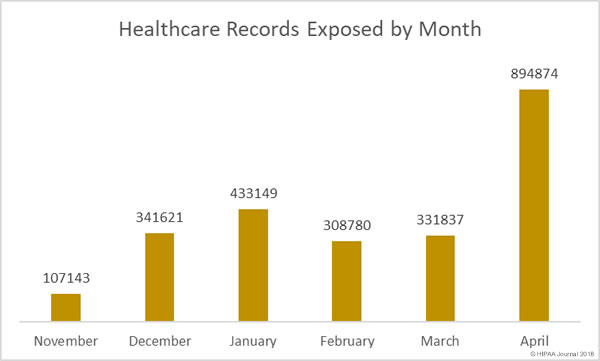
Unsurprisingly given the sharp increase in reported breaches, the number of records exposed in December also increased month over month. The records of 341,621 individuals were exposed or stolen in December: An increase of 219% from last month.


Records Exposed in December 2017 Healthcare Data Breaches


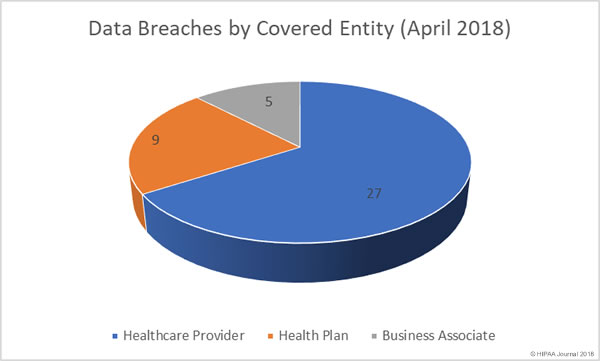
December saw a similar pattern of breaches to past months, with healthcare providers experiencing the most data breaches; however, there was a notable increase in breaches reported by health plans in December – rising from 2 in November to six in December.


December 2017 Healthcare Data Breaches by Covered Entity Type

Causes of Healthcare Data Breaches in December 2017

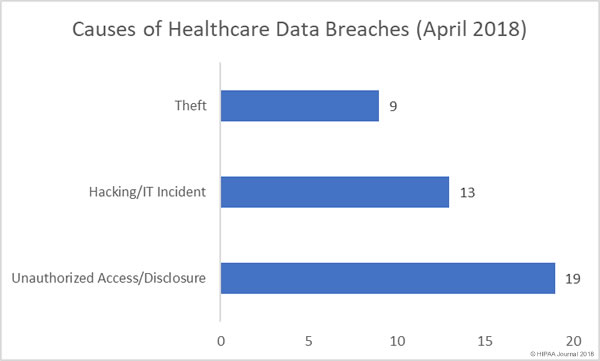
As was the case last month, hacking/IT incidents and unauthorized access/disclosures were the most common causes of healthcare data breaches in December, although there was a notable increase in theft/loss incidents involving portable electronic devices and paper records.


December 2017 healthcare data breaches by incident type


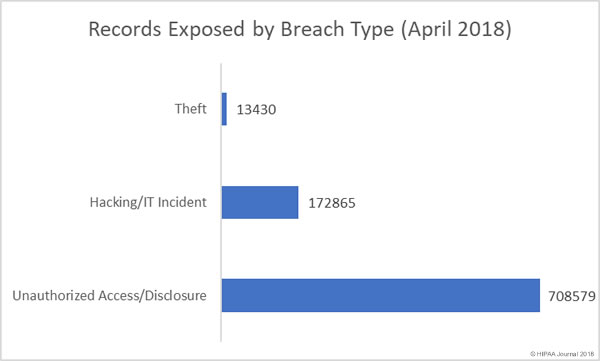
While hacking incidents usually result in the greatest number of records being exposed/stolen, this month saw a major increase in records exposed due to the theft of portable electronic devices. The theft of devices containing PHI – and paper records – resulted in 122,921 patients’ protected health information being exposed. The mean number of records exposed in theft incidents was 20,487 and the median was 15,857 – Both higher than any other cause of data breach.


Causes of Healthcare Data Breaches (Dec 2017)


Records Exposed by Breach Type (Dec 2017)


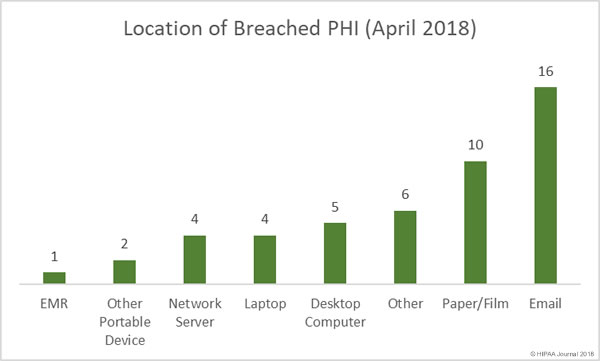
Network server incidents were the most numerous in December with 12 incidents, although there were 9 incidents involving paper records, showing that while healthcare organizations must ensure appropriate technological defenses are in place to protect electronic data, physical security is also essential to ensure paper records are secured.


Location of Breached PHI (Dec 2017)


10 Largest Healthcare Data Breaches in December 2017

In December, there were 9 data breaches that impacted more than 10,000 individuals reported to the Office for Civil Rights by HIPAA covered entities. In contrast to past months when hacking incidents dominated the top ten breach list, there was an even spread between hacking incidents, unauthorized access/disclosures, and theft of healthcare records and electronic devices.

The largest data breach reported in December affected Oklahoma Department of Human Services. However, this was not a recent data breach. The breach occurred in April 2016, but a breach report was not submitted to the Office for Civil Rights at the time of discovery. It took 18 months after the 60-day deadline for the breach to be reported.

Name of Covered Entity Covered Entity Type Individuals Affected Type of Breach
Oklahoma Department of Human Services Health Plan 47000 Hacking/IT Incident
Henry Ford Health System Healthcare Provider 43563 Theft
Coplin Health Systems Healthcare Provider 43000 Theft
SSM Health Healthcare Provider 29579 Unauthorized Access/Disclosure
UNC Health Care System Healthcare Provider 27113 Theft
Emory Healthcare Healthcare Provider 24000 Unauthorized Access/Disclosure
Franciscan Physician Network of Illinois and Specialty Physicians of Illinois Healthcare Provider 22000 Loss
Longs Peak Family Practice, P.C. Healthcare Provider 16238 Hacking/IT Incident
Sinai Health System Healthcare Provider 11347 Hacking/IT Incident
Golden Rule Insurance Company Health Plan 9305 Unauthorized Access/Disclosure

December 2017 Healthcare Data Breaches by State

California experienced the most healthcare data breaches in December with 5 reported incidents, followed by Michigan with 4 data breaches.

Eight states experienced two data breaches each – Florida, Illinois, Minnesota, New England, Nevada, New York, Philadelphia and Texas.

13 states each had one reported breach: Colorado, Georgia, Iowa, Indiana, Massachusetts, Missouri, New Jersey, North Carolina, Ohio, Oklahoma, Oregon, Tennessee, and West Virginia.

Data source: Department of Health and Human Services’ Office for Civil Rights.

The post Summary of Healthcare Data Breaches in December 2017 appeared first on HIPAA Journal.

67% of CISOs Expect a Cyberattack or Data Breach in 2018

The perceived risk of a cyberattack or data breach occurring has increased year on year, according to a new survey conducted by the Ponemon Institute.

The Opus-sponsored survey was conducted on 612 CISOs, CIOs, and other information security professionals, who were asked questions about data security and cyber risk.

The survey revealed confidence in cybersecurity defenses is getting worse, with more than 67% of respondents now believing they will experience a data breach or cyberattack in 2018. Last year, 60% of respondents thought they would likely experience a data breach or cyberattack in 2017.

Hackers have been responsible for a large number of data breaches over the past 12 months and the threat from malware is greater than ever, but the biggest perceived data security risk comes from within. 70% of respondents said the most probable cause of a data breach was a lack of competent in-house staff, with 64% of respondents saying a lack of in-house expertise would likely result in a data breach.

Cyberattacks and malware infections are likely causes of data breaches, but the biggest threat is phishing. Respondents to the survey believed there was a 65% chance of their organization experiencing credential theft as a result of a careless employee falling for phishing scams. Malware infections were expected by 61% of respondents, while cyberattacks resulting in significant downtime were expected by 59% of respondents.

Other probable causes of data breaches were the inability to protect sensitive data (59% of respondents), the inability to keep up with increasingly sophisticated cyberattacks (56% of respondents), and the inability to control the use of sensitive data by third parties (51% of respondents).

The increased use of Internet of Things (IoT) devices is a major risk. 60% of respondents rated IoT devices as the most difficult to secure, followed by mobile devices (54%) and cloud services (50%).

The rapidly changing threat landscape and the broadening of the attack surface means defending an organization from cyberattacks has increased significantly, and as a result, jobs in information security have become harder.

69% of respondents believe their jobs will become more stressful in 2018, while there is also fear that if a data breach is experienced, heads will roll. 45% of respondents were worried they would lose their jobs following a cyberattack on their organization.

Previous surveys have shown a lack of board involvement in cybersecurity, although that does appear to be changing. Half of respondents said the C-Suite was becoming more involved in cybersecurity matters, while a third of respondents said the path to an improved security posture is clear.

Perhaps unsurprisingly considering how employees are perceived to be the main threat, top areas for improvement were staffing, better leadership, and more actionable cyber-intelligence. Technology improvements were also deemed a necessity. However, even though the risk of a cyberattack is increasing, IT security budgets are not. Information security professionals must therefore make budgets go further.

“Once again, we find that people – not just third parties – are the weak link in information security. Smart companies can’t prevent all data breaches, but implementing solid risk management programs supported by good governance, training, proven frameworks and robust technology will go a long way to reducing risk and alleviating CISO stress,” said Dov Goldman, VP, Innovation & Alliances of Opus.

Data breaches and cyber-attacks continue to plague organizations and the responsibility of protecting sensitive data stops with the CISO. It’s critical that companies support CISOs and reduce risk by implementing standard processes, including policy review and documentation, senior leadership and board member oversight, as well as other safeguards to reduce their vulnerability,” said Dr. Larry Ponemon, Chairman and Founder of the Ponemon Institute.

The post 67% of CISOs Expect a Cyberattack or Data Breach in 2018 appeared first on HIPAA Journal.

Indiana Health System Pays $55K Ransom to Recover Files

A ransomware attack on Greenfield, Indiana-based Hancock Health on Thursday forced staff at the hospital to switch to pen and paper to record patient health information, while IT staff attempted to block the attack and regain access to encrypted files.

The attack started around 9.30pm on Thursday night when files on its network started to be encrypted. The attack initially caused the network to run slowly, with ransom notes appearing on screens indicating files had been encrypted. The IT team responded rapidly and started shutting down the network to limit the extent of the attack and a third-party incident response firm was called upon to help mitigate the attack.

An attack such as this has potential to cause major disruption to patient services, although Hancock Health said patient services were unaffected and appointments and operations continued as normal.

An analysis of the attack uncovered no evidence to suggest any patient health information was stolen by the attacker(s). The purpose of the attack was solely to cause disruption and lock files to force the hospital to pay a ransom to recover its files.

According to a report in the Greenfield Reporter, the attack involved a variant of ransomware called SamSam. The ransomware variant has been used in numerous attacks on healthcare organizations in the United States over the past 12 months. The unknown attacker(s) demanded a payment of 4 Bitcoin to supply the keys to unlock the encryption.

As required by HIPAA, Hancock Health had performed backups and no data would have been lost as a result of the attack; however, the process of recovering files from backups takes a considerable amount of time. The hospital would not have had access to files and information systems for several days – potentially even weeks – if backups were used to recover data. On Saturday, the decision was taken to pay the ransom.

The decision to pay the ransom was not taken lightly. While patient services were not affected, restoring files from backups would almost certainly have impacted patients and paying the ransom was seen to be the best option to avoid disruption. The keys to unlock the encryption were supplied within two hours of the ransom being paid and the network was brought back online on Sunday.

Typically, these attacks occur as a result of employees responding to phishing emails or visiting malicious websites, although Hancock Health says this attack was not caused by an employee responding to a phishing email.

The attack was sophisticated. “This was not a 15-year-old kid sitting in his mother’s basement,” said Hancock Health CEO Steve Long.

Hancock Health has now implemented software that can detect atypical network activity indicative of an intrusion or ransomware attack, which will allow rapid action to be taken to block, and limit the severity, of any further attacks. Hancock Health is continuing to work with national law enforcement to learn more about the incident.

The post Indiana Health System Pays $55K Ransom to Recover Files appeared first on HIPAA Journal.
The HIPAA Password Requirements and the Best Way to Comply With Them

The HIPAA password requirements stipulate procedures must be put in place for creating, changing and safeguarding passwords unless an alternative, equally-effective security measure is implemented. We suggest the best way to comply with the HIPAA password requirements is with two factor authentication.

The HIPAA password requirements can be found in the Administrative Safeguards of the HIPPA Security Rule. Under the section relating to Security Awareness and Training, §164.308(a)(5) stipulates Covered Entities must implement “procedures for creating, changing and safeguarding passwords”.

Experts Disagree on Best HIPAA Compliance Password Policy

Although all security experts agree the need for a strong password (the longest possible, including numbers, special characters, and a mixture of upper and lower case letters), many disagree on the best HIPAA compliance password policy, the frequency at which passwords should be changed (if at all) and the best way of safeguarding them.

Whereas some experts claim the best HIPAA compliance password policy involves changing passwords every sixty or ninety days, other experts say the effort is a waste of time, as a competent hacker should be able to crack any password within ten minutes using a combination of technical, sociological, or subversive means.

There is more agreement between experts when it comes to safeguarding passwords. In respect of a best practice for a HIPAA compliance password policy, a large majority recommend the use of password management tolls. Although these tools can also be hacked, the software saves passwords in encrypted format, making them unusable by hackers.

The HIPAA Password Requirements are Addressable Requirements

One important point to mention when discussing the HIPAA password requirements is that they are “addressable” requirements. This does not mean they can be put off to another date. It means Covered Entities can “implement one or more alternative security measures to accomplish the same purpose.”

In the context of the Administrative Safeguards, the purpose of the HIPAA password requirements is to “limit unnecessary or inappropriate access to and disclosure of Protected Health Information”. Therefore, if an alternative security measure can be implemented that accomplishes the same purpose as creating, changing and safeguarding passwords, the Covered Entity is in compliance with HIPAA.

Two-factor authentication fulfills this requirement perfectly. Whether by SMS notification or push notification, a person using a username and password to log into a database containing PHI also has to insert a PIN code to confirm their identity. As a unique PIN code is issued with each log in attempt, a compromised password alone will not give a hacker access to the secure database.

Two Factor Authentication is Already Used by Many Medical Facilities

Interestingly, two factor authentication is already used by many medical facilities, but not to safeguard the confidentiality, integrity and security of PH. Instead it is used by medical facilities accepting credit card payments to comply with the Payment Card Industry Data Security Standard (PCI DSS) and by others to comply with the DEA´s Electronic Prescription for Controlled Substances Rules.

Healthcare IT professionals will be quick to stress that two factor authentication can slow workflows, but recent advances in the software allow for LDAP integration and Single Sign-On between healthcare technologies. As two factor authentication software only transmits PIN codes (and not PHI) the software is HIPAA compliant, and it is a far easier solution for compliance with the HIPAA Password requirements than frequent changes of passwords. Effectively, Covered Entities never need change a password again.

The only thing Covered Entities have to remember before implementing two factor authentication to protect PHI is that, because the HIPAA Password requirements are addressable safeguards, the reasons for implementing the alternative solution have to be documented. This will satisfy the HIPAA requirements for conducting a risk analysis and auditors if the Covered Entity is chosen to be investigated as part of HHS´ HIPAA Audit Program.

The post The HIPAA Password Requirements and the Best Way to Comply With Them appeared first on HIPAA Journal.

Is Azure HIPAA Compliant?

Is Azure HIPAA compliant? Can Microsoft’s cloud services be used by HIPAA covered entities without violating HIPAA Rules?

Many healthcare organizations are considering moving some of their services to the cloud, and a large percentage already have. The cloud offers considerable benefits and can help healthcare organizations lower their IT costs, but what about HIPAA?

HIPAA does not prohibit healthcare organizations from taking advantage of cloud services; however, it does place certain restrictions on the services that can be used, at least as far as protected health information is concerned.

Most healthcare organizations will consider the three main providers of cloud services. Amazon Web Services (AWS), Google Cloud Platform (GCP), and Microsoft Azure. We have already covered AWS HIPAA compliance here, but what about Azure? Is Azure HIPAA compliant?

Is Azure HIPAA Compliant?

Before any cloud service can be used by healthcare organizations, they must first enter into a business associate agreement with the service provider.

Under HIPAA Rules, cloud service providers are considered business associates. Before any PHI can be uploaded to the cloud, HIPAA-covered entities must obtain satisfactory assurances that the service incorporates all the appropriate privacy and security safeguards to meet the requirements of the HIPAA Privacy and Security Rules.

Those assurances come in the form of a business associate agreement – essentially a contract with a vendor in which the responsibilities of the vendor are explained. The BAA must be obtained before any cloud service can be used for storing, processing, or sharing PHI. It does not matter is the service provider does not access customers’ data. A BAA is still required.

Microsoft Will Sign a BAA for Azure

Microsoft is willing to sign a BAA with healthcare organizations that covers Azure*, so does that make Azure HIPAA compliant?

Unfortunately, it is not that simple. No cloud platform can be truly HIPAA compliant. Cloud HIPAA compliance is not so much about platforms and security controls, but how those services are used. Even a cloud service such as Azure can easily be used in a way that violates HIPAA Rules. It is the responsibility of the covered entity to ensure cloud instances are configured correctly.

So Azure is not HIPAA compliant per se, but it does support HIPAA compliance, and incorporates all the necessary safeguards to ensure HIPAA requirements can be satisfied.

Access, Integrity, Audit and Security Controls

Microsoft provides a secure VPN to connect to Azure, so any data uploaded to, or downloaded from, Azure is encrypted and all data stored in its cloud instances are encrypted.

HIPAA requires access controls to be implemented to limit who can access to PHI. Azure offers these controls and uses Active Directory to allow permissions to be set. Multi-factor authentication can also be added.

Audit controls are also necessary for HIPAA compliance. Azure includes detailed logging, so administrators can see who accessed, attempted to access PHI.

So, is Azure HIPAA compliant? Azure can be used in a way that satisfies HIPAA Rules, but note that it is the responsibility of the covered entity to ensure the service is configured and used correctly and staff are trained on its use. Microsoft will accept no responsibility for HIPAA violations caused as a result of the misuse of its services.

*Not all Azure services are included in the BAA. See here for up-to-date information.

The post Is Azure HIPAA Compliant? appeared first on HIPAA Journal.

Largest Healthcare Data Breaches of 2017

This article details the largest healthcare data breaches of 2017 and compares this year’s breach tally to the past two years, which were both record-breaking years for healthcare data breaches.

2015 was a particularly bad year for the healthcare industry, with some of the largest healthcare data breaches ever discovered. There was the massive data breach at Anthem Inc., the likes of which had never been seen before. 78.8 million healthcare records were compromised in that single cyberattack, and there were also two other healthcare data breaches involving 10 million or more records. 2015 was the worst ever year in terms of the number of healthcare records exposed or stolen.

2016 was a better year for the healthcare industry in terms of the number of healthcare records exposed in data breaches. There was no repeat of the mega data breaches of the previous year. Yet, the number of incidents increased significantly. 2016 was the worst ever year in terms of the number of breaches reported by HIPAA-covered entities and their business associates. So how have healthcare organizations fared in 2017? Was 2017 another record-breaking year?

Healthcare Data Breaches Increased in 2017

The mega data breaches of 2015 were fortunately not repeated in 2017, and the decline in massive data breaches continued in 2017.

Last year, there were three breaches reported that impacted more than one million individuals and 14 breaches of more than 100,000 records.

In 2017, there was only one reported data breach that impacted more than 500,000 people and 8 breaches that impacted 100,000 or more individuals. The final total for individuals impacted by breaches last year was 14,679,461 – considerably less than the 112,107,579 total the previous year.

The final figures for 2017 cannot yet be calculated as there is still time for breaches to be reported to OCR. The HIPAA Breach Notification Rules allows covered entities up to 60 days to report data breaches of more than 500 records, so the final figures for 2017 will not be known until March 1, 2018. However, based on current data, 2017 has been a reasonably good year in terms of the number of exposed healthcare records. The current total stands at 3,286,498 records – A 347% reduction in breached records year on year.

While it is certainly good news that the severity of breaches has reduced, that only tells part of the story. Breaches of hundreds of thousands of records have reduced, but breaches of more than 10,000 records have remained fairly constant year over year. In 2015, there were 52 breaches of 10,000 or more records. That figure jumped to 82 in 2016. There were 78 healthcare data breaches in 2017 involving more than 10,000 records.

The bad news is there has been a significant rise in the number of healthcare data breaches in 2017.  As of January 4, 2017, there have been 342 healthcare security breaches listed on the OCR breach portal for 2017. It is likely more incidents will be added in the next few days.

The final total for 2015 was 270 breaches, and there were 327 breaches reported in 2016. The severity of healthcare security incidents may have fallen, but the number of incidents continues to rise year on year.


reported healthcare data breaches in 2017


Unfortunately, there is little evidence to suggest that the annual rise in healthcare data breaches will stop in 2018. Many cybersecurity firms have made predictions for the coming year, and they are united in the view that healthcare data breaches will continue to increase.

The 20 Largest Healthcare Breaches of 2017

The list of the 20 largest healthcare data breaches of 2017 is listed below.

Position Breached Entity Entity Type Records Exposed Cause of Breach
1 Commonwealth Health Corporation Healthcare Provider 697,800 Theft
2 Airway Oxygen, Inc. Healthcare Provider 500,000 Hacking/IT Incident
3 Women’s Health Care Group of PA, LLC Healthcare Provider 300,000 Hacking/IT Incident
4 Urology Austin, PLLC Healthcare Provider 279,663 Hacking/IT Incident
5 Pacific Alliance Medical Center Healthcare Provider 266,123 Hacking/IT Incident
6 Peachtree Neurological Clinic, P.C. Healthcare Provider 176,295 Hacking/IT Incident
7 Arkansas Oral & Facial Surgery Center Healthcare Provider 128,000 Hacking/IT Incident
8 McLaren Medical Group, Mid-Michigan Physicians Imaging Center Healthcare Provider 106,008 Hacking/IT Incident
9 Harrisburg Gastroenterology Ltd Healthcare Provider 93,323 Hacking/IT Incident
10 VisionQuest Eyecare Healthcare Provider 85,995 Hacking/IT Incident
11 Washington University School of Medicine Healthcare Provider 80,270 Hacking/IT Incident
12 Emory Healthcare Healthcare Provider 79,930 Hacking/IT Incident
13 Salina Family Healthcare Center Healthcare Provider 77,337 Hacking/IT Incident
14 Stephenville Medical & Surgical Clinic Healthcare Provider 75,000 Unauthorized Access/Disclosure
15 Morehead Memorial Hospital Healthcare Provider 66,000 Hacking/IT Incident
16 Primary Care Specialists, Inc. Healthcare Provider 65,000 Hacking/IT Incident
17 Enterprise Services LLC Business Associate 56,075 Unauthorized Access/Disclosure
18 ABCD Pediatrics, P.A. Healthcare Provider 55,447 Hacking/IT Incident
19 Network Health Health Plan 51,232 Hacking/IT Incident
20 Oklahoma Department of Human Services Health Plan 47,000 Hacking/IT Incident

The Largest Healthcare Data Breaches of 2017 Were Due to Hacking

One thing is abundantly clear from the list of the largest healthcare data breaches of 2017 is hacking/IT incidents affect more individuals than any other breach type. Hacking/IT incidents accounted for all but three of the largest healthcare data breaches of 2017.

In 2016, hacking incidents only accounted for 11 out of the top 20 data breaches and 12 of the top 20 in 2015. Hacking incidents therefore appear to be rising.


healthcare data breaches in 2017 (hacking)


The rise in hacking incidents can partly be explained by the increase in ransomware attacks on healthcare providers in 2017. Healthcare organizations are also getting better at discovering breaches.

Other Major Causes of Healthcare Data Breaches in 2017

Unauthorized access/disclosures continue to be a leading cause of healthcare data breaches, although there was a slight fall in numbers of these incidents in 2017. That decrease is offset by an increase in incidents involving the improper disposal of physical records and electronic devices used to store ePHI.


healthcare data breaches of 2017 (Unauthorized access/disclosures)


The use of encryption for stored data is more widespread, with many healthcare organizations having implemented encryption on all portable storage devices and laptops, which has helped to reduce the exposure of ePHI when electronic devices are stolen.


Healthcare Data Breaches of 2017 (loss/theft)

Minimizing the Risk of Healthcare Data Breaches

This year saw OCR publish the preliminary findings of its HIPAA compliance audits on HIPAA-covered entities. The audits revealed there is still widespread non-compliance with HIPAA Rules.

One of the biggest problems was not a lack of cybersecurity defenses, but the failure to conduct an enterprise-wide risk analysis.

Even with several layers of security, vulnerabilities are still likely to exist. Unless a comprehensive risk analysis is performed to identify security gaps, and those gaps are addressed, it will only be a matter of time before they are exploited.

Complying with HIPAA Rules will not prevent all data breaches, but it will ensure healthcare organizations achieve at least the minimum standard for data security, which will prevent the majority of healthcare data breaches.

There is a tendency to invest cybersecurity budgets in new technology, but it is important not to forget the basics. Many healthcare data breaches in 2017 could have been prevented had patches been applied promptly, if secure passwords had been chosen, and if cloud storage services and databases had been configured correctly. Many data breaches were caused as a result of employees leaving unencrypted laptops in risky locations – in unattended vehicles for instance.

Phishing remains one of the main ways that malicious actors gain access to protected health information, yet security awareness training is still not being provided frequently. As a result, employees are continuing to fall for phishing and social engineering scams. Technological solutions to block phishing emails are important, but healthcare organizations must also educate employees about the risks, teach them how to recognize scams, and reinforce training regularly. Only then will organizations be able to reduce the risk from phishing to an acceptable and appropriate level.

Insiders continue to be a major threat in healthcare. The value of data on the black market is high, and cash-strapped healthcare employees can be tempted to steal data to sell to identity thieves. Healthcare organizations can hammer the message home that data theft will be discovered and reported to law enforcement, but it is the responsibility of healthcare organizations to ensure policies and technologies are implemented to ensure that the unauthorized accessing of records – theft or snooping – is identified rapidly.  That means frequent audits of access logs and the use of automated monitoring solutions and user behavior analytics.

2017 was a bad year for ransomware attacks and extortion attempts on healthcare organizations. There is no sign that these attacks will slow in 2018, and if anything, they are likely to increase. Ensuring data is backed up will allow organizations to recover files in the event of an attack without having to pay a ransom. The rise in sabotage attacks – NotPetya for example – mean data loss is a real possibility if backups are not created.

By getting the basics right and investing in new technologies, it will be possible for the year on year rise in data breaches to be stopped. But until healthcare organizations get the basics right and comply with HIPAA Rules, healthcare data breaches are likely to continue to rise.

The post Largest Healthcare Data Breaches of 2017 appeared first on HIPAA Journal.

OIG Finds Data Security Inadequacies at North Carolina State Medicaid Agency

The Department of Health and Human Services’ Office of Inspector General (OIG) has published the findings of an audit of the North Carolina State Medicaid agency. The report shows the State agency has failed to implement sufficient controls to ensure the security of its Medicaid eligibility determination system and the security, integrity, and availability of Medicaid eligibility data.

HHS oversees the administration of several federal programs, including Medicaid. Part of its oversight of the Medicaid program involves the auditing of State agencies to determine whether appropriate system security controls have been implemented and State agencies are complying with Federal requirements.

The aim of the OIG audit was to determine whether adequate information system general controls had been implemented by the state of North Carolina to ensure its Medicaid eligibility determination system and data were secured.

The Office of North Carolina Families Accessing Services Through Technology (NC FAST) was tasked with operating North Carolina’s Medicaid eligibility determination system. NC FAST was assessed on entitywide security, access controls, configuration management, network device management, service continuity, mainframe operations, and application change control, and how those controls related to the North Carolina eligibility determination system for State fiscal year 2016.

OIG found the information security general controls were inadequate and did not meet federal requirements.

The vulnerabilities identified by OIG placed the confidentiality, integrity, and availability of North Carolina’s Medicaid eligibility data in jeopardy. The vulnerabilities could potentially be exploited by malicious actors to gain access to sensitive information. A cyberattack could also result in critical disruption of North Carolina Medicaid eligibility operations. OIG reports “the vulnerabilities are collectively and, in some cases, individually significant.”

While the vulnerabilities could be exploited, no evidence was uncovered to suggest that its system had been compromised or sensitive information had been viewed or stolen.

OIG made several recommendations to North Carolina to ensure its Medicaid eligibility determination system is appropriately secured. North Carolina must work with NC FAST to address all vulnerabilities in a timely manner and bring its information security general controls up to the required Federal standards.

North Carolina did not directly address the recommendations, but concurred with eight of the nine findings and partly agreed with one finding. North Carolina has agreed to make corrective actions that will resolve all nine security vulnerabilities identified by the auditors.

Last year, North Carolina was also found to have failed to ensure sufficient controls were implemented to ensure the security of its Medicaid claims processing systems. Those systems are managed by CRSA, Inc. OIG auditors similarly found vulnerabilities that were collectively and, in some cases, individually significant and could potentially compromise the confidentiality, integrity, or availability of data and its systems. North Carolina concurred with all recommendations and agreed to take corrective actions to address the vulnerabilities.

The post OIG Finds Data Security Inadequacies at North Carolina State Medicaid Agency appeared first on HIPAA Journal.

2017 HIPAA Enforcement Summary

Our 2017 HIPAA enforcement summary details the financial penalties paid by healthcare organizations to resolve HIPAA violation cases investigated by the Department of Health and Human Services’ Office for Civil Rights (OCR) and state attorneys general.

2017 saw OCR continue its aggressive pursuit of financial settlements for serious violations of HIPAA Rules. There have been 9 HIPAA settlements and one civil monetary penalty in 2017.

In total, OCR received $19,393,000 in financial settlements and civil monetary penalties from covered entities and business associates to resolve HIPAA violations discovered during the investigations of data breaches and complaints.

Last year, there were 12 settlements reached with HIPAA-covered entities and business associates, and one civil monetary penalty issued. In 2016, OCR received $25,505,300 from covered entities to resolve HIPAA violation cases.

Summary of 2017 HIPAA Enforcement by OCR

Listed below are the 2017 HIPAA enforcement activities of OCR that resulted in financial penalties for HIPAA-covered entities and their business associates.

Covered Entity Amount Type Violation Type
Memorial Healthcare System $5,500,000 Settlement Insufficient ePHI Access Controls
Children’s Medical Center of Dallas $3,200,000 Civil Monetary Penalty Impermissible Disclosure of ePHI
Cardionet $2,500,000 Settlement Impermissible Disclosure of PHI
Memorial Hermann Health System $2,400,000 Settlement Careless Handling of PHI
21st Century Oncology $2,300,000 Settlement Multiple HIPAA Violations
MAPFRE Life Insurance Company of Puerto Rico $2,200,000 Settlement Impermissible Disclosure of ePHI
Presense Health $475,000 Settlement Delayed Breach Notifications
Metro Community Provider Network $400,000 Settlement Lack of Security Management Process
St. Luke’s-Roosevelt Hospital Center Inc. $387,000 Settlement Unauthorized Disclosure of PHI
The Center for Children’s Digestive Health $31,000 Settlement Lack of a Business Associate Agreement

OCR’s 2017 HIPAA enforcement activities have revealed covered entities are continuing to fail to comply with HIPAA Rules in key areas: Safeguarding PHI on portable devices, conducting an organization-wide risk analysis, implementing a security risk management process, and entering into HIPAA-compliant business associate agreements with all vendors.

Throughout 2016 and 2017, many covered entities have failed to issue breach notifications promptly. In 2017, OCR took action for this common HIPAA violation and agreed its first HIPAA settlement solely for delaying breach notifications to patients.

HIPAA Desk Audits Revealed Widespread HIPAA Violations

In late 2016, OCR commenced the much-delayed second phase of its HIPAA-compliance audit program. The first stage involved desk audits of 166 HIPAA-covered entities – 103 audits on the Privacy and Breach Notification Rules, and 63 audits on the Security Rule. 41 desk audits were conducted on business associates on the Breach Notification and Security Rules.

While the full results of the compliance audits have not been released, this fall OCR announced preliminary findings from the compliance audits.

Covered entities were given a rating from 1 to 5 for the completeness of compliance efforts on each control and implementation specification. A rating of 1 signifies full compliance with goals and objectives of the standards and implementation specifications that were audited. A rating of 5 indicates there was no evidence that the covered entity had made a serious attempt to comply with HIPAA Rules.

Preliminary Findings of HIPAA Compliance Audits on Covered Entities

Listed below are the findings from the HIPAA compliance audits. A rating of 5 being the worst possible score and 1 being the best.

Preliminary HIPAA Compliance Audit Findings (2016/2017)
HIPAA Rule Compliance Controls Audited Covered Entities Given Rating of 5 Covered Entities Given Rating of 1
Breach Notification Rule (103 audits) Timeliness of Breach Notifications 15 67
Breach Notification Rule (103 audits) Content of Breach Notifications 9 14
Privacy Rule (103 audits) Right to Access PHI 11 1
Privacy Rule (103 audits) Notice of Privacy Practices 16 2
Privacy Rule (103 audits) Electronic Notice 15 59
Security Rule (63 audits) Risk Analysis 13 0
Security Rule (63 audits) Risk Management 17 1


Almost a third of covered entities failed to issue breach notifications promptly and next to no covered entities were found to be fully compliant with the HIPAA Privacy and Security Rules.

OCR has delayed the full compliance reviews until 2018. While some organizations will be randomly selected for a full review – including a site visit – OCR has stated that poor performance in the desk audits could trigger a full compliance review. Financial penalties may be deemed appropriate, especially when there has been no attempt to comply with HIPAA Rules.

Attorneys General Fines for Privacy Breaches

The HITECH Act gave state attorneys general the authority to pursue financial penalties for HIPAA violations and assist OCR with the enforcement of HIPAA Rules. Relatively few state attorneys general exercise this right. Instead they choose to pursue cases under state laws, even if HIPAA Rules have been violated.

Notable 2017 settlements with healthcare organizations and business associates of HIPAA covered entities have been listed below.

Covered Entity State Amount Individuals affected Reason
Cottage Health System California $2,000,000 More than 54,000 Failure to Safeguard Personal Information
Horizon Healthcare Services Inc., New Jersey $1,100,000 3.7 million Failure to Safeguard Personal Information
SAManage USA, Inc. Vermont $264,000 660 Exposure of PHI on Internet
CoPilot Provider Support Services, Inc. New York $130,000 221,178 Late Breach Notifications
Multi-State Billing Services Massachusetts $100,000 2,600 Failure to Safeguard Personal Information

The post 2017 HIPAA Enforcement Summary appeared first on HIPAA Journal.

Cybersecurity Best Practices for Travelling Healthcare Professionals

In its December cybersecurity newsletter, the U.S. Department of Health and Human Services’ Office for Civil Rights (OCR) offered cybersecurity best practices for travelling healthcare professionals to help them prevent malware infections and the exposure of patients’ protected health information (PHI).

Many healthcare professionals will be travelling to see their families over the holidays and will be taking work-issued devices with them on their travels, which increases the risk to the confidentiality, integrity, and availability of PHI.

Using work-issued laptops, tablets, and mobile phones in the office or at home offers some protection from cyberattacks and malware infections. Using the devices to connect to the Internet at cafes, coffee shops, hotels, and other Wi-Fi access points increases the risk of a malware infection or man-in-the-middle attack. Even charging portable devices via public USB charging points at hotels and airports can see malware transferred.

Not only will malware and cyberattacks potentially result in data on the device being exposed, login credentials can be stolen leading to a substantial data breach, or malware can be transferred to your organization’s network when you return to work.

Ensure Travel is Covered in Your Risk Analysis

HIPAA-covered entities and business associates must conduct a risk analysis to identify all risks to the confidentiality, integrity, and availability of PHI. The risk analysis must include the risks when healthcare professionals travel, be it on holiday or for business trips. Vulnerabilities and risks identified by the risk assessment must then be managed and reduced to an acceptable and appropriate level through a HIPAA-compliant risk management process.

OCR’s Suggested Cybersecurity Best Practices for Travelling Healthcare Professionals

The following cybersecurity best practices for travelling healthcare professionals are particularly relevant during the holiday season, but apply whenever work-issued devices are removed from the protection of a secured network.

Healthcare organizations that permit healthcare employees to remove work-issued devices should incorporate these cybersecurity best practices into their training programs and ensure all healthcare employees are made aware of the additional risks when travelling and how they can manage those risks.

Leave Portable Devices at the Office or at Home

If you don’t really need to take a work-issued device with you, leave it at home or at the office and make sure it is secured.

Ensure Devices are Fully Patched

All portable devices should be kept patched and up to date, although this becomes even more important when travelling and connecting to public Wi-Fi hotspots. Software, mobile apps, and operating systems should be updated to the latest versions.

Secure the Devices Using Strong Passwords

All devices should be secured with strong passwords. OCR suggests passwords should be more than 10 characters and should include numbers, letters (upper and lower case) and symbols. Passphrases can be used as they are difficult to guess but easy to remember. Multi-factor authentication should also be used if possible.

Activate Additional Security Controls

Activate additional security controls such as fingerprint readers on mobile phones to prevent data and account access in the event of loss or theft. This can buy you more time to secure accounts and change passwords if your device is stolen.

Encrypt all Sensitive Data on Your Devices

OCR suggests laptop computers should have full disk encryption to ensure data cannot be accessed in the event of loss or theft, and to remove data from portable devices if it is not required.

Create Multiple Backups of Files

It is essential that data can be recovered in the event of loss or theft of a portable device or a ransomware attack. Multiple backups should ideally be created on another device with a copy also stored securely in the cloud.

Bring Portable Chargers, Power Cords and Adaptors

Connecting to public charging points in airports and hotels can easily introduce malware. Avoid USB charging points, and charge devices using a portable charging pack or by plugging into the mains supply. If charging ports must be used, only connect after devices have been powered down.

Avoid Public Wi-Fi Hotspots

Avoid all public Wi-Fi networks as they are unlikely to be secure. If you do need to connect to Wi-Fi when travelling, always connect to the Internet via a VPN.

Turn Off Auto Connect for Bluetooth and Wi-Fi

Ensure your portable devices do not automatically connect to Wi-Fi networks and turn off Bluetooth connectivity.

Use Different PIN Numbers

Always use a unique PIN number for each of your devices. Never reuse a PIN anywhere else, such as on the hotel safe.

Never Leave Devices Unprotected

If you cannot lock a portable electronic device in a safe, take it with you. Any possible hiding spot in a hotel room will be checked by thieves. Devices should only ever be taken in hand luggage, never packed in a case that is put in the hold.

Use Geo-Location with Care

While geolocation services have their uses, they can also alert thieves that you are not at home. Consider turning off these services on social media networks when you are away, and avoid posting photos taken on your travels until you return home.

The post Cybersecurity Best Practices for Travelling Healthcare Professionals appeared first on HIPAA Journal.