Healthcare Cybersecurity

FirstHealth Attacked with New WannaCry Ransomware Variant

FirstHealth of the Carolinas, a Pinehurst, SC-based not for profit health network, has been attacked with a new WannaCry ransomware variant.

WannaCry ransomware was used in global attacks in May this year. More than 230,000 computers were infected within 24 hours of the global attacks commencing. The ransomware variant had wormlike properties and was capable of spreading rapidly and affecting all vulnerable networked devices. The campaign was blocked when a kill switch was identified and activated, preventing file encryption.  However, FirstHealth has identified the malware used in its attack and believes it is a new WarnnaCry ransomware variant.

The FirstHealth ransomware attack occurred on October 17, 2017. The ransomware is believed to have been introduced via a non-clinical device, although investigations into the initial entry point are ongoing to determine exactly how the virus was introduced.

FirstHealth reports that its information system team detected the attack immediately and implemented security protocols to prevent the spread of the malware to other networked devices. While the attack was detected rapidly, the ransomware did spread to other devices in the same work areas.

FirstHealth has issued a statement confirming the ransomware attack did not involve the encryption of patient information, and reports that its Epic EHR was unaffected. However, access to its Epic system has been blocked as part of its security protocol to prevent the encryption of patient data and the system is still inaccessible. The MyChart service is online, but no information has been uploaded to the system since the attack occurred.

Even though the attack was limited it has caused considerable disruption. FirstHealth has the arduous task of individually checking 4,000 devices spread across 100 locations to confirm they have not been infected with the virus – a process that will take a considerable amount of time.

FirstHealth is continuing to provide medical services to patients, although the health network has had to cancel some appointments and patients are experiencing delays due to the lack of access to its systems. FirstHealth said, “Our team is working tirelessly to remediate the virus and get our system back up to be fully operational.”

FirstHealth says a patch to address the vulnerability exploited by the new Wannacry ransomware variant has been developed and the patch is being applied on all vulnerable devices. FirstHealth said, “This patch will be added to anti-virus software available for others in the industry to apply to their systems,” suggesting it is not the same patch (MS17-010) that was made available by Microsoft in March to block the SMB flaw that the May 2017 WannaCry attacks exploited.

The post FirstHealth Attacked with New WannaCry Ransomware Variant appeared first on HIPAA Journal.
Summary of September 2017 Healthcare Data Breaches

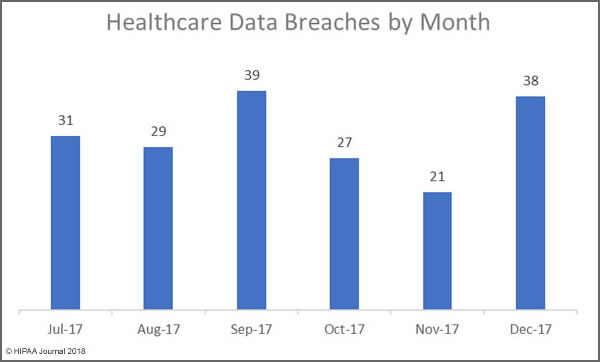
There were 35 healthcare data breaches involving more than 500 records reported to the Department of Health and Human Services’ Office for Civil Rights in September 2017. Those breaches resulting in the theft/exposure of 435,202 patients’ protected health information.

September 2017 Healthcare Data Breaches

September 2017 healthcare data breaches followed a similar pattern to previous months. Healthcare providers suffered the most breaches with 25 reported incidents, followed by health plans with 8 breaches, and 2 breaches reported by business associates of covered entities.

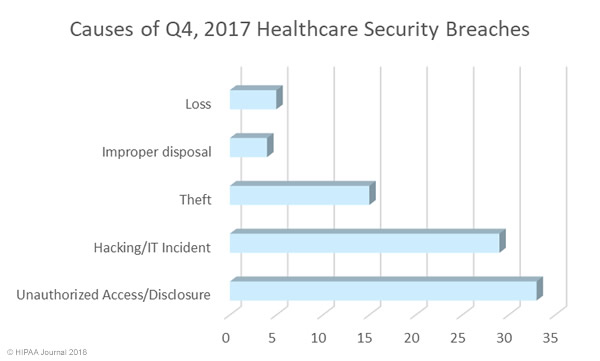
There was a fairly even split between unauthorized access/disclosures (16 incidents) and hacking/IT incidents (15 incidents). There were three theft incidents and one lost device, all of which involved laptop computers. One incident also involved a desktop computer and another the theft of physical records. There were no reported cases of improper disposal of PHI.


September 2017 Healthcare Data Breaches - Breach Type

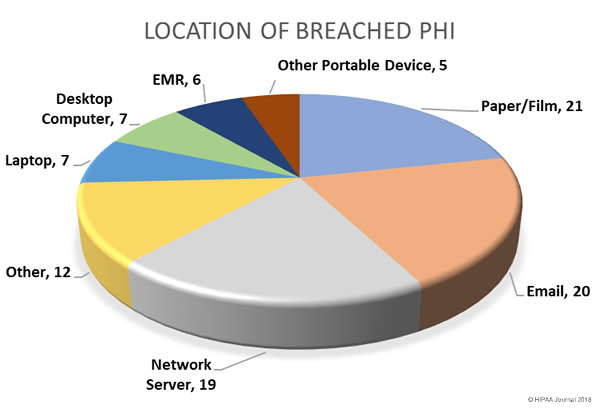
There were five attacks on network servers in September, but email attacks topped the list with 13 incidents. 6 were attributed to hacking, including two confirmed phishing attacks and one ransomware incident. The ransomware attack is also understood to have occurred as a result of an employee responding to a phishing email.

There were 7 cases of unauthorized access/disclosures via email. One of those incidents involved an employee emailing PHI to a personal email account. Another saw a healthcare employee email PHI to a relative to receive assistance with a work-related action.

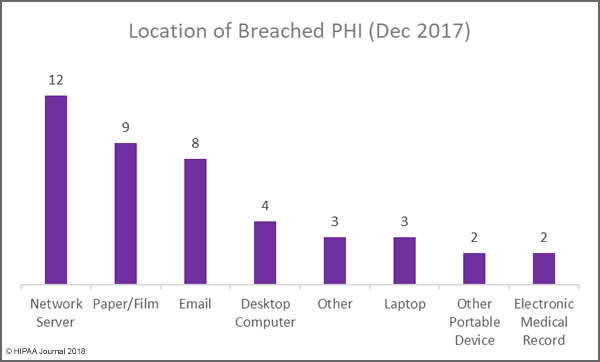
September 2017 Healthcare Data Breaches - Breach Location


Healthcare organizations in 24 states reported data breaches in September. The worst affected states were California, Florida and Texas, with three breaches each. Arkansas, Minnesota, North Carolina, Pennsylvania, Washington and Wisconsin each had two reported incidents.

Largest Healthcare Data Breaches in September 2017

The largest healthcare data breaches in September 2017 have been detailed in the table below. Six of the top ten breaches in September were the result of hacking/IT incidents. Hacking/IT incidents resulted in the exposure of 355,084 records – 81.6% of the records exposed in all reported breaches in September. Unauthorized access/disclosures resulted in the exposure of 73,409 records – 16.87% of the total.

The largest reported data breach in September was a ransomware attack that potentially affected 128,000 patients. Data theft was not suspected, although it could not be ruled out with a high degree of certainty.

Covered Entity Entity Type Breached Records Breach Type Breach Information
Arkansas Oral & Facial Surgery Center Healthcare Provider 128,000 Hacking/IT Incident Ransomware attack
Morehead Memorial Hospital Healthcare Provider 66,000 Hacking/IT Incident Phishing attack
Network Health Health Plan 51,232 Hacking/IT Incident Phishing attack
ABB, Inc. Healthcare Provider 28,012 Hacking/IT Incident
Arkansas Department of Human Services Health Plan 26,000 Unauthorized Access/Disclosure Employee emailed PHI to a personal account
CBS Consolidated, Inc. Business Associate 21,856 Hacking/IT Incident Server hacked
MetroPlus Health Plan, Inc. Health Plan 15,212 Unauthorized Access/Disclosure Employee emailed PHI outside company
Mercy Health Love County Hospital and Clinic Healthcare Provider 13,004 Theft Paper records stolen from a storage unit
The Neurology Foundation, Inc. Healthcare Provider 12,861 Unauthorized Access/Disclosure Employee stole PHI
Hand & Upper Extremity Centers dba Hand Rehabilitation Specialists Healthcare Provider 12,806 Hacking/IT Incident Data theft and extortion attempt

The post Summary of September 2017 Healthcare Data Breaches appeared first on HIPAA Journal.
New AEHIS/ MDISS Partnership to Focus on Advancing Medical Device Cybersecurity

A new partnership has been announced between CHIME’s Association for Executives in Healthcare Information Security (AEHIS) and the Foundation for Innovation, Translation and Safety Science’s Medical Device Innovation, Safety and Security Consortium (MDISS). The aim of the new collaboration is to help advance medical device cybersecurity and improve patient safety.

The two organizations will work together to help members identify, mitigate, and prevent cybersecurity threats by issuing cybersecurity best practices, educating about the threats to device security, training members, and promoting information sharing.

For the past three years, AEHIS has been helping healthcare organizations improve their information security defences. More than 700 CISOs and other healthcare IT security leaders have benefited from the education and networking opportunities provided by AEHIS. AEHIS helps its members protect patients from cyber threats, including cyberattacks on their medical devices, though its educational efforts, sharing best practices, and many other activities.

MDISS now consists of more than 2,000 hospitals and dozens of medical device manufacturers who are working together to improve medical device cybersecurity. MDISS has helped to make medical device risk assessments cheaper, faster, and more accessible, while bringing together regulatory bodies, patient advocates, insurers, security researchers, medical device manufacturers, and healthcare providers to advance best practices in medical device cybersecurity and risk management.

It is hoped that the collective voice of AEHIS and MDISS will help to improve information security practices and ensure patients – and health data – are better protected.

“The scale and reach of AEHIS’ education network is a perfect complement to MDISS’ continuous release of envelope-pushing technologies and best practices,” said Dale Nordenberg, executive director of MDISS. “AEHIS will play a key role in accelerating the adoption of next-generation medical device security assessment platforms like MDRAP.”

“Together, AEHIS and MDISS joining forces to advocate and advance better medical device security will benefit AEHIS members and MDISS stakeholders alike,” said Sean Murphy, chair of the AEHIS collaborative relationships committee and vice president and CISO at Premera Blue Cross.

Key Goals of the New Partnership

  • Educating healthcare organizations about medical device cybersecurity strategies
  • Developing and sharing medical device cybersecurity best practices
  • Promoting the adoption of the NIST’s cybersecurity framework
  • Identifying new best practices for securing medical devices and mitigating vulnerabilities
  • Increasing awareness of medical device vulnerabilities among federal policymakers
  • Determining best practices to engage members in advocacy for cyber protection of medical devices
  • Examining the issues that are preventing the sharing of cybersecurity and medical device vulnerability information and helping to support information sharing through existing or modified information sharing efforts.

The post New AEHIS/ MDISS Partnership to Focus on Advancing Medical Device Cybersecurity appeared first on HIPAA Journal.
53% of Businesses Have Misconfigured Secure Cloud Storage Services

The healthcare industry has embraced the cloud. Many healthcare organizations now use secure cloud storage services to host web applications or store files containing electronic protected health information (ePHI).

However, just because secure cloud storage services are used, it does not mean data breaches will not occur, and neither does it guarantee compliance with HIPAA. Misconfigured secure cloud storage services are leaking sensitive data and many organizations are unaware sensitive information is exposed.

A Business Associate Agreement Does Not Guarantee HIPAA Compliance

Prior to using any cloud storage service, HIPAA-covered entities must obtain a signed business associate agreement from their service providers.

Obtaining a signed, HIPAA-compliant business associate agreement prior to the uploading any ePHI to the cloud is an important element of HIPAA compliance, but a BAA alone will not guarantee compliance. ePHI can easily be exposed if cloud storage services are not configured correctly.

As Microsoft explains, “By offering a BAA, Microsoft helps support your HIPAA compliance, but using Microsoft services does not on its own achieve it. Your organization is responsible for ensuring that you have an adequate compliance program and internal processes in place, and that your particular use of Microsoft services aligns with HIPAA and the HITECH Act.”

Configure your account correctly and your data will be secure. Make a mistake and data will be exposed and you could easily violate HIPAA Rules.

Misconfigured Secure Cloud Storage Services

When it comes to secure cloud storage, many organizations believe their cloud environments have been secured, but that is often not the case. How many businesses are leaving data exposed? According to a recent study by cloud threat defense firm RedLock, more than half of businesses have made mistakes that have exposed sensitive data in the cloud.

The report reveals many organizations are not following established security best practices, such as using multi-factor authentication for all privileged account users. To make matters worse, many businesses are failing to monitor their cloud environments which means data is being exposed, but not detected.

The problem appears to be getting worse. RedLock’s last analysis for Q2 revealed 40% of businesses had misconfigured at least one of their cloud storage services – Amazon Simple Storage Service (Amazon S3) for example. A new analysis, published in its latest Cloud Security Trends Report, shows that percentage jumped to 53% between June and September 2017.

Key Findings

  • 53% of organizations have at least one exposed cloud storage service
  • 38% of users exposed data through compromised administrative user accounts
  • 81% are not managing host vulnerabilities in the cloud
  • 37% of databases accept inbound connection requests from suspicious IP addresses
  • 64% of databases are not encrypted
  • 45% of Center of Internet Security (CIS) compliance checks are failed
  • 48% of Payment Card Industry Data Security Standard (PCI DSS) compliance checks fail
  • 250 organizations were found to be leaking credentials to their cloud environments on internet-facing web servers

Cloud Misconfigurations Result in Data Breaches

One need look no further than the widespread misconfigured MongoDB installations that were discovered by hackers in January 2017. Misconfigured databases were plundered, data deleted, and ransom demands issued. More than 26,000 MongoDB databases were hijacked and held for ransom.

Is it not just small organizations that are making errors that are resulting in data exposure and data breaches. The Equifax data breach, which saw the records of more than 143 million Americans exposed, was the result of the failure to address a known vulnerability in Apache Struts; a framework that supported its dispute portal web application. Equifax CEO Richard Smith recently told the House Energy and Commerce Committee that the missed patch was due to a mistake by a single employee.

British insurance giant Aviva found out one of its cloud environments had been ‘hacked’ and was being used to mine Bitcoin. Kubernetes administration consoles were used to gain access to its cloud environment with ease. Its administration consoles lacked passwords.

RedLock is not the only company to report on the problem. IBM X-Force said it has tracked more than 1.3 billion records that were exposed as a result of misconfigured servers up to September 2017.

Training will only go so far. You can train your employees never to leave the firewall turned off, yet occasionally that happens. Bad errors can also occur in the cloud that will similarly lead to data breaches. Leave the door open to hackers and they will infiltrate cloud environments, steal data, and hold organizations to ransom.

What organizations must do is to make sure all doors have been closed and locked. Unless organizations proactively monitor their cloud environments, they will be unaware there is a problem until it is too late.

The post 53% of Businesses Have Misconfigured Secure Cloud Storage Services appeared first on HIPAA Journal.
Privacy and Security Awareness Lacking in 70% of Employees

When it comes to privacy and security awareness, many U.S. workers still have a lot to learn. Best practices for privacy and security are still not well understood by 70% of U.S. employees, according to a recent study by MediaPro, a provider of privacy and security awareness training.

For the study, MediaPro surveyed 1,012 U.S. employees and asked them a range of questions to determine their understanding of privacy and security, whether they followed industry best practices, and to find out what types of risky behaviors they engage in. 19.7% of respondents came from the healthcare industry – the best represented industry in the study.

Respondents were rated on their overall privacy and security awareness scores, being categorized as a hero, novice, or a risk to their organization. 70% of respondents were categorized as a novice or risk. Last year when the study was conducted, 88% of U.S. workers were rated as a novice or risk.

Last year, only 12% of respondents ranked as a hero. This year the percentage increased to 30% – A good sign that some employees have responded to training and are taking more care at work. Worryingly, while the percentage of novices fell from 72% last year to 51% in 2017, the number of individuals classed as a risk increased from 16% in 2016 to 19% this year.

Tom Pendergast, chief strategist for security, privacy, and compliance at MediaPro explained that in the risk category, there are two areas that have been consistently poor over the past two years: Physical security and safe remote working/mobile computing. In the latter category, one of the biggest risks was connecting to insecure Wi-Fi networks. The percentage of respondents that admitted doing this jumped from 45% last year to 62.3% this year – Overall, 19% of respondents admitted to risky practices when working remotely.

The overall scores across six of the eight categories being tested improved year over year, with notable improvements in identifying malware and phishing threats, reporting incidents, working remotely, identifying personal information, and cloud computing.

The two areas where there was decline were physical security – such as allowing individuals into a facility without checking identification – and social media security  – such as posting personal and sensitive company information on social media accounts.

Perhaps the biggest risk faced by organizations today is phishing. Phishing emails are the primary method of delivering malware and ransomware and obtaining sensitive information such as login credentials.

Respondents were tested on their phishing awareness and were presented with four emails, which they were asked to rate as legitimate or phishy. 8% of respondents were unable to identify the phishing emails correctly. Out of the phishing emails tested, the email offering a stock tip from a well-known investor fooled the highest number of respondents. 92% of respondents were able to identify a phishing email with a potentially malicious attachment, up from 75% last year.

The post Privacy and Security Awareness Lacking in 70% of Employees appeared first on HIPAA Journal.
NIST Updates its Risk Management Framework for Information Systems and Organizations

The National Institute of Standards and Technology (NIST) has updated its Risk Management Framework for Information Systems and Organizations: A System Life Cycle Approach for Security and Privacy (SP 800-37) – The first time the Risk Management Framework has been updated in the seven years since it was first published.

NIST was called upon to update the Framework by the Defense Science Board, the Office of Management and Budget, and the President’s Executive Order on Strengthening the Cybersecurity of Federal Networks and Critical Infrastructure.

Because of the importance of information risk management to an organization’s overall risk management strategy, the C-Suite needs to get more involved in the implementation of information risk management processes. Security and privacy need to be taken into account when larger risk management decisions are being made.

The Information Risk Management Framework is typically implemented at the system level, the realm of the Chief Information Security Officer (CISO) and Chief Information Officer (CIO). However, NIST found that organizations often fail to communicate issues effectively with the C-suite.

One of the main aims of the update is to provide closer linkage and communication risk management processes at the system and organization level with those of the C-Suite. More C-suite involvement will help to ensure that the Risk Management Framework is more effective when it is implemented.

The update will help to institutionalize critical enterprise-wide risk management preparatory activities enabling more cost-effective execution of the Framework at the system and operational level. NIST has also unified security and privacy concepts into the Framework to help organizations develop a more integrated approach to risk management.

The discussion draft of the updated NIST Risk Management Framework is open for comments until November 3, 2017. NIST said, “This draft is intended to promote discussion on the new organizational preparation step and the other innovations introduced in RMF 2.0.” Public comments will accepted when the public draft of the guidance is issued in November 2017.

NIST hopes to release the final draft of the updated Risk Management Framework for Information Systems and Organizations in January 2018, and the final publication in March 2018.

The post NIST Updates its Risk Management Framework for Information Systems and Organizations appeared first on HIPAA Journal.
National Cyber Security Awareness Month: What to Expect

October is National Cyber Security Awareness Month – A month when attention is drawn to the importance of cybersecurity and several initiatives are launched to raise awareness about how critical cybersecurity is to the lives of U.S. citizens.

National Cyber Security Awareness Month is a collaborative effort between the U.S. Department of Homeland Security (DHS), the National Cyber Security Alliance (NCSA) and public/private partners.

Throughout the month of October, the DHS, NCSA, and public and private sector organizations will be conducting events and launching initiatives to raise awareness of the importance of cybersecurity. Best practices will be shared to help U.S. citizens keep themselves safe online and protect their companies, with tips and advice published to help businesses improve their cybersecurity defenses and keep systems and data secure.

DHS and NCSA will focus on a different aspect of cybersecurity each week of National Cyber Security Awareness Month:

National Cyber Security Awareness Month Summary

  • Week 1: Simple Steps to Online Safety (Oct. 2-6)
  • Week 2: Cybersecurity at Work (Oct. 9-13)
  • Week 3: Today’s Predictions for Tomorrow’s Internet (Oct. 16-20)
  • Week 4: Careers in Cybersecurity (Oct. 23-27)
  • Week 5: Cybersecurity and Critical Infrastructure (Oct. 30-31)

Week 1 focuses on basic cybersecurity and cyber hygiene – simple steps that can be taken to greatly improve resilience to cyberattacks.

These basic cybersecurity measures are likely to have already been adopted by the majority of businesses, but these simple controls can all too easily be overlooked. The Department of Health and Human Services’ Office for Civil Rights (OCR) breach portal is littered with reports of security incidents that have resulted from the failures to get the basics of cybersecurity right. Week 1 is the perfect time to conduct a review of these basic cybersecurity measures to ensure they have all been adopted.

This year has already seen several major data breaches reported, including the massive breach at Equifax that impacted 143 million Americans. In May, WannaCry ransomware attacks spread to more than 150 countries and the NotPetya wiper attacks in June causes extensive damage. FedEx and Maersk have both announced that the attacks could end up costing $300 million.

All three of those cyberattacks occurred as a result of the failure to implement patches promptly. Then there is the recently announced Deloitte data breach. That security breach has been linked to the failure to implement two-factor authentication – Another basic cybersecurity measure.

Stop. Think. Connect

During the first week of National Cyber Security Awareness Month, the NCSA will be promoting its “STOP. THINK. CONNECT.” security awareness campaign, which was developed with assistance from the Anti-Phishing Working Group in 2010. The campaign makes available more than 140 online resources that can be used by U.S. citizens to keep themselves secure and by businesses to improve security awareness of the workforce.

Week 2 will focus on cybersecurity in the workplace, highlighting steps that can be taken by businesses to develop a culture of cybersecurity in the workplace. DHS and NCSA will also be encouraging businesses to adopt the National Institute of Standards and Technology Cybersecurity Framework.

Week 3 will focus on protecting personal information in the context of the smart device revolution, highlighting the importance of secure storage, transmission, and handling of data collected by IoT devices.

Week 4 will focus on encouraging students to consider a career in cybersecurity. By 2019, there is expected to be around 2 million unfilled cybersecurity positions in the United States. Advice will be offered about how to switch careers and embark upon a career in cybersecurity.

National Cyber Security Awareness Month finishes with two days of efforts to improve the resiliency of critical infrastructure to cyberattacks.

OCR Encourages HIPAA-Covered Entities to Go Back to Basics

Late last week in its monthly cybersecurity newsletter, OCR sent a reminder to HIPAA-covered entities about the importance of securing health data, saying, “The security of electronic health information is more critical than ever, and it is the responsibility of all in the regulated community to ensure the confidentiality, integrity, and availability of electronic protected health information.” These basic security measures are essential for HIPAA compliance.

OCR suggests HIPAA-covered entities should go back to basics during National Cyber Security Awareness Month and use the tips and advice being issued to ensure all the i’s have been dotted and the t’s crossed.

OCR suggests a good place to start is conducting a review to make sure:

  • Strong passwords have been set – Consisting of passphrases or passwords of at least 10 characters, including lower and upper-case letters, numerals, and special characters.
  • Regular training is provided – To improve phishing awareness, reporting of potential attacks, and covering other important cybersecurity issues.
  • Use multi-factor authentication – So that in the event that a password is obtained or guessed, it will not result in an account being compromised. MFA is strongly recommended for remote access, privileged accounts, and accounts containing sensitive information.
  • Review patch management policies – To ensure that software updates and patches are always applied promptly, on all systems and devices, to fix critical security vulnerabilities.
  • Devices are locked – All devices should be physically secured when they are not in use.
  • Portable device controls are developed – To prohibit the plugging in of personal portable devices into secure computers or networks without first having the devices scanned to make sure they do not contain malware.
  • Policies are developed on reporting threats – Educate the workforce on the importance of reporting potential threats immediately to ensure action can be taken to mitigate risk.

The post National Cyber Security Awareness Month: What to Expect appeared first on HIPAA Journal.
Why Dental Offices Should be Worried About HIPAA Compliance

In 2015, Dr. Joseph Beck became the first dentist to be fined for a HIPAA violation, which sent a warning to dental offices about HIPAA compliance.  Until that point, dental offices had avoided fines for noncompliance with HIPAA Rules.

The penalty was not issued by the Department of Health and Human Services’ Office for Civil Rights (OCR), but by the Office of the Indiana attorney general. The fine of $12,000 was for the alleged mishandling of the protected health information of 5,600 patients.

Since then, many settlements have been reached with covered entities for HIPAA violations. No further penalties have been issued to dental offices, although there is nothing to stop OCR or state attorneys general from fining dental offices for failing to comply with HIPAA Rules and settlements for alleged HIPAA violations are now being reached much more frequently than in 2015. Last year was a record year for settlements and 2017 has continued where 2016 left off.

The probability of HIPAA violations being discovered has also increased. OCR has already commenced the much-delayed second phase of its HIPAA compliance audit program and dental office may still be selected for an audit.

During the first phase of compliance audits in 2011/2012, at least one dental office was audited. That round of audits revealed multiple areas of noncompliance with HIPAA Rules, although OCR chose not to issue any financial penalties. Instead non-compliance was addressed by issuing technical guidance. Now, five years on, covered entities have had plenty of time to implement their compliance programs. Financial settlements can be expected if HIPAA violations are discovered by OCR auditors.

Last year, the threat of HIPAA compliance audits for dental offices prompted Dr. Andrew Brown, chair of the ADA Council on Dental Practice, to issue a stern warning to dental offices on HIPAA compliance, urging them to take HIPAA compliance seriously. Brown said, “There are steep consequences for health care providers that don’t comply with the law and we don’t want to see any dentists having to pay tens of thousands of dollars in a penalty.”

If your dental office has not been selected to demonstrate compliance with HIPAA Rules already, that does not mean an investigation will not be conducted. OCR has only conducted the first round of its phase 2 HIPAA audit program. The second round will involve on-site visits, which are expected to start in early 2018.

OCR also investigates all covered entities that experience a breach of more than 500 records. There has been an increase in cyberattacks on healthcare organizations in recent years, and dental offices can could all too easily come under attack.

Laptop computers containing ePHI can easily be lost or stolen, employees may snoop on records or steal sensitive information, errors can easily be made configuring software, and unaddressed vulnerabilities can easily be exploited. This year, the hacking group TheDarkOverlord exploited a vulnerability and gained access to the records of Aesthetic Dentistry of New York City and stole data – a reportable breach under HIPAA Rules.

If a data breach is experienced, OCR will need to be provided with evidence that HIPAA Rules have been followed. Complaints about privacy violations and other potential HIPAA failures can be submitted via the HHS website, and can easily lead to HIPAA investigations.

It would be a serious error to think that OCR will not investigate small practices. OCR has made it clear that all covered entities, regardless of their size, must comply with HIPAA Rules. It is not only large healthcare organizations that may have to pay a financial penalty for non-compliance with HIPAA Rules, as Dr. Beck could confirm.

The threat of data breaches is greater than ever before and OCR is taking a harder line on healthcare organizations that fail to comply with HIPAA Rules and keep electronic protected health information secure. Dental office should therefore take HIPAA compliance seriously and ensure HIPAA Rules are being followed.

The post Why Dental Offices Should be Worried About HIPAA Compliance appeared first on HIPAA Journal.

HIPAA Compliance and Cloud Computing Platforms

Before cloud services can be used by healthcare organizations for storing or processing protected health information (PHI) or for creating web-based applications that collect, store, maintain, or transmit PHI, covered entities must ensure the services are secure.

Even when a cloud computing platform provider has HIPAA certification, or claims their service is HIPAA-compliant or supports HIPAA compliance, the platform cannot be used in conjunction with ePHI until a risk analysis – See 45 CFR §§ 164.308(a)(1)(ii)(A) – has been performed.

A risk analysis is an essential element of HIPAA compliance for cloud computing platforms. After performing a risk analysis, a covered entity must establish risk management policies in relation to the service – 45 CFR §§ 164.308(a)(1)(ii)(B). Any risks identified must be managed and reduced to a reasonable and appropriate level.

It would not be possible to perform a comprehensive, HIPAA-compliant risk analysis unless the covered entity fully understands the cloud computing environment and the service being offered by the platform provider.

Cloud Service Providers are HIPAA Business Associates

A HIPAA business associate is any person or entity who performs functions on behalf of a covered entity, or offers services to a covered entity that involve access being provided to protected health information (PHI).

The HIPAA definition of business associate was modified by the HIPAA Omnibus Rule to include any entity that “creates, receives, maintains, or transmits” PHI. The latter two clearly apply to providers of cloud computing platforms.

Consequently, a covered entity must obtain a signed business associate agreement (BAA) from the cloud platform provider. The BAA must be obtained from the cloud platform provider before any PHI is uploaded to the platform. A BAA must still be obtained even if the platform is only used to store encrypted ePHI, even if the key to unlock the encryption is not given to the platform provider. The only exception would be when the cloud platform is only used to store, process, maintain or transmit de-identified ePHI.

The BAA is a contract between a covered entity and a service provider. The BAA must establish the allowable uses and disclosures of PHI, state that appropriate safeguards must be implemented to prevent unauthorized use or disclosure of ePHI, and explain all elements of HIPAA Rules that apply to the platform provider. Details of the contents of a HIPAA-compliant BAA can be obtained from the HHS on this link.

Cloud computing platform providers and cloud data storage companies that have access to PHI can be fined for failing to comply with HIPAA Rules, even if the service provider does not view any data uploaded to the platform. Not all cloud service providers will therefore be willing to sign a BAA.

A BAA Will Not Make a Covered Entity HIPAA Compliant

Simply obtaining a BAA for a cloud computing platform will not ensure a covered entity is compliant with HIPAA Rules. HIPAA Rules can still be violated, even with a BAA in place. This is because no cloud service can be truly HIPAA compliant by itself. HIPAA compliance will depend on how the platform is used.

For example, Microsoft will sign a BAA for its Azure platform; but it is the responsibility of the covered entity to use the platform in a HIPAA-compliant manner. If a covered entity misconfigures or fails to apply appropriate access controls, it would be the covered entity that is in violation of HIPAA Rules, not Microsoft. As Microsoft explains, “By offering a BAA, Microsoft helps support your HIPAA compliance, but using Microsoft services does not on its own achieve it. Your organization is responsible for ensuring that you have an adequate compliance program and internal processes in place, and that your particular use of Microsoft services aligns with HIPAA and the HITECH Act.”

Penalties for Cloud-Related HIPAA Violations

The Department of Health and Human Services’ Office for Civil Rights has already settled cases with HIPAA-covered entities that have failed to obtain business associate agreements before uploading PHI to the cloud, as well as for risk analysis and risk management failures.

St. Elizabeth’s Medical Center in Brighton, Mass agreed to settle its case with OCR in 2015 for $218,400 for potential violations of the HIPAA Security Rule after PHI was uploaded to a document sharing service, without first assessing the risks of using that service.

Phoenix Cardiac Surgery also agreed to settle a case with OCR for failing to obtain a business associate agreement from a vendor of an Internet-based calendar and email service prior to using the service in conjunction with PHI. The case was settled for $100,000.

In 2016, OCR settled a case with Oregon Health & Science University for $2.7 million after it was discovered ePHI was being stored in the cloud without first obtaining a HIPAA-compliant business associate agreement.

HIPAA Compliant Cloud Computing Platforms

Both Amazon’s AWS and Microsoft’s Azure platforms can be used by HIPAA-covered entities. Both have all the necessary privacy and security protections in place to satisfy HIPAA requirements, and Amazon and Microsoft will sign BAAs with healthcare providers and agree to comply with HIPAA Rules.

AWS has long been the leading cloud service provider, although Microsoft appears to be catching up. If you are unsure of the best cloud computing platform provider to use, you can find out more information in this comparison of Azure and AWS.

Cloud storage companies that support HIPAA-compliance and can be used by HIPAA-covered entities for storing ePHI (after a BAA has been obtained) include Box, Carbonite, Dropbox, Google Drive, and Microsoft OneDrive.

The post HIPAA Compliance and Cloud Computing Platforms appeared first on HIPAA Journal.