HIPAA Breach News

566,217 Customers of Chicago-Based Health Insurer Impacted by Data Breach

The Chicago-based health insurer Bankers Life, a division of CNO Financial Group Inc., has discovered hackers gained access to its systems and potentially stole the personal information of more than half a million individuals.

Bankers Life provides a range of insurance services to customers, including life insurance, long term care insurance, health insurance, and Medicare supplemental insurance and is the largest division of CNO Financial Group.

Hackers first gained access to its systems between May 30 and September 13, 2013. Bankers Life said it discovered the breach on August 7, 2018.

The hackers gained access to a range of sensitive personal information of a ‘limited number’ of its employees. A ‘limited group’ of customers had names, Social Security numbers, driver’s license numbers, bank account numbers, state identification numbers, medication information, diagnoses, and treatment information exposed. The protected health information of a much larger group of customers was also potentially accessed by the hackers. For that group, names, addresses, dates of birth, insurance policy numbers, insurance type, premium amounts, dates of service, claim amounts, and the last four digits of Social Security numbers were potentially stolen.

Bankers Life hired a third-party computer forensics investigator to conduct an investigation into the breach to determine how access was gained to its systems and the extent of the breach. The details of how the hackers gained access to its systems has not been publicly disclosed.

Bankers Life has now taken steps to restrict access to its systems, monitoring has been enhanced, and additional security procedures have now been implemented to prevent further breaches.

The disclosure of the breach was delayed at the request of federal investigators. Affected customers are now being notified and have been offered free identity theft repair and credit monitoring services.

The breach report submitted to the Department of Health and Human Services’ Office for Civil Rights indicates 566,217 customers have been affected by the breach.

The Bankers Life data breach is the fifth largest healthcare data breach to be reported in 2018.

The post 566,217 Customers of Chicago-Based Health Insurer Impacted by Data Breach appeared first on HIPAA Journal.

Q3 Healthcare Data Breach Report: 4.39 Million Records Exposed in 117 Breaches

The latest installment of the Breach Barometer Report from Protenus shows there was a quarterly fall in the number of healthcare data breaches compared to Q2, 2018; however, the number of healthcare records exposed, stolen, or impermissibly disclosed increased in Q3.

In each quarter of 2018, the number of healthcare records exposed in data breaches has risen. Between January and March 1,129,744 healthcare records were exposed in 110 breaches. Between April and June, 3,143,642 records were exposed in 142 breaches, and 4,390,512 healthcare records were exposed, stolen, or impermissibly disclosed between July and September in 117 breaches.

The largest healthcare data breach in Q3 was reported by the Iowa Health System UnityPoint Health. The breach was due to a phishing attack that saw multiple email accounts compromised. Those accounts contained the protected health information of more than 1.4 million patients. That breach was the second phishing attack experienced by UnityPoint Health. An earlier phishing attack resulted in the exposure of 16,400 healthcare records.

In Q3, hacking was the leading cause of healthcare data breaches. 51% of the 117 breaches were due to hacking and those incidents accounted for 83% of all exposed records in the quarter. Hacking incidents and the number of records exposed through hacking both increased in Q3.

23% of data breaches in Q3 (27 breaches) were due to insider wrongdoing or insider error, resulting in the theft/exposure/disclosure of 680,117 health records – 15% of the records exposed in Q3. Insider wrongdoing includes theft of data by employee, snooping on medical records, and other incidents where insiders violated HIPAA Rules.

19 breaches were caused by insider error – mistakes made by healthcare employees that resulted in the exposure or impermissible disclosure of healthcare records. Insider errors resulted in the exposure/disclosure of 389,428 patient records. There were 8 incidents involving insider wrongdoing.

Protenus has drawn attention to the significant increase in records exposed/stolen through insider wrongdoing. In Q1, 4,597 patients were affected by insider wrongdoing, the number increased to 70,562 in Q2, and 290,689 patients were affected by insider wrongdoing incidents in Q3.

There were 22 breaches reported in Q3 that involved paper records (19% of the total). Those incidents saw 344,729 healthcare records exposed.

Healthcare providers disclosed 86 breaches in Q3, 13 health plans reported breaches, and a further 13 breaches were reported by business associates. 5 breaches were reported by other entities. 27 incidents – 23% of the total – had some business associate involvement.

On average, it took 402 days to discover data breaches. The median time to detect a breach was 51 days. One healthcare provider took 15 years to discover an employee had been accessing healthcare records without authorization. Over that time frame, the employee had viewed the records of 4,686 patients without any work reason for doing so. The average time to report breaches was 71 days and the median time was 57.5 days.

The states worst affected by healthcare data breaches in Q3 were Florida with 11 incidents, followed by California with 10, and Texas with 9 incidents.

The post Q3 Healthcare Data Breach Report: 4.39 Million Records Exposed in 117 Breaches appeared first on HIPAA Journal.

Ransomware Attacks Increase: Healthcare Industry Most Heavily Targeted

Ransomware attacks are on the rise once again and healthcare is the most targeted industry, according to the recently published Beazley’s Q3 Breach Insights Report.

37% of ransomware attacks managed by Beazley Breach Response (BBR) Services affected healthcare organizations – more than three times the number of attacks as the second most targeted industry: Professional services (11%).

Kaspersky Lab, McAfee, and Malwarebytes have all released reports in 2018 that suggest ransomware attacks are in decline; however, Beazley’s figures show monthly increases in attacks in August and September, with twice the number of attacks in September compared to the previous month. It is too early to tell if this is just a blip or if attacks will continue to rise.

The report highlights a growing trend in cyberattacks involving multiple malware variants. One example of which was a campaign over the summer that saw the Emotet banking Trojan downloaded as the primary payload with a secondary payload of ransomware.

Emotet is used to steal bank credentials and has the capability to download further malicious payloads. Once credentials have been obtained, a ransomware payload is downloaded and executed. This twofer strategy has been adopted by several threat groups. The ransom demands can be considerable. One group demanded a $2.8 million ransom after an extensive infection that included the encryption of backups.

Beazley cites research conducted by Kivu Consulting that shows there has been an increase in the use of rough and ready ransomware variants that use powerful encryption to lock files yet lack the functionality to allow the full decryption of data. These attacks can see files remain locked even if a ransom is paid or the encryption/decryption process can result in file corruption and significant data loss.

These attacks show how critical it is for organizations to perform regular backups and to test those backups to ensure that file recovery is possible. Healthcare organizations should consider a 3.2.1 approach to backing up: Create three backup copies, on at least two different media, with one copy stored securely offsite.

It stands to reason that large organizations are an attractive target for cybercriminals. Large numbers of encrypted devices mean higher ransom demands can be issued. Large organizations are also more likely to have funds available to pay large ransoms, although they also have more resources to devote to cybersecurity.

Attacks on small to medium sized businesses are typically easier and this is reflected in Beazley’s figures. Out of the ransomware attacks that the BBR Services team have handled, 71% of victims were small to medium sized businesses.

The Breach Insights report shows that in contrast to most industry sectors, accidental disclosures are the leading type of breach in the healthcare industry and accounting for 32% of all data breaches in Q3, closely followed by hacks/malware incidents on 30%. Beazley notes that healthcare hacking/malware incidents have increased from 20% to 30% in 2018. 17% of breaches were caused by insiders, 9% involved the loss of physical records, and 6% involved the loss of portable electronic devices.

The post Ransomware Attacks Increase: Healthcare Industry Most Heavily Targeted appeared first on HIPAA Journal.

Stolen Raley’s Pharmacy Laptop May Have Contained PHI of 10,000 Patients

Approximately 10,000 patients of Raley’s Pharmacy are being notified that some of their protected health information (PHI) has potentially been compromised.

On September 24, 2018, a laptop computer was stolen from a Raley’s pharmacy that may have contained some patients’ PHI.

Raley’s pharmacy immediately launched an investigation to determine what information was stored on the device. Interviews were conducted with staff members who had used the device in an attempt to understand the types of content that may have been exposed. The email accounts of employees were also checked for attachments and links to documents that contained ePHI, to determine which files had been downloaded or were stored in cache files in a temporary directory on the laptop.

After careful analysis, Raley’s Pharmacy was able to determine that the only patients affected by the security incident were those that had visited a Raley’s, Bel Air, and Nob Hill Foods pharmacy between January 1, 2017 and September 24, 2018 to have prescriptions filled.

An analysis of the files which had potentially been downloaded to the laptop confirmed that highly sensitive information such as Social Security numbers, addresses, credit card information, and driver’s license numbers had not been compromised. The breach was limited to first and last names, gender, dates of birth, visit dates, pharmacy location visited, medical condition, prescription information, and health plan ID numbers.

Since Health plan/insurance information has potentially been exposed, affected patients have been advised to monitor their Explanation of Benefits statements for any sign of fraudulent activity.

The security incident has prompted Raley’s Pharmacy to implement encryption on all laptops to prevent data access by unauthorized individuals should further theft incidents occur. Additional security controls are also being evaluated.

The post Stolen Raley’s Pharmacy Laptop May Have Contained PHI of 10,000 Patients appeared first on HIPAA Journal.

PHI of 40,000 Patients of Sioux City Eye Clinic Potentially Compromised

The protected health information of up to 40,000 patients of the Jones Eye Clinic and its affiliated surgery center, CJ Elmwood Partners, L.P, in Sioux City, IA has potentially been compromised.

The breach is the result of a ransomware attack which affected data stored in an information system used for scheduling appointments and billing patients. Electronic medical records were unaffected as they were housed in a separate system which was not accessed by the attacker.

Jones Eye Clinic discovered the ransomware attack on August 23, 2018, although an investigation by a third-party forensic investigator revealed that the attacker gained access to its system and installed the ransomware on the evening of August 22.

A ransom was demanded for the keys to decrypt the files; however, no payment was made as it was possible to recover the files from backups. A full data restoration was completed on August 23.

The investigation into the ransomware attack did not uncover any evidence to suggest that the attacker viewed or obtained patient data, although since data theft could not be ruled out, all affected patients have been offered free credit monitoring services for 12 months. Patients have been notified of the data breach by mail and have up to January 19, 2019 to enroll for credit monitoring services.

The information potentially accessed was limited to full names, dates of birth, addresses, medical record numbers, dates of service, and general descriptions of surgical procedures and clinic visits. Some patients may also have had their insurance status, Social Security number, and claims information exposed. Jones Eye Clinic does not believe financial information was accessed or exposed.

The breach potentially affects all patients of the eye clinic and surgery center who registered or received medical services between January 1, 2003 and August 23, 2018.

The post PHI of 40,000 Patients of Sioux City Eye Clinic Potentially Compromised appeared first on HIPAA Journal.

Catawba Valley Medical Center Phishing Attack Impacts 20,000 Patients

On August 13, 2018, Catawba Valley Medical Center (CVMC) in Hickory, NC discovered an unauthorised individual accessed the email account of a CVMC employee. Upon discovery of the email breach, steps were taken to secure the account and prevent further access and a third-party computer forensics firm was called in to assist with the investigation and determine the extent of the breach.

That investigation revealed that between July 4 and August 17, 2018, three employees’ email accounts had been compromised after the employees responded to phishing emails. Some of the emails in those accounts contained patients’ protected health information including names, dates of birth, details of medical services received at CVMC, health insurance details, and for certain patients, Social Security numbers.

No evidence was found to suggest that any emails had been accessed or copied and no information has been received to suggest patient health information has been misused in any way.

The phishing incidents have prompted CVMC to hire security experts to enhance employee education, more robust email security controls have been implemented, and CVMC will continue to upgrade hardware and software as appropriate to repel malicious threats.

All patients whose protected health information may have been compromised as a result of the email account breaches were notified by mail on October 12, 2018.

The breach summary on the HHS’ Office for Civil Rights’ breach portal indicates up to 20,000 patients have potentially been affected by the email account breaches.

Byram Healthcare Alerts Patients to Insider Breach

Byram Healthcare, a provider of medical supplies, has been informed by law enforcement that a former employee has been accused of stealing the credit card information of patients.

Byram Healthcare investigated the incident and determined that the employee had access to personal information including names, addresses, dates of birth, limited health information, and credit card numbers, but not Social Security numbers. It is unclear at this stage how many patients have been affected.

Byram Healthcare has responded to the breach by providing further training to staff on privacy and security obligations and safeguarding patients’ protected health information. Monitoring of staff has also been increased.  Affected patients were notified by mail of the privacy violation and possible theft of PHI on October 22, 2018.

The post Catawba Valley Medical Center Phishing Attack Impacts 20,000 Patients appeared first on HIPAA Journal.

Email Error Exposed the PHI of 8,000 Members of FirstCare Health Plans

Texas-based First Care Health Plans is notifying more than 8,000 plan members that some of their personal information may have been impermissibly disclosed as a result of automated reports being accidentally emailed to an incorrect recipient.

The daily reports were automatically generated and sent to an email distribution list. The reports contained medical requests which included members’ names, member ID numbers, procedure codes, descriptions of treatments, authorization numbers, and names of treating providers.

On August 15, 2018, the FirstCare IT security team became aware that the reports had been sent to an external email address in error and the emails had not been encrypted. An investigation into the incident revealed the reports had been sent over a period of 17 months, starting on March 22, 2017. The reports contained the protected health information of 8,056 plan members.

FirstCare explained in its breach notice that various security solutions had been deployed to monitor for unauthorized access, acquisition, and unauthorized use of ePHI, but they had failed to identify the misdirected emails.

Upon discovery of the error, the incorrect recipient was removed from the distribution list and a full review was conducted of all other automated reports to ensure similar errors had not been made. FirstCare has now developed a new protocol to ensure the recipients of active reports are regularly monitored and new auditing parameters have been implemented related to change controls.

FirstCare has taken several steps to contact the user of the email account and secure the ePHI. Emails were sent to the account in an attempt to get the user to make contact, but those attempts failed.  FirstCare also engaged the U.S Federal Government to investigate and help identify the owner of the email account to minimize the potential for harm.

“We have not received any indication that the information has been accessed or used by an unauthorized individual,” explained FirstCare in its substitute breach notice. Since it is not possible to confirm whether there has been an impermissible disclosure of ePHI, FirstCare is offering to reimburse all affected patients for one year of credit monitoring services through LifeLock.

The post Email Error Exposed the PHI of 8,000 Members of FirstCare Health Plans appeared first on HIPAA Journal.

Phishing Attack on Children’s Hospital of Philadelphia Results in Double Account Breach

Children’s Hospital of Philadelphia (CHOP) has discovered the email accounts of two employees have been compromised following successful phishing attacks on August 23 and August 29, 2018.

On August 24, CHOP discovered an unauthorized individual had gained access to the email account of a one of its physicians. The investigation revealed the account was first accessed the previous day. Two weeks later, on September 6, CHOP discovered a second email account had also been compromised. In that case, access to the account was first gained on August 29. In both cases, prompt action was taken to secure the accounts and prevent further access. A leading computer forensics firm was also retained to assist with the investigation and assess the scope of the breach.

An analysis of the email accounts revealed the individual(s) behind the phishing attacks may have been able to gain access to the protected health information (PHI) of a limited number of patients of CHOP’s neonatal and fetal programs. The information that was exposed differs from patient to patient and may have included a full name, birth date, and clinical information related to neonatal/fetal services received at Children’s Hospital of Philadelphia and, in a limited number of cases, the Hospital of the University of Philadelphia. No Social Security numbers or financial information were compromised at any point.

While emails in the account were potentially accessed and ePHI may have been stolen, CHOP has not uncovered any evidence to suggest that patient information has been misused.

Mothers and parents/legal guardians of current and former patients were notified of the breach by mail on October 23, 2018. Affected individuals have been advised to monitor statements from their healthcare providers for any signs of fraudulent activity.

CHOP has not yet disclosed how many individuals have been affected. The phishing incidents have yet to appear on the Department of Health and Human Services’ Office for Civil Rights breach portal.

The post Phishing Attack on Children’s Hospital of Philadelphia Results in Double Account Breach appeared first on HIPAA Journal.

September 2018 Healthcare Data Breach Report

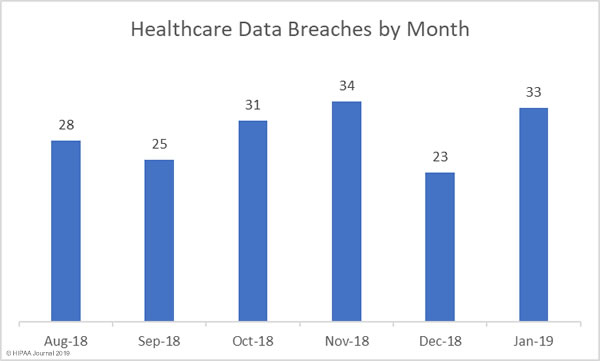
For the second consecutive month there has been a reduction in both the number of reported healthcare data breaches and the number of exposed healthcare records. In September, there were 25 breaches of 500 or more records reported to the Department of Health and Human Services’ Office for Civil Rights – the lowest breach tally since February.

Healthcare data breaches April to September

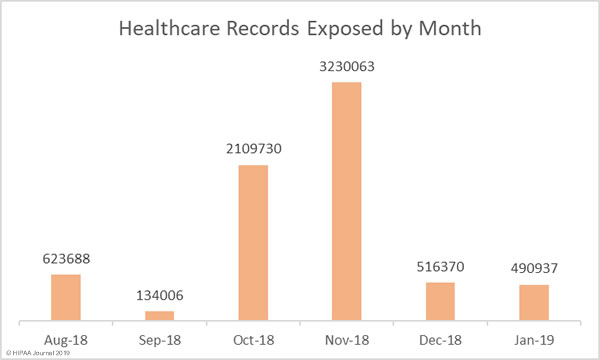
There was also a substantial reduction in the number of exposed/stolen healthcare records in September. Only 134,000 healthcare records were exposed/stolen in September – A 78.5% reduction in compared to August. Fewer records were exposed in September than in any other month in 2018.

Causes of September 2018 Healthcare Data Breaches

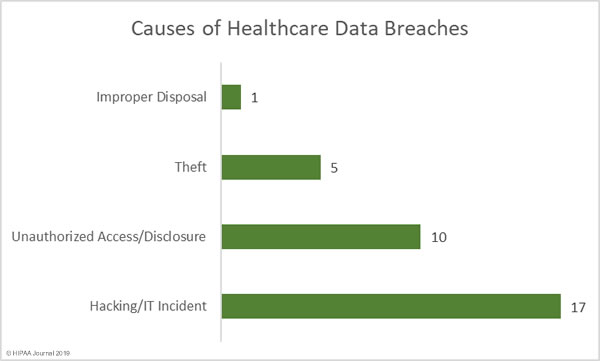
In August, hacking/IT incidents dominated the healthcare breach reports, but there was a major increase (55.55%) in unauthorized access/disclosure breaches in September, most of which involved paper records. There were no reported cases of lost paperwork or electronic devices containing ePHI, nor any improper disposal incidents.

September 2018 Healthcare Data Breaches - Causes

While there were fewer hacking/IT incidents than unauthorized access/disclosure incidents in September, they resulted in the exposure of more healthcare records. Six of the top ten healthcare data breaches in September were hacking/IT incidents.

Ten Largest Healthcare Data Breaches in September 2018

Covered Entity Entity Type Records Exposed Breach Type Location of PHI
WellCare Health Plans, Inc. Health Plan 26942 Unauthorized Access/Disclosure Paper/Films
Reliable Respiratory Healthcare Provider 21311 Hacking/IT Incident Email
Toyota Industries North America, Inc. Health Plan 19320 Hacking/IT Incident Email
Independence Blue Cross, LLC Business Associate 16762 Unauthorized Access/Disclosure Other
Ransom Memorial Hospital Healthcare Provider 14329 Hacking/IT Incident Email
Ohio Living Healthcare Provider 6510 Hacking/IT Incident Email
University of Michigan/Michigan Medicine Healthcare Provider 3624 Unauthorized Access/Disclosure Paper/Films
Reichert Prosthetics & Orthotics, LLC Healthcare Provider 3380 Theft Other Portable Electronic Device
J.A. Stokes Ltd. Healthcare Provider 3200 Hacking/IT Incident Desktop Computer, Electronic Medical Record, Network Server
J&J Medical Service Network Inc. Business Associate 2500 Hacking/IT Incident Network Server

Location of Breached Protected Health Information

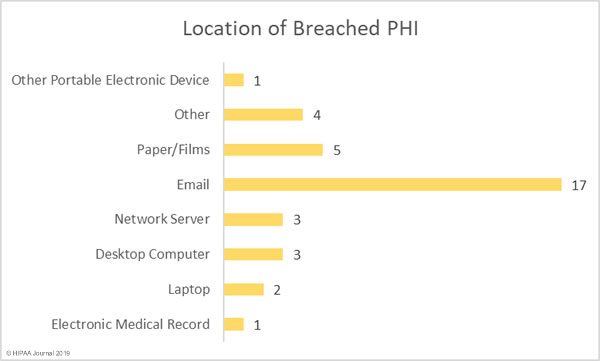
Over the past few months, email has been the most common location of breached PHI. September also saw a high number of email-related breaches reported – mostly due to phishing attacks – but the highest percentage of breaches involved paper records. There were 9 incidents involving unauthorized access/disclosure of paper records and one theft incident.

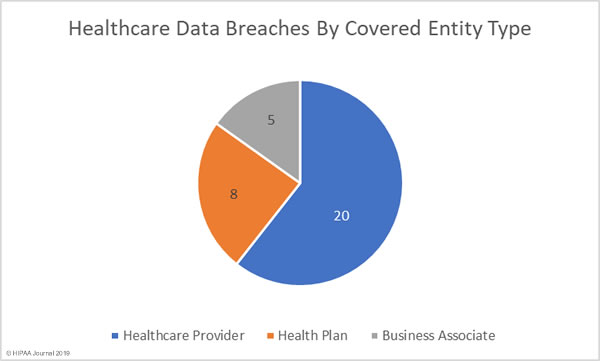
Data Breaches by Covered Entity Type

There was a 150% month-over-month rise in health plan data breaches in September, although healthcare providers were the worst affected with 17 healthcare data breaches reported in September 2018. While there were only 3 data breaches reported by business associates of HIPAA-covered entities, a further four breaches had some business associate involvement.

Healthcare Data Breaches by State

Healthcare organizations based in 18 states reported data breaches in September. Texas was the worst affected with four separate healthcare data breaches in September. There were three breaches reported by healthcare providers in Massachusetts and two reported breaches in California and Kansas. One breach was reported in Arizona, Colorado, Florida, Indiana, Michigan, Nebraska, New Jersey, Nevada, New York, Ohio, Oregon, Pennsylvania, Rhode Island, and Wisconsin.

HIPAA Enforcement Actions in September

After two months without any OCR financial penalties, OCR agreed settlements with three hospitals in September to resolve potential HIPAA violations. All three hospitals were alleged to have violated the HIPAA Privacy Rule by allowing an ABC film crew to record footage for the TV show “Boston Med.”

In all cases, OCR determined that patient privacy had been violated by allowing filming to take place without first obtaining patients’ consent. OCR also determined there had been failures to safeguard patients’ protected health information.

Massachusetts General Hospital agreed to a settlement of $515,000, Brigham and Women’s Hospital settled its case with OCR for $384,000, and Boston Medical Center paid OCR $100,000. New York Presbyterian Hospital had already settled its Boston Med-related case with OCR for $2.2 million in 2016.

State attorneys general also enforce HIPAA Rules and can issue fines for HIPAA violations. In September there was one settlement agreed with a state attorney general.  UMass Memorial Health Care paid $230,000 to Massachusetts to resolve alleged HIPAA failures related to two data breaches that exposed the protected health information (PHI) of more than 15,000 state residents. In both cases, employees had accessed and copied PHI without authorization.

The post September 2018 Healthcare Data Breach Report appeared first on HIPAA Journal.