Pros Expert Posts

A Comprehensive Guide to HIPAA Designated Record Sets

This guide to HIPAA designated record sets is designed to reduce common misunderstandings about how individually identifiable non‑health information may become Protected Health Information (PHI) when it is maintained in a designated record set, and what information patients have the right to access, amend, or request restrictions on under HIPAA.

Understanding how HIPAA defines and protects patient information requires more than familiarity with the term “Protected Health Information.” HIPAA treats information contextually, and whether a non-health data element is protected often depends on how it is maintained and used within the organization.

This is why the concept of HIPAA designated record sets is so important to HIPAA compliance. The designated record set determines which information falls under HIPAA’s privacy protections and becomes subject to individual rights such as access and amendment. When organizations misunderstand what belongs in a designated record set, they risk misclassifying information, mishandling access requests, and applying HIPAA protections inconsistently.

This guide explains how HIPAA designated record sets function, how non‑health information may assume HIPAA protections by virtue of its context, and how federal and state confidentiality laws and minor‑consent statutes interact with HIPAA’s framework.

Although written primarily for healthcare providers, who typically maintain patient information across diverse operational systems, this guide is equally relevant to health plans and business associates responsible for classifying HIPAA‑regulated data and responding to access requests.

Why Understanding HIPAA Designated Record Sets Matters

HIPAA designated record sets sit at the center of HIPAA’s privacy and individual rights framework, yet they are often misunderstood. These misunderstandings have real consequences because HIPAA does not protect information based solely on where it is stored or the category of information it represents, but rather on how the information is used and whether it resides within a designated record set.

HIPAA designated record sets matter for three reasons:

  • They determine when individually identifiable non‑health information may be treated as PHI.
    HIPAA protects information contextually. A piece of information that is not inherently health‑related, such as a name, address, or scanned ID, may assume HIPAA protections when it is maintained within a designated record set if it becomes part of the records associated with an individual’s care or benefits. The same information stored elsewhere may not be PHI at all.
  • They define the scope of patient access and amendment rights.
    Individuals have the right to inspect, obtain copies of, and request corrections to information in HIPAA designated record sets. If an organization misidentifies what is or is not part of a designated record set, it may improperly deny access, fail to amend inaccurate information, or disclose information that should not be disclosed. These errors are among the most common sources of HIPAA complaints and enforcement actions.
  • They determine which information is subject to HIPAA’s privacy and security protections.
    Information outside of HIPAA designated record sets may not be PHI under HIPAA, even if it identifies an individual. Conversely, information inside a designated record set can be protected as PHI even when it is not inherently health‑related. Misunderstanding this distinction can lead to the over‑protection of non‑PHI, the under‑protection of PHI, or the failure to apply other federal and state confidentiality laws that may govern the same information.

Misunderstandings can also lead to:

  • incomplete or delayed responses to access requests,
  • improper denials of access or amendment,
  • unauthorized disclosures of specially protected information (e.g., Title X, Part 2, minor‑consent records),
  • inconsistent handling of patient information across departments,
  • gaps in HIPAA Security Rule risk analyses,
  • litigation exposure when records are omitted or misclassified, and
  • erosion of patient trust.

Understanding designated record sets is therefore essential not only for HIPAA compliance but also for ensuring that individuals can exercise their HIPAA rights and that organizations apply privacy protections consistently and appropriately.

The Definition of a Designated Record Set Under HIPAA

HIPAA’s designated record set concept reflects the Privacy Act’s principle that individuals should have access to records used to make decisions about them. HIPAA applies this principle to healthcare entities and expands it to include medical and billing records. Under §164.501 of the HIPAA Privacy Rule, HIPAA designated record sets are defined as:

“A group of records maintained by or for a covered entity that is:
(i) The medical records and billing records about individuals maintained by or for a covered health care provider;
(ii) The enrollment, payment, claims adjudication, and case or medical management record systems maintained by or for a health plan; or
(iii) Used, in whole or in part, by or for the covered entity to make decisions about individuals.”

The word “or” in the definition means that each category stands independently:

  • Category (i): All medical and billing records maintained by or for a provider automatically qualify as HIPAA designated record sets.
  • Category (ii): All enrollment, payment, claims adjudication, and case or medical management systems maintained by or for a health plan automatically qualify.
  • Category (iii): Any other clinical or administrative records that do not qualify under categories (i) or (ii) qualify as a set – or part thereof – if they are used to make decisions about individuals.

HIPAA defines a record broadly as any item, collection, or grouping of information that includes PHI and is maintained, collected, used, or disseminated by or for a covered entity. This means HIPAA designated record sets may span multiple systems, formats, and data types, and may even consist of a single document.

A Recap of the Definition of Protected Health Information

Protected Health Information is individually identifiable health information created or received by a covered entity or business associate that relates to an individual’s health, the provision of healthcare, or payment for healthcare. Any individually identifiable non-health information becomes PHI when it:

  • identifies an individual or could reasonably be used to identify them, and
  • relates to health, healthcare, or payment.

HIPAA protects non-health information contextually. Individually identifiable non‑health information may assume HIPAA protections when it is maintained within a designated record set because it becomes part of the records associated with an individual’s care or benefits. Examples include demographic data, financial identifiers, scanned identification documents, and administrative attachments stored in an EHR or billing system. The practical effect of context determining protection is that:

  • The same piece of information may be PHI in one context and not PHI in another.
  • The same identifier may be protected under HIPAA in one system but not in another.
  • The same data element may be subject to access rights in one location but not in another.

Note: With regard to the “18 HIPAA identifiers”, these originate from the HIPAA Safe Harbor de‑identification method and do not define PHI. Because PHI is defined by function and context, information that identifies a person in connection with healthcare qualifies as PHI even if it does not appear on the Safe Harbor list. Conversely, information that identifies a person, but is unrelated to healthcare, is not PHI even when maintained in the same designated record set as PHI.

Case Study 1: Emotional Support Animal Details as PHI

A behavioral health provider documents that a patient owns a rare, easily identifiable emotional support animal. Although “animal details” are not one of the 18 HIPAA identifiers, the information can identify the patient and relate to care. It is therefore PHI and, because it appears in the medical record, is automatically part of the designated record set.

Case Study 2: PHI vs. Non‑PHI in Operational Systems

A hospital parking garage maintains a database of license plate numbers, credit card numbers, timestamps, and stall assignments in the same designated record set as patients’ PHI. None of this information relates to healthcare or payment for healthcare. Even though some identifiers appear on the HIPAA Safe Harbor list, the data is not PHI because it is not connected to treatment, care, or payment.

Specially Protected Categories of Patient Information

Some categories of patient information are subject to heightened protections under federal or state law, regardless of whether they are included in a designated record set. These laws may restrict disclosure, limit parental access, require specific consent, or impose redisclosure prohibitions that override HIPAA.

  • 42 CFR Part 2: Protects substance use disorder treatment records. These records may be part of a HIPAA designated record set but cannot be disclosed without patient consent or a specific exception.
  • Title X: Protects information related to family planning services for minors.
  • State minor‑consent laws: May grant minors exclusive control over certain categories of information.
  • State mental health confidentiality laws: May impose additional restrictions on psychotherapy notes or mental health evaluations.
  • Other federal and state protections: Such as Family Violence Prevention and Services Act (FVPSA) confidentiality requirements or CMIA in California.

These overlays mean that inclusion in a designated record set does not automatically determine whether information can be accessed or disclosed. The most protective standard typically governs.

Healthcare providers must implement reliable methods for identifying and segregating specially protected categories of information within a designated record set to prevent impermissible disclosures. Because HIPAA allows broad use and disclosure of PHI for treatment, payment, and healthcare operations, but other federal and state laws impose stricter rules, tagging is essential to ensure that these stricter standards are honored.

Effective document, encounter, and data element tagging, role-based access controls, and automated disclosure-blocking rules allow organizations to maintain a unified medical record while still applying heightened protections to sensitive data.

Multiple HIPAA Designated Record Sets and Single Record Sets

As mentioned previously, the definition of a designated record set in §164.501 of the HIPAA Privacy Rule notes that “the term record means any item, collection, or grouping of information that includes Protected Health Information and is maintained, collected, used, or disseminated by or for a covered entity.”

This is important because it means that a covered health care provider can maintain multiple designated record sets for the same patient. For example, a provider might maintain separate sets of patient information for clinical care, specialty care, and billing. Payment plans and financial assistance programs may also qualify as sets.

Other reasons why a health care provider might maintain multiple HIPAA designated record sets for patients include incompatible data structures between systems, different retention rules, and compliance with minimum necessary and role-based access standards. It may also be the case that some patient information is maintained on paper or in legacy systems.

The inclusion of “any item” in the definition means a designated record set can consist of a single item of medical or billing information which, unless it is de-identified, will also qualify as PHI. This matters because a covered entity must be able to identify every location where designated record sets are maintained in order to meet the patients’ rights requirements of the HIPAA Privacy Rule.

At the same time, the HIPAA Security Rule requires covered entities to know where PHI is created, received, stored, or transmitted so they can conduct risk assessments. Understanding that even one document can constitute a designated record set reinforces the need for clear visibility into both where designated record sets reside and where PHI exists across the organization.

Case Study 3: A Standalone Patient Authorization as a Single‑Item Designated Record Set

A patient signs an authorization allowing the clinic to release PHI to an attorney for a non‑routine purpose. Instead of scanning the authorization into the EHR, the clinic’s Health Information Management (HIM) department stores the original signed form in its Release‑of‑Information (ROI) system. The ROI system is separate from the medical record and the billing system, and the authorization is kept there as the only document associated with that request.

The signed authorization contains the patient’s name, date of birth, and details about the PHI to be disclosed, so it is PHI. It is also used to make decisions about the individual, specifically whether the clinic is permitted to release the requested information. Because it is maintained in a system that is not part of the medical or billing record, the authorization does not become part of those record sets.

Instead, the authorization itself becomes a single‑item designated record set under the third category of the HIPAA definition: a record used, in whole or in part, to make decisions about individuals. Even though it is only one document, the patient has the right to request access to it, and the organization must include it when responding to an access request.

Case Study 4: A Baby Photo That Is PHI but Not Part of a Designated Record Set

A pediatrician keeps a “baby wall” in the clinic hallway with photos of former patients. One of the photos shows an identifiable infant and includes the child’s first name and birth month. Because the photo reveals that the child received care from the practice, it qualifies as PHI. However, the photo is not part of the medical record and is not maintained within any medical or billing record system. It is displayed for decoration and does not document treatment, support clinical decision‑making, or serve any billing or operational purpose.

Since HIPAA defines the designated record set as the medical and billing records maintained by a provider, the baby photo – while PHI – is not part of the designated record set and does not need to be produced in response to an access request.

Patients’ Rights to Access, Amend, and Withhold Protected Health Information

HIPAA grants individuals several rights related to designated record sets, including the right to access, amend, and request restrictions on the use and disclosure of their PHI.

The right of access allows individuals to inspect or obtain copies of their PHI in HIPAA designated record sets. The right of amendment allows individuals to request corrections to inaccurate or incomplete information in the sets. Covered entities must review the request, determine whether the amendment is appropriate, and document their decision.

The right to request restrictions allows individuals to ask covered entities not to use or disclose certain PHI for treatment, payment, or health care operations. While covered entities are not required to agree to most restrictions, they must honor restrictions on disclosures to health plans when the individual pays out of pocket in full.

These rights reinforce the importance of accurately identifying HIPAA designated record sets. If information is part of a designated record set, it is subject to these rights. If it is not, the rights do not apply. Covered entities must therefore maintain clear policies and procedures for classifying information, responding to requests, and documenting decisions.

Case Study 5: Operational Information About a Patient That Falls Outside the Designated Record Set

A large outpatient clinic uses a visitor management system (VMS) to track everyone who enters the building. The system captures each visitor’s name, the time they arrived, the time they left, and the reason for their visit. When patients check in for appointments, they also pass through the VMS, which records their arrival time and the name of the provider they are scheduled to see. The VMS is used exclusively for building security, emergency evacuation procedures, and general operational oversight. It is not connected to the electronic health record (EHR), billing system, scheduling system, or any clinical workflow.

A patient submits a HIPAA access request asking for “all information the clinic maintains about me, including logs of my arrival and departure times.” The clinic’s Health Information Management (HIM) department reviews the request and determines that the VMS data is not part of any designated record set. The information is not a medical record, not a billing record, and not used to make decisions about the individual’s care, benefits, or financial responsibility. It is also not incorporated into any system that constitutes a designated record set under §164.501.

Because the VMS data does not meet any of the three criteria, it is not subject to HIPAA’s access or amendment rights. The clinic responds to the patient by providing all information contained in HIPAA designated record sets but explains that building security logs are not part of a designated record set and therefore are not included in the HIPAA response.

Operational Considerations for Managing HIPAA Designated Record Sets

Understanding the definition of HIPAA designated record sets is only the first step for compliance officers, HIM leaders, privacy teams, and business associates. Compliance officers (et al.) must also translate that definition into day‑to‑day operational practices that ensure HIPAA compliance across complex, distributed information environments.

Modern healthcare organizations maintain patient information in dozens of systems, platforms, and archives. Many of these may contain a mixture of PHI, non‑PHI, DRS content, and non‑DRS content. Without clear operational structures, even a correct conceptual understanding of HIPAA designated record sets can break down in practice.

The following sections outline operational considerations that organizations must address to manage HIPAA designated record sets (DRS) effectively. Together, these considerations form the operational backbone of a compliant DRS program and ensure that individuals can meaningfully exercise their rights under HIPAA.

Building and Maintaining a DRS Inventory

A comprehensive DRS inventory is essential for ensuring HIPAA compliance and for enabling organizations to respond accurately and consistently to patient access, amendment, and restriction requests. Because modern healthcare environments rely on multiple systems, organizations must identify every location where DRS‑eligible records are created, stored, or maintained.

An effective inventory documents not only the systems themselves but also system owners, data stewards, retention rules, access pathways, and any system‑specific limitations that may affect how information is retrieved or amended.

A complete inventory must also include paper archives, scanned documents, and legacy systems that remain accessible for historical reference. These systems often contain PHI that qualifies as part of the DRS even if they are no longer actively used. The inventory should align with the HIPAA Security Rule’s asset inventory so that privacy and security teams share a common understanding of where PHI resides.

Because healthcare organizations frequently undergo EHR upgrades, vendor transitions, mergers, and acquisitions, the DRS inventory must be updated regularly to reflect changes in system architecture and data flows. Without a current and accurate inventory, organizations cannot reliably meet their HIPAA obligations or ensure that individuals receive complete and timely access to their information.

Conducting the Decision‑Making Analysis for Category (iii)

Category (iii) of the definition of a designated record set under HIPAA requires a functional analysis rather than a system‑based one. A record qualifies for inclusion when it is used, in whole or in part, to make decisions about individuals. This includes decisions related to treatment, benefits, eligibility, case management, care coordination, utilization review, or other determinations that affect the individual’s care or financial responsibility.

Records such as care coordination notes, case management documentation, external consult reports, and HIE data incorporated into clinical workflows typically meet this standard because they inform clinical or administrative decisions.

Conversely, records that are not used to make decisions about individuals generally fall outside the DRS. Examples include quality improvement reports, peer review materials, internal business planning documents, and administrative workflow notes. These records may contain PHI, but they are not used to guide care or benefits for specific individuals.

Because the decision‑making analysis can be nuanced, organizations should document their rationale for including or excluding specific record types. This documentation supports consistency across departments, reduces the risk of improper access denials, and provides defensibility during audits or investigations. A clear, repeatable analysis ensures that the DRS reflects how information is used, not merely where it is stored.

Redisclosure Rules and Their Interaction with the DRS

Even when information is part of a DRS, redisclosure may be restricted by federal or state confidentiality laws that impose stricter protections than HIPAA. For example, 42 CFR Part 2 governs substance use disorder treatment records and prohibits redisclosure without patient consent or a specific regulatory exception, even when the records are part of the DRS.

Title X family planning records for minors may not be disclosed to parents without the minor’s consent, regardless of their inclusion in the DRS. State minor‑consent laws may similarly restrict parental access to mental health, reproductive health, or STI‑related information.

State mental health confidentiality laws may impose additional restrictions on psychotherapy notes, mental health evaluations, or behavioral health records. FVPSA confidentiality rules protect information about individuals receiving domestic violence services and may prohibit redisclosure even when HIPAA would otherwise permit it. When records contain a mixture of specially protected patient information and standard PHI, such as Part 2 information embedded in an EHR, organizations must apply the strictest applicable standard. Understanding redisclosure rules is essential for ensuring that DRS access does not inadvertently violate other legal obligations. Organizations must train staff to recognize specially protected categories and implement workflows that prevent unauthorized redisclosure.

The Designated Record Set and Accounting of Disclosures

The right to an accounting of disclosures applies to PHI, but not all PHI is part of the designated record set, and not all disclosures from the DRS must be included in an accounting. HIPAA exempts disclosures for treatment, payment, and healthcare operations from accounting requirements, even when the information comes from a DRS.

However, disclosures for public health reporting, law enforcement, judicial proceedings, and certain administrative functions must be tracked and reported upon request. Understanding the boundaries of the DRS helps organizations determine which disclosures involve PHI that is subject to accounting and which disclosures fall outside the scope of the requirement.

Organizations must maintain consistent documentation practices to ensure that required disclosures are captured accurately. This includes identifying systems that generate reportable disclosures, ensuring that audit logs are retained, and training staff to document disclosures that occur outside automated systems.

Because accounting requests may span multiple years, organizations must also ensure that historical systems and archives remain accessible for reporting purposes. A clear understanding of the DRS helps organizations avoid over‑reporting, under‑reporting, or misreporting disclosures, all of which can lead to compliance risks and patient dissatisfaction.

Confidential Communications and the DRS

Individuals have the right to request confidential communications, such as receiving correspondence at an alternate address or phone number or through a different communication channel. Because demographic and contact information typically reside within the DRS, organizations must ensure that these requests are honored when reasonable and that updated contact information is stored and protected appropriately.

Systems must support alternate contact fields, and staff must understand how to classify and safeguard this information to prevent inadvertent disclosures.

Confidential communication requests often intersect with sensitive services, such as reproductive health, behavioral health, or minor‑consent services. Failure to honor these requests can result in unauthorized disclosures that violate HIPAA and other federal or state confidentiality laws. Organizations must implement workflows that ensure confidential communication preferences are consistently applied across all systems, including EHRs, billing platforms, patient portals, and communication tools.

Mixed‑Purpose Systems

Modern healthcare systems frequently serve multiple functions and contain a mixture of PHI, non‑PHI, DRS content, and non‑DRS content. Examples include EHRs that store administrative attachments, CRM systems used for both care coordination and marketing, and patient portals that contain clinical information alongside appointment reminders and billing notices. Because HIPAA defines the DRS based on function rather than system location, organizations must classify each data element according to how it is used, not where it resides.

This requires a granular understanding of system architecture and data flows. For example, a scanned driver’s license stored in the EHR may be part of the DRS if it is used for identity verification related to care or billing, but marketing preferences stored in the same system may fall outside the DRS. Organizations must document which components of mixed‑purpose systems are included in the DRS and ensure that access and amendment rights are applied appropriately. Clear classification prevents over‑disclosure, under‑disclosure, and inconsistent handling of patient information.

Patient‑Generated Data in HIPAA Designated Record Sets

Patient‑generated data becomes part of the DRS when it is incorporated into the medical record or used to make decisions about the individual. Examples include home monitoring data, wearable device data, patient‑entered portal information, and documents uploaded by patients. When clinicians rely on this information to guide treatment or administrative decisions, it becomes part of the DRS and is subject to access and amendment rights.

However, not all patient‑generated data qualifies. Information that is submitted but not reviewed, not used in decision‑making, or stored in systems outside the DRS may fall outside HIPAA’s access and amendment requirements. Organizations must establish clear policies for how patient‑generated data is reviewed, incorporated, and stored.

Clear policies that address how data is triaged, when it becomes part of the medical record, and how it is retained. ensure that patient‑generated data is handled consistently and that individuals understand how their information will be used.

External Records Incorporated into the DRS

External records become part of the designated record set when they are used to make decisions about the individual, incorporated into the medical record, or stored in systems that constitute the DRS. Examples include outside consultation notes, imaging or laboratory results performed elsewhere, HIE data, and referral packets. When clinicians rely on these records to guide treatment or administrative decisions, they become part of the DRS and must be included in responses to access and amendment requests.

However, external records that are received but not used, such as unsolicited consult notes or duplicate imaging reports, may fall outside the DRS if they are not incorporated into the medical record or used in decision‑making. Organizations must establish clear policies for reviewing and classifying external records to ensure consistent handling. Documentation of inclusion or exclusion decisions supports defensibility during audits and ensures that individuals receive complete and accurate access to their information.

Mergers, Acquisitions, and EHR Transitions

During mergers, acquisitions, or EHR transitions, organizations must ensure continuity of access to designated record sets across legacy systems, archives, and new platforms. This includes identifying all systems that contain DRS‑eligible records, classifying archived data, and ensuring that individuals retain their rights to access and amend information regardless of system changes.

The failure to maintain access to legacy systems and archives when all patient data is not imported into new platforms can result in incomplete responses to access requests, compliance violations, and litigation risk. Organizations must document DRS boundaries during system consolidation, including which systems will be retained, which will be archived, and how archived data will be accessed.

Organizations must also ensure that amendments made in new systems are reflected in legacy data when appropriate. Clear communication between IT, HIM, compliance, and legal teams is essential to ensure that transitions do not disrupt individuals’ rights or compromise the integrity of PHI stored in legacy systems and archives.

Retention and Destruction Policies

Retention policies must align with HIPAA’s access and amendment rights, state medical record retention laws, federal program requirements, and organizational policies. Because the designated record set determines which information is subject to access and amendment rights, organizations must distinguish between PHI in the DRS, PHI outside the DRS, and non‑PHI. DRS content must be retained long enough to support individuals’ rights, while non‑DRS content may be subject to different retention rules.

Organizations must also ensure that destruction practices are consistent with retention requirements and that records are not destroyed prematurely. Clear documentation of retention schedules, destruction procedures, and DRS classifications supports compliance and reduces litigation risk. Retention policies should be reviewed regularly to reflect changes in law, technology, and organizational structure.

Documenting DRS Decisions for Audit and Litigation

Organizations should document designated record set boundaries, inclusion and exclusion rationales, system inventories, decision‑making analyses, and responses to access and amendment requests. This documentation provides defensibility during audits, investigations, and litigation by demonstrating that the organization applied consistent, well‑reasoned criteria when classifying records.

Documentation should include the methodology used to determine whether records fall within the DRS, the systems that contain DRS‑eligible content, and the processes used to retrieve and amend records. It should also include logs of access and amendment requests, including the rationale for any denials. Clear documentation supports transparency, reduces the risk of inconsistent practices, and strengthens the organization’s ability to defend its decisions.

The Importance of Including HIPAA Definitions in Workforce Training

The inclusion of HIPAA definitions in workforce training is essential for ensuring that staff correctly identify designated record sets and respond appropriately to individual rights requests. Staff must understand the definitions of PHI, designated record sets, and the rights associated with them. Without this foundational knowledge, errors are likely to occur, leading to compliance risks and potential harm to individuals.

More advanced HIPAA training should cover the functional criteria for HIPAA designated record sets, the distinction between PHI that is and is not part of a designated record set, and the operational implications of maintaining multiple HIPAA designated record sets. Staff in management roles should also understand how to identify records used to make decisions about individuals, how to handle access and amendment requests, and how to document decisions.

Including HIPAA definitions in training helps ensure that staff understand the scope of their responsibilities and the importance of accurate classification. It also helps prevent common errors, such as denying access to information that is part of a designated record set or providing access to information that is not. Effective training supports compliance, protects patient rights, and strengthens trust in the health care system.

Understanding Requires More Than Reading Regulatory Text

Understanding designated record sets requires more than reading the regulatory text. It requires recognizing how HIPAA’s definition interacts with the realities of contemporary healthcare information systems. The “OR”‑based structure of §164.501 makes clear that medical and billing records qualify automatically, health plan administrative systems qualify automatically, and only the third category of other records used to make decisions requires a functional analysis. This structure means that the designated record set is always a subset of the information a provider maintains, not a separate system or folder.

In practice, healthcare providers maintain far more information about a patient than HIPAA strictly requires for a designated record set. Modern EHRs and billing platforms are designed as comprehensive repositories that capture every item entered into the system. Providers do this, not because HIPAA requires all of this information to be part of the designated record set, but because unified storage supports continuity of care, reduces operational risk, and reflects how clinical and administrative work is actually performed.

The interpretation clarifies that this broad storage does not expand the designated record set. Instead, it highlights the importance of distinguishing between what is stored and what is subject to access and amendment rights. Some information in the system is PHI but not part of the designated record set. Some information is not PHI at all, and some information becomes part of the designated record set only when it is used to make decisions about the individual.

This distinction matters. It ensures that individuals can access and amend the information that shapes their care and benefits, while allowing covered entities to maintain internal documents and operational data that support their work but fall outside HIPAA’s access requirements. It also underscores the need for clear policies, staff training, and well‑maintained DRS inventories so organizations can respond accurately and consistently to individual rights requests.

Taken together, the regulatory definition and the operational reality reinforce the same principle: the designated record set is not defined by where information is stored, but by what it is and how it is used. Understanding that principle is essential for compliance, transparency, and patient trust.

HIPAA Designated Record Sets: FAQs

Is All Protected Health Information Maintained in HIPAA Designated Record Sets?

Not all PHI maintained by a covered entity is part of a designated record set. HIPAA designated record sets only include the records that fall into one of the three categories in §164.501. Many types of PHI fall outside these categories because they are not medical or billing records, not part of health plan administrative systems, and not used to make decisions about individuals.

Examples of PHI that are not part of a designated record set include:

  • Internal quality improvement reports,
  • Peer review materials,
  • Risk management analysis,
  • Workforce training materials,
  • System testing data,
  • Administrative notes not used in decision‑making.

These documents may contain PHI, but they are not subject to access or amendment rights because they do not meet any of the three criteria for qualifying as a designated record set. This distinction is especially important when PHI is maintained in systems that are not connected to clinical care or payment.

Case Study 6: A Nurse’s Informal Sticky Note

A nurse writes a temporary reminder on a sticky note and compliantly disposes of the note after entering the information into the EHR. The sticky note is not part of the medical record, not part of a health plan administrative system, and not used to make decisions. It is PHI until such time as it is disposed of, but not part of the designated record set.

Does All Individually Identifiable Information Maintained in a Designated Record Set Qualify as PHI?

Most individually identifiable information maintained in a designated record set qualifies as PHI, but not all. Individually identifiable information such as names, addresses, and Social Security Numbers qualifies as PHI when it relates to a patient’s health, treatment, or payment for the treatment. In such circumstances, the individually identifiable information assumes the same privacy and security protection as PHI.

When individually identifiable information stored in a designated record set does not relate to a patient’s health, treatment, or payment, it does not qualify as PHI and is not protected by HIPAA, although state privacy and data security laws may offer similar protection. Examples of individually identifiable information that do not qualify as PHI include:

  • Administrative information, such as a scanned driving license used for identity verification or a form acknowledging receipt of the Notice of Privacy Practices.
  • Documents about the patient that do not reveal a treatment relationship – for example, a complaint about the furniture in the waiting room.
  • Operational metadata such as document IDs or internal routing notes that identify the patient but do not relate to health, treatment, or payment.
  • Information about a third party that does not relate to the patient’s health, treatment, or payment and is not protected by the Genetic Information Non-Discrimination Act.

The post A Comprehensive Guide to HIPAA Designated Record Sets appeared first on The HIPAA Journal.

HIPAA Training Requirements

The HIPAA training requirements are that “a covered entity must train all members of its workforce on policies and procedures […] as necessary and appropriate for the members of the workforce to carry out their functions within the covered entity” (§164.530(b)(1) of the HIPAA Privacy Rule). In addition, a covered entity or business associate must “implement a security awareness and training program for all members of its workforce including management”. (§164.308(a)(5) of the HIPAA Security Rule).

What are the HIPAA Training Requirements?

The first thing to be aware of with respect to the HIPAA training requirements is that not only HIPAA-Covered Entities are required to comply with the HIPAA Privacy Rule training standard. The Applicability standard at the beginning of the HIPAA Administrative Simplification Regulations (§160.102) states “Where provided, the standards, requirements, and implementation specifications adopted under this subchapter apply to a business associate”.

This means that if a HIPAA Business Associate provides a service for or on behalf of a covered entity that requires compliance with a HIPAA Privacy Rule standard, the business associate must also comply with the HIPAA Privacy Rule training standard. Both covered entities and business associates are required to comply with the HIPAA Security Rule training standard,  which applies to all members of the workforce regardless of whether they have access to PHI or not.

The HIPAA Privacy Rule Training Standard

To best explain the HIPAA Privacy Rule training standard, it is necessary to start with the “Policies and Procedures” standard of the HIPAA Privacy Rule’s Administrative Requirements. This standard states:

“A covered entity must implement policies and procedures with respect to protected health information that are designed to comply with the standards, implementation specifications, or other requirements of this subpart [the HIPAA Privacy Rule] and subpart D of this part [the Breach Notification Rule]. The policies and procedures must be reasonably designed, taking into account the size and the type of activities that relate to protected health information undertaken by a covered entity, to ensure such compliance.”

This standard requires HIPAA-Covered Entities (and HIPAA Business Associates “where provided”) to develop and implement policies and procedures for every area of their operations which may involve uses and disclosures of PHI – including how to react to unauthorized uses and disclosures. Thereafter, with the above standard in mind, the Training standard of Administrative Requirements states:

“A covered entity must train all members of its workforce on the policies and procedures with respect to protected health information required by this subpart and subpart D of this part, as necessary and appropriate for the members of the workforce to carry out their functions within the covered entity.”

The HIPAA Security Rule Training Standard

Compared to the HIPAA Privacy Rule training standards, the HIPAA Security Rule training standard appears straightforward. It states:

“Implement a security awareness and training program for all members of its workforce (including management).”

To guide covered entities and business associates with what should be included in HIPAA security awareness training, the standard has four addressable implementation specifications:

  1. Periodic security updates.
  2. Procedures for guarding against, detecting, and reporting malware.
  3. Procedures for monitoring login attempts and reporting discrepancies.
  4. Procedures for creating, changing, and safeguarding passwords.

However, the section of the HIPAA Security Rule in which the training standard appears (the Administrative Safeguards §160.308) commences with the line “A covered entity or business associate must, in accordance with §164.306”. Section §164.306 contains the General Requirements for the HIPAA Security Rule, which state state covered entities and business associates must protect against any reasonably anticipated uses or disclosures not permitted under the HIPAA Privacy Rule. This implies organizations should incorporate HIPAA Privacy Rule training into HIPAA security awareness training, but it is left to organizations to make this connection themselves. Many don’t.

Therefore, although the HIPAA Security Rule training standard appears more straightforward, it potentially has more issues than the HIPAA Privacy Rule training standard inasmuch as there are many more opportunities for gaps in HIPAA knowledge and avoidable HIPAA violations. For example, training business associate workforces on detecting malware, reporting discrepancies, and safeguarding passwords, does not explain why it is a violation of HIPAA to copy and paste PHI databases and email them to yourself. HIPAA Security Rule training that only focusses on the cybersecurity aspects of HIPAA security will therefore have the wrong focus. The focus on HIPAA security awareness training should be the use and protection of PHI, and any technical aspects of cybersecurity are in the context of PHI.

Organizations that do incorporate HIPAA Privacy Rule training into HIPAA security awareness training can benefit from delivering HIPAA Security Rule training in the correct context. But, to combine training in this way, organizations have to develop multiple training courses to accommodate (for example) members of a covered entity’s workforce with different functions, and members of a business associate’s workforce with no access to PHI who have to undergo security training to “tick the box”.

How Often is HIPAA Training Required?

According to the HIPAA Administrative Requirements, HIPAA training is required for “each new member of the workforce within a reasonable period of time after the person joins the covered entity’s workforce” and also when “functions are affected by a material change in policies or procedures”, again within a reasonable period of time. As well as providing HIPAA training to new staff as soon as possible, the best practice in the healthcare sector is to provide healthcare staff with annual HIPAA training.

The HIPAA Security Rule training standard implies that security and awareness training programs should be ongoing. HIPAA training should also be provided whenever there is a change in working practices or technology, whenever a risk assessment identifies a need for further training, or whenever new rules or guidelines are issued by the Department of Health and Human Services (HHS). In order to assess whether HIPAA training is required, HIPAA Privacy and HIPAA Security Officers should:

  • Monitor HHS and state publications for advance notice of rule changes. Ideally, this should involve subscribing to a news feed or other official communication channel.
  • When new rules or guidelines are issued, conduct a risk assessment to determine how they will affect the organization’s operations and if HIPAA training is required.
  • Liaise with HR and Practice Managers to receive advance notice of proposed changes in order to determine their impact on compliance with the HIPAA Privacy Rule.
  • Liaise with IT managers to receive advance notice of hardware or software upgrades that may have an impact on compliance with the HIPAA Security Rule.
  • Conduct regular risk assessments to identify how material changes in policies or procedures may increase or decrease the risk of HIPAA violations.
  • Compile a training program that addresses how any changes will affect employees’ compliance with HIPAA – not only the changes themselves.
  • Develop a HIPAA refresher training program that can be conducted at least annually if training is not provided for any other purpose.

Naturally, in the event of changes in working practices and technology, HIPAA training only needs to be provided to workforce members whose roles will be affected by the changes. As mentioned in our “Best Practices” section below, it is also advisable to include at least one member of senior management in the training sessions,  even if they are not affected by the new policies or procedures – as it shows the whole organization is taking its HIPAA training requirements seriously.

A potential issue with the frequency of training is that, if there are no material changes to policies and procedures, working practices, or technology, if no new rules or guidelines are issued by HHS, or if HIPAA security awareness training is only provided “periodically”, it can be a long time between training sessions, during which time members of the workforce may take shortcuts with compliance to “get the job done”. This is why the best practice in the healthcare sector is to provide healthcare staff with annual HIPAA training.

What Should be Included in a HIPAA Training Course?

The basic elements that should be included in a HIPAA training course are suitable as an introduction to HIPAA or can be used as the basis for am annual refresher course.

Recommended Content for HIPAA Compliance Training

The Role of the HIPAA Officers
This training should cover the roles of HIPAA Compliance Officer, HIPAA Privacy Officer, and HIPAA Security Officers, when to contact them, and how to use official reporting channels.

Definitions and Lexicons
This training should include clear definitions of PHI, ePHI, Minimum Necessary, Covered Entity, Business Associate, and Designated Record Set, with role-based examples.

The Main HIPAA Regulatory Rules
This training should cover the HIPAA Privacy Rule, HIPAA Security Rule, and HIPAA Breach Notification Rule and how each maps to day-to-day tasks.

HIPAA Compliance for Staff
This training should include core obligations for handling PHI/ePHI, documentation standards, and step-by-step incident reporting.

Why HIPAA Compliance is Important
This training should cover benefits to patients, the organization, and employees, emphasizing confidentiality as part of care quality.

The Consequences of HIPAA Violations and Breaches
This training should include personal and organizational impacts, the difference between violations and breaches, and why prompt reporting matters.

Preventing HIPAA Violations
This training should cover common error patterns and practical habits to avoid them, including mindful, permitted disclosures.

PHI Disclosure Guidelines
This training should include required vs. permitted disclosures, exceptions, professional discretion, identity verification, and escalation triggers.

HIPAA Rights for Patients
This training should cover patient rights (access, amendments, restrictions, confidential communications, accounting of disclosures) and routing requests correctly.

HIPAA Security Rule: Threats to Patient Data
This training should cover accidental, internal, external, and environmental threats—and the importance of quick reporting.

HIPAA Security Rule: Protecting Electronic PHI
This training should include shared responsibilities for ePHI safeguards (devices, credentials, email) and when to alert Security about insider risks.

HIPAA and Emergency Situations
This training should cover permitted disclosures during medical, manmade, and physical emergencies and conditions for OCR enforcement discretion.

Recent HIPAA Updates
This training should include summaries of recent and proposed changes, workflow impacts, and practical cautions to avoid impermissible or missed disclosures.

Additional HIPAA Training Required for New Technologies

Several important technologies emerged after the passing of the HIPAA law and the subsequence introduction of the HIPAA rules.

HIPAA Training for Email, Messaging, and Texting
This training for staff must cover using only approved, secure channels for PHI; applying the Minimum Necessary standard; verifying identity before sending; and documenting disclosures per policy. It must teach employees how to craft message content (no diagnoses in subject lines, limited details in voicemails/texts), handle misdirected messages (immediate recall/notification and escalation), and use safeguards such as encryption, access controls, and auto-lock on mobile devices.

HIPAA Training for Social Media
This training for employees must explain how casual posts, photos, or “anonymous” case descriptions can disclose PHI and trigger sanctions. It must teach employees that once content is online they lose control of further disclosure or manipulation, and that work stories, images from clinical areas, and patient details—even without names—are risky. It should reinforce a culture of caution: follow organizational policy, avoid posting about patients or workplaces, and ask questions to the HIPAA Privacy and HIPAA Compliance Officers.

HIPAA Training for Artificial Intelligence (AI) Tools
This training must teach employees what AI tools are used in healthcare, when they are approved, and how unapproved or untrained AI can cause impermissible disclosures or exceed HIPAA Minimum Necessary Rule. It must cover best practices: never paste PHI into non-approved AI tools, validate AI outputs before use, log interactions as required, and report anomalies or inaccurate results. It must also explain that employees should not use AI to answer HIPAA compliance questions because these tools are often inaccurate or out of date.

Best Practices for HIPAA Compliance Training

Because no detailed HIPAA training requirements listed in the legislation, we have put together a short series of best practices that HIPAA compliance managers may want to consider when compiling “necessary and appropriate” security awareness training, HIPAA training for employees at onboarding, and HIPAA refresher training programs. Our best practices for HIPAA compliance training are not set in stone and can be selected from as best suits each training program.

  • Do test trainees during the training because self-attestation does not work because staff will only pay attention if they know they are going to be tested.
  • Do cover everything required. While it might be tempting to omit some elements of HIPAA to reduce the number of work hours required for an organization, it is a false economy that will almost certainly cost more in the longer term with regard to HIPAA violations or HIPAA breaches.
  • Do include the consequences of a HIPAA breach in the training, not just the financial implications for the organization, but also the personal career implications for trainees and their colleagues, and of course the person(s) whose PHI has been exposed.
  • Do provide Continuing Education Units (CEUs) during HIPAA training because they provide motivation for staff to complete the training. Only use HIPAA training that provides CEUs.
  • Don’t quote long passages of text from the HIPAA guidebooks or the regulations. HIPAA compliance training not only has to be absorbed, but it also has to be understood and followed in day-to-day life.
  • Do include senior management in the training. Even if senior managers have no contact with PHI, it is essential they are seen to be involved with HIPAA compliance training. Knowing that the training is being taken seriously at the top will encourage others to take it seriously.
  • Don’t forget to document your training. In the event of an OCR investigation or audit, it is important to be able to produce the content of the training as well as when it was conducted, to whom, and how frequently. Trainees should sign attestations to confirm they have received training if progress is not monitored by a learning management system.
  • Do provide comprehensive security awareness training that combines HIPAA compliance training and general online security training to cover best practices such as using a password manager, reducing phishing susceptibility, and backing up data. This will help to build a security culture in your organization and reduce the risk of data breaches.  The HIPAA security training must be targeted at PHI and medical records, not generic IT security training.

Additional State Medical Privacy Law Training

State medical privacy laws often supplement and sometimes preempt HIPAA by imposing stricter or additional obligations on workforce members that require additional training in these states. Staff must follow HIPAA plus any stricter state rule, for example, tighter consent, shorter response timelines, expanded breach notice content, or added safeguards for automated tools. It is therefore important that in some states, the HIPAA training also includes the related and relevant additional privacy training.

Texas Medical Privacy and Data Security Laws

In Texas, requirements can exceed HIPAA under the Texas Medical Records Privacy Act (as amended by HB 300), with further duties shaped by the Texas Identity Theft Enforcement and Protection Act, the Texas Data Privacy and Security Act, and AI-related measures such as the Texas Responsible AI Governance Act and SB 1188 on AI and electronic health records.

California Medical and Data Privacy Laws

California likewise layers additional protections above HIPAA through the Confidentiality of Medical Information Act, the Patient Access to Health Records Act, Medi-Cal rules, and the California Consumer Privacy Act/Privacy Rights Act (including automated decision-making provisions), along with new Health and Safety Code provisions added by SB 81 (Patient Access and Protection).

Additional Federal Laws

HIPAA is a federal statute that applies to covered entities and business associates, but it is not the only legislation covering the privacy and security of healthcare data. HIPAA sets minimum standards for health information privacy and security, but there are circumstances in which other federal and state health information privacy laws preempt HIPAA. For example, federal agencies also have to comply with the Privacy Act, while teaching institutions have to comply with FERPA.

States may also implement more stringent privacy requirements that preempt HIPAA. When more stringent requirements exist, in addition to providing HIPAA training, training must also be provided to comply with state laws where the state laws – or areas of the state laws – preempt HIPAA. For instance, organizations in Texas and those serving Texas residents are required to provide training on Texas HB 300 and the requirements of the Texas Medical Records Privacy Act, which go further than the minimum standards of HIPAA.

Benefits of Online HIPAA Training - the hipaajournal.com

Targeted HIPAA Training

HIPAA Training Requirements for Employers

In most cases, the HIPAA training requirements for employers only apply to employers that are HIPAA-Covered Entities or business associates. Qualifying employers must provide HIPAA training to all members of the workforce regardless of their role within the organization as per the Administrative Safeguards of the HIPAA Security Rule.

If an employer is not a covered entity or a business associate but engages in HIPAA-covered transactions (for example, the employer administers a self-insured health plan), HIPAA training only needs to be provided to employees with access to PHI or ePHI. Further information about HIPAA training requirements for employers in these circumstances can be found in this article.

HIPAA Training for Employees

In addition to providing “necessary and appropriate” HIPAA training for employees, it is advisable to provide additional training that gives context to the training each employee receives. For example, when training employees on the HIPAA rules for PHI disclosures, it is recommended to also discuss the consequences of HIPAA violations.

Documenting the training provided to employees is a requirement of HIPAA. However, this has advantages inasmuch as, if material changes to policies or procedures occur and they impact only a specific area of HIPAA compliance, a record exists of who has been trained in that specific area of HIPAA compliance and who now needs refresher training.

HIPAA Training for Business Associate Staff

The HIPAA training requirements for business associates are often misunderstood because – notwithstanding the Applicability standard §160.102 – nowhere in the HIPAA Privacy Rule does it state HIPAA training for Business Associates is mandatory. However, the Administrative Safeguards of the HIPAA Security Rule (45 CFR § 164.308) state:

“A covered entity or business associate must … … implement a security awareness and training program for all members of its workforce (including management).”

While this could be interpreted as a general security awareness and training program rather than HIPAA awareness training for business associates, it makes sense for training to be HIPAA-related because if a violation of HIPAA occurs, and there is no evidence of appropriate HIPAA Business Associate training being provided, it will likely result in heavier sanctions for willful neglect.

Consequently, while Business Associates must comply with the HIPAA security standards relating to a security and awareness training program, it is advisable to train workforces on whichever elements of the Administrative Requirements, HIPAA Privacy Rule, and/or Breach Notification Rule are appropriate to individuals’ roles or which are stipulated in a Business Associate Agreement.

Business associate staff need HIPAA training because the Privacy Rule can apply to their roles in addition to standard security awareness. This training explains who is who (covered entities, business associates, subcontractors) and how PHI moves along the chain of custody, so employees understand their part of the workflow. It clarifies responsibilities under the HIPAA Security Rule, why safeguards exist, what a Business Associate Agreement (BAA) permits, and when to alert Security or Privacy if confidentiality, integrity, or availability could be at risk. Employees learn the limits on uses and disclosures tied to the BAA and the service provided, the Minimum Necessary principle for access, and the exact steps to take if a mistake exposes PHI. The program also sets expectations about consequences, sanctions, patient harm, and organizational costs, using case studies to keep compliance top of mind.

HIPAA Compliance Training for Students

The HIPAA Privacy Rule states that HIPAA compliance training should be provided to new employees “within a reasonable period of time of a new employee joining a covered entity’s workforce”; and while there may be justifiable reasons not to provide training before a new employee accesses PHI (for example, they have transferred from another healthcare facility and already have an understanding of HIPAA), that is not the case for healthcare students. The HIPAA training for healthcare students is different than regular HIPAA training because the students require extra training on some topics that are not relevant to regular healthcare professionals, such as using PHI in student assignments.

Healthcare students should be provided with HIPAA compliance training before they access PHI so they are aware of PHI disclosure guidelines when they start working with patients or when they use healthcare data to support reports and projects. With this in mind, an appropriate HIPAA compliance training course for healthcare students would consist of the elements listed above, plus further elements relevant to their education.

Electronic Health Record Access by Healthcare Students

During their training, healthcare students may be permitted to access EHRs under supervision. It is important students know what they can and cannot do with patient PHI under HIPAA, and also that it is a violation of HIPAA to use another person’s EHR login credentials to access patient PHI.

PHI & Student Reports and Projects

Students need to be aware that, when writing reports, preparing case studies, or giving presentations, they are unable to use PHI unless the patient has given their informed consent, or unless PHI is de-identified by removing any identifiers that make the health information “protected”.

Being a HIPAA Compliant Student

It is a student’s responsibility to understand the covered entity’s HIPAA policies and procedures and comply with them just as if they were a healthcare professional. They also need to know how to identify a violation of HIPAA and who to report the violation to.

HIPAA Training for Small Medical Practice Employees

Small medical practices have some unique circumstances that are different than, for example, hospitals. HIPAA training for small medical practice staff should prepare employees for real-world constraints: tight spaces, multitasking at a busy front desk, unfamiliar software, and working in close-knit communities where people ask about neighbors’ health. This training must teach employees to control the physical environment (screen privacy, clean desks, locked bins), manage interruptions without over-sharing, and use only approved systems for PHI, no personal email, texting, or ad-hoc tools. It should explain why copying shortcuts from others is risky, provide simple tech steps (strong passwords, MFA, logouts), and offer scripts to resist community pressure (“I can’t discuss patient information”). Employees must learn the difference between a violation and a breach, how to report incidents quickly, and what sanctions or external penalties can follow.

HIPAA Training for IT Professionals

While it is natural to assume HIPAA training for IT professionals should focus on IT security and protecting networks against unauthorized access, it is also important IT professionals receive training about the challenges experienced by frontline healthcare professionals operating in compliance with HIPAA.

This is so IT professionals design systems and develop procedures that streamline with healthcare professionals’ needs. If systems and procedures are too complicated or appear irrelevant to individuals’ roles, ways will be found to circumnavigate the systems – potentially placing ePHI at the risk of exposure, loss, or theft.

HIPAA Training for Medical Office Staff

Depending on the size of a medical office and the variety of roles filled by staff, HIPAA training for medical office staff is likely to be more comprehensive than for any other category of healthcare employee. This is because medical office teams can often deal with patients, their families, inquiries from third parties, suppliers, payment processors, and health care plans.

The range of scenarios medical office staff are likely to experience is one of the reasons HIPAA training needs to be memorable so it is applied in day-to-day life. With regards to HIPAA training for medical office staff, the more contextual it is the better, as it will help employees better understand the significance of HIPAA and why safeguarding ePHI is important.


Why HIPAA Training is Important- the hipaajournal.com


HIPAA Refresher Training

In addition to being provided regularly to prevent the development of cultural norms, HIPAA refresher training should be provided to staff whenever new threats to patient data are discovered. It is important employees know how to identify the threats and respond to them and delaying training of this nature until an annual refresher training day could result in an avoidable data breach.

As well as covering changes to policies and procedures, HIPAA refresher training also needs to go over old ground periodically in order to remind employees why HIPAA is important and what patients’ rights are – especially as changes to the HIPAA Privacy Rule have recently been proposed that will improve data sharing and interoperability, and prohibit information blocking.


HIPAA Training Requirements FAQ

What is HIPAA training?

HIPAA training is part of the training new members of a covered entity’s workforce receive when they start working for a covered health plan, healthcare clearinghouse, healthcare provider, or pharmacy. The training should include an explanation of terms such as Protected Health Information and why it is necessary to protect the privacy of individually identifiable health information.

Additionally, HIPAA training should consist of security awareness training such as password management and phishing awareness. This element of training should not only be provided for members of a covered entity’s workforce, but also to members of a business associate’s workforce regardless of the access to electronic Protected Health Information.

How long is HIPAA training good for?

HIPAA training is good for one year because best practice in the healthcare sector is to provide annual HIPAA training.

There are circumstances where additional HIPAA training is required, such as when the HSS issues new guidelines,  when members of the workforce are required to undergo HIPAA refresher training due to an internal company policy, when an empolyee receives a sanction for a non-compliant event, or when there is a Corrective Action Plan imposed by HHS.

As well as policy and procedure training, the HIPAA Security Rule stipulates that all members of the workforce are required to participate in a security awareness and training program. As the use of the term “program” implies security and awareness training is ongoing, HIPAA training of this nature has no specific expiry date. It is necessary to continue improving the workforce’s resilience against online threats.

How can you get HIPAA training?

In most cases, you get HIPAA training from your employer when you start working for a business required to comply with the HIPAA Privacy, Security, and/or Breach Notification Rules. However, if you have no previous knowledge of HIPAA, it can be beneficial to invest in an online HIPAA training course to better understand the basics of HIPAA before moving onto policy and procedure training.

When must new employees complete their HIPAA training?

New employees must complete their HIPAA training “within a reasonable period of time” according to the HIPAA Privacy Rule. However, some states and some organizations have fixed time limits. For example, new employees in Texas must complete their HIPAA training within 90 days, while personnel attached to the Defense Health Agency must complete their training within 30 days.

How often should HIPAA training be completed?

HIPAA training should be completed as often as is necessary to mitigate the risk of a HIPAA violation or data breach. For some members of the workforce, this may mean completing HIPAA training monthly or quarterly; while, for other members of the workforce, annual refresher training is often sufficient to maintain a compliant organization.

Is there a difference between HIPAA compliance training and other types of HIPAA training?

Although there is no official difference between HIPAA compliance training and other types of HIPAA training, some organizations refer to policy and procedure training as HIPAA compliance training while HIPAA rules and regulations training (i.e., security and awareness training) is referred to as HIPAA training.  The HIPAA Journal has designed its HIPAA training to provide comprehensive training on HIPAA rules and regulations.

How often do healthcare workers need to have HIPAA training?

Healthcare workers need to have HIPAA training as often as required to perform their roles in compliance with the HIPAA Privacy, Security, and Breach Notification Rules. Many healthcare workers only have HIPAA training when they start working for a new employer and when there is a material change to policies and procedures – and this is often not enough to ensure compliance.

How long must HIPAA security awareness training documents be maintained?

HIPAA security awareness training documents must be maintained for as long as policies or procedures related to the training (including sanctions policies) are in force plus six years. This is because documentation relating to policies and procedures have to be maintained for six years from the date they are last in force and, if training is based around the policies and procedures, the documents relating to the training must also be maintained for the same period of time.

How often does CMS require HIPAA training?

Although the Centers for Medicare and Medicaid Services (CMS) regulates compliance with Part 162 of HIPAA (relating to the operating rules for transactions, code sets, identifiers, etc.), CMS does not require HIPAA training. However, the agency does provide a series of web-based training courses on the Medicare Learning Network which cover a broad range of topics related to Part 162 compliance.

Who is in charge of HIPAA training?

The individual in charge of HIPAA training is the Privacy Officer or the Security Officer depending on whether the training relates to HIPAA policies and procedures or security and awareness training. Although in charge of training, neither Officer has to be present during a training session if – for example – a member of the IT team is demonstrating how a software solution works.

HIPAA requires specific training on what?

HIPAA requires specific training on the policies and procedures developed by the organization to protect the privacy of individually identifiable health information. Members of the workforce do not have to receive training on every policy and procedure – just those that are relevant to their roles (although it is also a good idea to provide general HIPAA training to all members of the workforce).

Where do I take HIPAA training for the army?

HIPAA training for the army is required for all Defense Health Agency military, civilian, and contractor personnel within 30 days of onboarding and annually thereafter. HIPAA training and Privacy Act training (also a requirement for Defense Health Agency personnel) is accessible via the Joint Training System on the Joint Chiefs of Staff website.

Are the training requirements under HB 300 any different from the HIPAA training requirements?

The training requirements under HB 300 are different from the HIPAA training requirements inasmuch as new members of a workforce subject to the Texas Medical Records Privacy Act must be trained on policies and procedures within 90 days. The HIPAA training requirements are that new members of the workforce are trained “within a reasonable period of time”, so the difference is that HIPAA does not stipulate a timeframe whereas HB 300 does.

It is worth noting that HIPA-Covered Entities are exempted from complying with the Texas Medical Records Privacy Act, but business associates are not. As a result, HB 300 applies to more types of organizations than HIPAA; and, while the training “requirements” do not differ a great deal, the number of organizations required to provide training is much higher.

Can Covered Entities be fined for not providing HIPAA training?

Covered entities can be fined for not providing HIPAA training if it transpires that a violation investigated by HHS’ Office for Civil Rights is attributable to a lack of training. Most often, rather than fine a covered entity, HHS’ Office for Civil Rights will require the covered entity to follow a Corrective Action Plan which includes monitored and documented training.

Is it necessary to have HIPAA refresher training whenever new technology is implemented?

It is necessary to have HIPAA refresher training whenever new technology is implemented if the new technology is being implemented to address a vulnerability or threat to the privacy and security of Protected Health Information. In most cases, the HIPAA element of the training will be incorporated into the technology element of the training to make both elements more understandable.

If a material change to a policy occurs, but it only affects a few people, is it necessary for everyone to undergo refresher training?

If a material change to a policy occurs, but it only affects a few people, it is not necessary for everyone to undergo refresher training unless the material change has a knock-on effect for other members of the workforce. For example, if a covered entity changes its policy for responding to PHI access requests, only those who respond to PHI access requests need to undergo refresher training, but public-facing members of the workforce will also need to know the policy has changed.

How much is the fine for failing to comply with the HIPAA training requirements?

The fine for failing to comply with the HIPAA training requirements – if a fine is imposed – varies according to the nature of a subsequent violation attributable to the training failure. Fines for failing to comply with the HIPAA training requirements can also be imposed when no subsequent violation has occurred if the training failure is identified during a compliance audit.

How does HHS’ Office for Civil Rights find out about HIPAA training violations?

HHS’ Office for Civil Rights can find out about HIPAA training violations in a number of ways. The agency can discover a training violation when investigating a complaint from a patient, when investigating a data breach, when investigating a tip-off from a member of the workforce, or when conducting a compliance audit.

Is it a requirement to provide HIPAA refresher training to the entire workforce when there is a material change to a policy or procedure?

It is not a requirement to provide HIPAA refresher training to the entire workforce when there is a material change to a policy or procedure unless the material change affects the entire workforce. For example, if there is a change to the content of Business Associate Agreements, only those members of the workforce that handle Business Associate Agreements will have to undergo HIPAA refresher training. However, if there is a material change to the organization’s HIPAA sanctions policy, all members of the workforce need to be trained on the implications of the change.

Why do all members of the workforce have to have HIPAA security and awareness training?

All members of the workforce have to have HIPAA security and awareness training because it is important that all members of the workforce are aware of cyber risks. Cybercriminals do not necessarily know who has access to PHI stored on a network, so will target every member of the workforce to try to infiltrate the network and move laterally until they find unprotected PHI.

Is there a benefit of HIPAA training packages offered by third-party compliance companies?

There is a benefit of HIPAA training packages offered by third-party compliance companies inasmuch as the packages provide a foundation of HIPAA knowledge. Trainees learn about the basics of HIPAA, why it exists, and what it protects to better prepare them for when they undergo policy and procedure training – which is subsequently more understandable.

For covered entities and business associates, the benefit of HIPAA training packages offered by third-party compliance companies is three-fold. The packages prepare new members of the workforce for more advanced policy and procedure training, put security and awareness training into context, and can also be used as the basis for periodic refresher training.

Who is responsible for organizing HIPAA training?

HIPAA compliance officers should be responsible for organizing HIPAA training for members of the workforce – although they don’t necessarily have to conduct the training themselves. If, for example, HIPAA security and awareness training involves how to compliantly use a new piece of software, it may be better for a member of the IT team to present the training – although the compliance officer should be in attendance at the presentation.

Should a Privacy Officer provide privacy training and a Security Officer provide security training?

While it would appear to make sense that a Privacy Officer provides privacy training and a Security Officer provides security training – as each Officer should be a specialist in their own field to answer questions – it is not necessary to divide training responsibilities. A lot of crossover exists between privacy and security in HIPAA, so both topics can often be covered together in a training session unless the session is about a specific privacy or security topic.

What is an example of a “material change to policies”?

An example of a material change to policies is when hospitals had to amend policies and procedures to accommodate the change from CMS’ Meaningful Use program to the Promoting Interoperability program. If the policy changes affect the way in which ePHI is managed, the personnel involved in managing data for the Promoting Interoperability program should undergo training to avoid there being gaps in their knowledge.

Which senior managers should be involved in HIPAA training?

All senior managers must be involved in HIPAA training – particularly security and awareness training. Additionally, while it is important all senior managers are aware of the impact HIPAA compliance has on operations, it is more practical to involve (for example) CIOs and CISOs in technology training, and CFOs in training that concerns interactions between healthcare organizations and health insurance companies.

What is the most important element of HIPAA training?

The most important element of HIPAA training should be determined by a risk assessment. Thereafter, the “most important element” of HIPAA training will vary on a case-by-case basis and likely vary according to workforce roles. However, it is important for personnel to understand why HIPAA is important and why they are undergoing training in a particular aspect of HIPAA compliance.

How long does HIPAA training take?

How long HIPAA training takes is subject to the amount of content included in the session, the number of people attending the session, and the volume of questions asked during and after the session. Online training modules generally take around five minutes each, so it would take around two hours to complete an online training course, but probably longer in a classroom environment.

How often do you have to do HIPAA training?

How often you have to do HIPAA training depends on factors such as material changes to policies and procedures, risk assessments, and OCR corrective action plans. In addition, as well as maintaining an ongoing security and awareness training program, it is recommended covered entities and business associates provide HIPAA Privacy Rule refresher training at least annually.

Why is HIPAA training important?

HIPAA training is important because – beyond the legal requirement to provide/undergo HIPAA training – it demonstrates to members of the workforce how covered entities and business associates protect patient privacy and ensure the confidentiality, integrity, and availability of PHI so members of the workforce can perform their duties without violating HIPAA regulations.

Who needs HIPAA training?

Everybody needs HIPAA training if they are a member of a covered entity’s or business associate’s workforce. This not only means employees have to be trained on HIPAA policies, but also volunteers, students, and contractors who may encounter Protected Health Information in visual, verbal, written, or electronic form. It is also a requirement of the HIPAA Security Rule that all members of the workforce – including senior managers – participate in a security and awareness training program.

When does HIPAA training expire?

HIPAA training does not expire – even though some training organizations issue time-limited certificates of compliance. No training provided in compliance with the HIPAA Privacy and Security Rules has an expiry date unless changes are made to policies and procedures, a risk analysis identifies a need for further training or an individual moves from one covered entity to another where different policies and procedures apply and the new employer has a legal obligation to provide HIPAA training on the different policies and procedures.

What kind of HIPAA training do I need to provide to new hires for HIPAA and HITECH?

The kind of HIPAA training you need to provide to new hires for HIPAA and HITECH depends on whether your organization is a covered entity or business associate.

If your organization is a HIPAA covered entity, you must train new hires on policies and procedures with respect to Protected Health Information and the Breach Notification Rule, and provide security and awareness training.

If your organization is a business associate for a covered entity, the training you need to provide for new hires varies according to the service provided to the covered entity. Breach notification training and security and awareness training are mandatory. However, it may be a condition of a Business Associate Agreement that your organization also provides HIPAA Privacy Rule training to new hires.

Why is documentation of HIPAA training necessary?

The documentation of HIPAA training is necessary for two reasons. First, it demonstrates a covered entity or business associate is complying with the HIPAA training requirements in the event of an audit, inspection, or investigation. Secondly, it records what training has been received by individuals to determine if additional training is required as a consequence of a risk analysis, a policy change, or a promotion.

What do you learn during HIPAA training?

What you learn during HIPAA training depends on the reason for the training being provided. HIPAA training for new employees will likely focus on the basics of HIPAA, policies, and procedures relating to PHI in the workplace, and how to respond to a breach of PHI. Security and awareness training will likely be more focused on best practices for accessing, using, and sharing ePHI online. There may also be occasions when HIPAA training focuses on specific issues identified in a risk assessment or prompted by a patient complaint.

What is a HIPAA training certificate?

A HIPAA training certificate is a third-party accreditation awarded to individuals who pass a HIPAA training course. Often the courses are designed to provide individuals with a basic knowledge of HIPAA so that subsequent training on (for example) policies and procedures or security and awareness is more understandable. HIPAA training certificates can also demonstrate to potential employers that a job candidate has an understanding of the HIPAA rules and regulations.

Who is responsible for training students about HIPAA?

The organization responsible for training students about HIPAA is the covered entity they are under the control of when first exposed to Protected Health Information. However, teaching institutions that do not provide medical services to the general public are not considered to be covered entities. Because of this, it may be the case a student does not receive any HIPAA training until after they have graduated and start working as an employee for a healthcare organization.

What HIPAA training is required?

What HIPAA training is required depends on the reason for the training. The basic HIPAA training requirements are that covered entities train members of the workforce on HIPAA-related policies and procedures relevant to their roles and that both covered entities and business associates provide a security awareness and training program. These requirements are not sufficient to prevent the most common types of HIPAA violations, and it is recommended all businesses supplement the minimum requirements with frequent refresher training.

The post HIPAA Training Requirements appeared first on The HIPAA Journal.
Why do Hackers Focus on Medical Records?

Hackers focus on medical records because the combination of demographic data, insurance details, clinical information, and financial identifiers creates a dataset that can be misused in multiple ways.

Medical records contain a broad range of identifiers. A single file can include a person’s name, address, date of birth, Social Security number, treatment history, prescription details, insurance information, and more. This concentration of Protected Health Information allows attackers to commit several forms of fraud without needing to combine data from multiple sources. The same record can support identity theft, insurance fraud, tax fraud, and the creation of synthetic identities. Because the information is detailed and stable over time, it retains value long after the initial theft.

Financial data such as credit card numbers lose value quickly once a breach is detected. Banks can cancel cards, reverse transactions, and block further activity. Medical information does not have an equivalent cancellation mechanism. A diagnosis, a date of birth, or a Social Security number remains constant. Attackers can use the same information repeatedly, and the victim may not discover the misuse for years. This long period of usefulness increases the appeal of medical data in underground markets.

The Operational Environment is Also a Factor

Healthcare organizations rely on interconnected networks that support clinical workflows, diagnostic equipment, scheduling systems, billing platforms, and communication tools. Many of these networks were not designed with modern security expectations in mind. Legacy software, outdated operating systems, and specialized medical devices can be difficult to update or replace. These conditions create opportunities for attackers to exploit vulnerabilities that remain unpatched for extended periods.

Healthcare organizations also face operational pressures that influence how they respond to incidents. Interruptions to clinical systems can delay treatment, disrupt the administration of medication, and affect patient safety. This creates leverage for extortion attempts, particularly in ransomware incidents. When systems are encrypted and no reliable, well-tested backup and recovery plan exists, the urgency to restore operations can narrow the organization’s options and influence decision‑making.

Attackers Often Target Organizations with Extensive Networks

Healthcare organizations store large volumes of data, and attackers know that a single intrusion can yield thousands or millions of records. This scale increases the potential return on effort. A breach affecting a small clinic can expose hundreds of records, while a breach affecting a large health system can expose millions. Attackers often target organizations with extensive networks because a single point of entry can provide access to multiple facilities, subsidiaries, or business partners.

The presence of business associates also contributes to the risk. Healthcare organizations rely on billing companies, transcription services, cloud platforms, and other external partners. Each partner may have access to medical information or systems that store it. Attackers frequently target business associates because a compromise at one point in the chain can provide access to multiple clients. When a business associate experiences a breach, the impact can extend across many organizations.

How Hackers Misuse Medical Records

Medical records can reveal vulnerabilities that attackers can use to manipulate individuals via targeted social engineering. Knowledge of a diagnosis, a recent procedure, or a prescription can be used to craft convincing messages that appear legitimate. Attackers may impersonate insurers, pharmacies, or healthcare providers to obtain additional information or gain access to accounts. Because the information appears credible, victims may not recognize the deception.

The misuse of medical records can also extend into areas unrelated to financial fraud. Clinical data can be used to impersonate individuals to obtain controlled substances or to take over patients’ portal accounts. It can also be used to submit false insurance claims for services never provided. In some cases, attackers use stolen identities to receive medical treatment under another person’s name. This can lead to inaccurate entries in the victim’s medical record, which may affect future care.

Examples of How Hackers Misuse Medical Records

Record Contamination and Financial Fallout

In one widely reported incident, a San Diego woman discovered that another individual had used her identity to obtain treatment at Scripps Memorial Hospital. The imposter’s clinical history — including behavioral‑health notes and diagnostic information — was added directly into the victim’s medical record. The victim only learned of the theft after receiving a bill exceeding $100,000. Beyond the financial impact, the contamination of her medical record created uncertainty about which entries reflected her actual health status, complicating future care and insurance interactions.

Kidney Transplant Obtained Under a Stolen Identity

In another documented case, a Guatemalan national used a stolen identity to obtain a kidney transplant in the United States. Prosecutors later noted that the victim “missed out on the chance to get the kidney” because the transplant was recorded under his name. The fraudulent procedure altered the victim’s medical history, created confusion about his transplant status, and introduced long‑term risks related to organ‑matching, eligibility, and continuity of care.

Insurance Benefits Exhausted by a Fraudster

The Federal Trade Commission has documented a case involving a New York woman whose insurance benefits were used up by an unknown individual receiving care under her identity. When she later sought legitimate treatment, her insurer initially denied coverage because her benefits had already been exhausted. She then faced unexpected out‑of‑pocket costs, collection notices, and months of administrative work to correct her records and restore her coverage.

Strengthen Defenses Against Hackers with Cybersecurity Training

Under the HIPAA Security Rule, healthcare organizations must provide workforce training that equips employees to recognize and mitigate threats to medical records. Effective cybersecurity training goes beyond technical instruction. It helps employees understand how their daily actions influence the security of Protected Health Information (PHI) and the organization’s overall risk posture.

To strengthen defenses against hackers, a healthcare organization’s cybersecurity training should consist of at least the following:

Building a Shared Understanding of Cybersecurity Risks

Training should begin by establishing a common foundation. Workforce members need a clear explanation of why cybersecurity matters in a clinical environment, how a HIPAA violation differs from a data breach, and what security failures mean for patients and the organization. Using real examples helps employees see that cybersecurity is not an abstract IT issue — it directly affects patient safety, continuity of care, and the organization’s ability to function.

HIPAA, the Security Rule, and What Counts as PHI

Training should include a practical refresher on HIPAA and the major Security Rule requirements, especially for employees who do not handle PHI every day. This portion should clarify what qualifies as PHI, why some organizations adopt stricter internal standards, and how cybersecurity expectations fit into broader compliance obligations. The goal is to help employees understand why safeguards exist and how their actions influence the organization’s risk profile.

Protecting Workstations, Devices, and Physical Spaces

Training should address everyday behaviors that prevent avoidable breaches. Employees need guidance on securing workstations, carts, and connected equipment; logging out of systems before stepping away; and avoiding the use of personal devices unless authorized. This section should also explain the risks associated with removable media and outline proper disposal procedures for any device that has stored PHI.

Passwords, Access Controls, and Account Security

Training should reinforce the importance of unique user credentials and the risks associated with weak or reused passwords. Employees need to understand why passwords must never be shared, how attackers exploit compromised credentials, and what steps to take if they suspect their account has been misused. These lessons prepare the workforce for later discussions about phishing, social engineering, and privilege escalation.

Recognizing Social Engineering in Healthcare Settings

Training should help employees recognize the tactics attackers use to manipulate people. This includes explaining phishing, spear‑phishing, and business‑email‑compromise attacks, as well as the specific ways these threats appear in healthcare environments. Employees should practice identifying unusual requests, verifying unexpected messages, and slowing down when something feels “off.”

Understanding Technical Safeguards and Workforce Responsibilities

Training should explain how technical safeguards work and why they matter. Employees need to understand how attackers move laterally through networks, why malicious insiders pose a risk, and how small lapses — such as ignoring a security alert or staying logged in on a shared workstation — can create openings for attackers. This section should also reinforce that undermining technical safeguards or mishandling credentials can result in sanctions.

Identifying and Reporting Security Incidents

Training should conclude with clear guidance on how to recognize and report potential security incidents. Employees need to know the early signs of suspicious activity, from repeated login failures to unusual system behavior, and understand that an incident does not need to result in a breach to require reporting. Clear reporting pathways help security teams act before attackers gain a foothold.

Cybersecurity in Healthcare is a Shared Responsibility

Medical records will continue to attract attackers as long as the information they contain remains valuable, difficult to revoke, and essential to patient care. Healthcare organizations cannot eliminate every vulnerability, but they can reduce the likelihood and impact of an attack by strengthening their technical safeguards, improving operational resilience, and investing in workforce readiness. When employees understand how attackers operate and how their own actions influence security, they become an essential part of the organization’s defense.

Cybersecurity in healthcare is a shared responsibility. Technology, policies, and monitoring tools matter, but they are most effective when paired with a workforce that recognizes threats early and responds appropriately. By building a culture of awareness and accountability, healthcare organizations can better protect their systems, their data, and the patients who depend on them.

The post Why do Hackers Focus on Medical Records? appeared first on The HIPAA Journal.
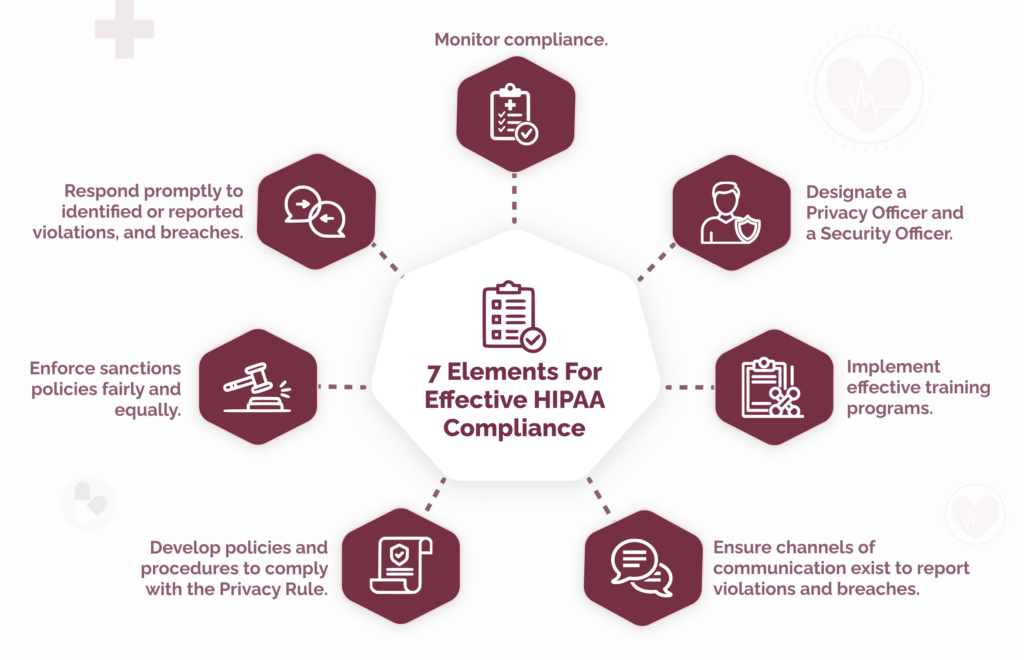
Seven Elements Of A Compliance Program

The Seven Elements HIPAA Compliance Software SolutionThe seven elements of a compliance program are integrated processes organizations can adopt to help develop a culture of compliance in the workplace; and, when applied effectively, the seven elements can also be used to streamline operational processes, optimize organizational performance, and reduce overall costs.

Because HIPAA compliance can be confusing, we have compiled this guide to the seven elements to make them relevant for HIPAA. Some compliance software solutions guide compliance officers through the seven elements as part of their set-up process.

Summary Of The Seven Elements

While the seven elements of a compliance program apply to all industries, they originated in the healthcare industry in the 1990s. This was in response to the growing level of healthcare fraud and abuse and an alleged “compliance disconnect” at the executive level in many hospitals and health systems.

These are the seven elements, which we outline in more detail below:

#1: Implement written policies, procedures, and standards of conduct.
#2: Designate a compliance officer and a compliance committee.
#3: Conduct effective training and education.
#4: Develop effective lines of communication.
#5: Conduct internal monitoring and auditing.
#6: Enforce standards through well-publicized disciplinary guidelines.
#7: Respond promptly to detected offenses and undertake corrective action.

The Seven Elements For Effective HIPAA Compliance

Despite being more than twenty-five years old – and not necessarily having been adopted to tackle the same issues – many organizations still use the seven elements in their original format.

The Background to the Seven Elements

In 1991, the Department of Health and Human Services (HHS) launched the Workgroup for Electronic Data Interchange (WEDI). WEDI had the objective of reducing administrative costs in the healthcare system by promoting electronic claims submission.

It achieved its objective by requiring insurance carriers to reimburse healthcare providers more quickly for electronic claims than for paper claims, thus encouraging providers to submit more claims electronically.

As a result, the percentage of claims submitted electronically over the next five years more than doubled – making it harder for adjudicators to identify fraud and abuse attributable to unbundling, duplication, and global service violations.

According to a Congressional Report published by the General Accounting Office in 1995, it was estimated that as much as 10 percent of national healthcare spending was attributable to waste, fraud, and abuse (around $98 billion at the time).

The following year, the long-running Caremark Derivative Litigation case concluded – a case in which it was claimed the company’s board of directors had failed in their fiduciary duty of care to ensure the company’s compliance program was enforced.

Although cleared of “lacking good faith in the exercise of monitoring duties or conscientiously permitting a known violation to occur”, the company settled multiple felony charges against it by paying $250 million in civil and criminal fines.

The relevance of this case is that Caremark’s primary operations were providing patient care and managed care services; and, although the company had implemented compliance policies to prevent breaches of Anti-Referral Payments Laws, a series of violations resulted in shareholders claiming the board of directors had failed to adequately enforce the policies and, as a result, exposed the company to regulatory fines.

This accusation was not lost on the HHS’ Office of Inspector General (OIG).

OIG Publishes First Model Compliance Plan

The year after the conclusion of the Caremark Derivative Litigation case, OIG published its first model compliance plan (62 FR 9435-9441). Although aimed at clinical laboratories, the model compliance plan consisted of seven “compliance plan elements” that subsequently evolved into “the seven fundamental elements of an effective compliance program” in later compliance plans for hospitals, home health agencies, hospices, and nursing facilities.

The primary objective of the plan is fairly transparent. In the preamble to each of the plans, OIG states “many providers and provider organizations have expressed an interest in better protecting their operations from fraud and abuse through the adoption of voluntary compliance programs.” The word “fraud” is repeated a further twenty-eight times in the compliance plan for hospitals (63 FR 8987) and the compliance plan for nursing facilities (65 FR 14289).

It is also noticeable that, from the second plan onward, each plan includes a footnote stating “recent case law suggests that the failure of a corporate Director to attempt in good faith to institute a compliance program in certain situations may be a breach of a Director’s fiduciary obligations” – referencing the Caremark Derivative Litigation case. Clearly, OIG wanted to send the message that, if a voluntary compliance plan was implemented, oversight of the plan was expected.

The biggest influence for the creation of the seven elements of a compliance program (fraud prevention) is sometimes overlooked. This is not necessarily a bad thing because – around the same time – the passage of HIPAA introduced fraud controls and transaction standards that made it harder for healthcare providers to defraud or abuse the system. However, the seven elements can be adapted for more positive purposes than preventing, detecting, and responding to fraud.

What are the Seven Elements of a Compliance Program?

The Seven Elements Of A Compliance ProgramSince the first appearance of the seven elements, some versions have been amended or extended to meet organizational or regulatory requirements.

For example, when the Affordable Care Act made a compliance program a requirement of Medicare participation for some healthcare providers (42 CFR §483.85), an element was added that prohibits organizations from delegating discretionary authority to individuals who “the organization knew, or should have known through the exercise of due diligence, had the propensity to engage in criminal, civil, and administrative violations of the Social Security Act.”

However, as mentioned in the introduction to this article, many organizations that have implemented a compliance plan voluntarily still use the seven elements of a compliance program in their original format.

Please use the form on this page to arrange to receive a free copy of the HIPAA Compliance Checklist to use with the seven elements of a compliance program.

#1 Implement written policies, procedures, and standards of conduct

The best HIPAA compliance softwareThe seven elements of a compliance program are often depicted as a linear “start-to-finish” program or as a wheel that starts revolving again when it is completed its first cycle. Neither depiction is entirely accurate, as the seven elements of a compliance program have to integrate with each other at all times to make the program work effectively and facilitate improvements to the program.

The first of the seven elements of a compliance program is a suitable example of why it is important to view a compliance program holistically because it calls for the development of standards (etc.) under the direction of a compliance officer. Yet organizations are not advised to designate a compliance office until element #2:

“Every compliance program should develop and distribute written compliance standards, procedures, and practices that guide the facility and the conduct of its employees throughout day-to-day operations. These policies and procedures should be developed under the direction and supervision of the compliance officer, the compliance committee, and operational managers.”

If you view the seven elements of a compliance program as a linear program, you could be confused when the second element instructs you to designate the compliance officer you need to complete the first element. You might also be confused if you view the compliance program as a wheel, because it means you will need to rotate the wheel counter clockwise from #2 to #1.

#2 Designate a compliance officer and compliance committee

The temptation with element #2 is to delegate the role of compliance officer and the membership of a compliance committee to members of the same HR, legal, or operations teams or department heads of these teams. This can be a mistake if (for example) the legal team does not understand the real-life challenges of compliance in the workplace.

While it is a good idea to head the compliance committee with a person of authority, it is beneficial to include personnel with public-facing roles (i.e., healthcare professionals) and a mixture of personnel from IT, security, and administration who can provide insights on which policies will work and which won’t without changes to working practices.

#3 Conduct effective training and education

Integrating training and education into a compliance program should not be difficult for most organizations in the healthcare industry, as the majority are required to comply with the HIPAA training requirements, while some are also required to provide annual compliance training as a condition of participation in the Medicare program.

Of significance, in the original seven elements of a compliance program, OIG notes that the continual retraining of personnel at all levels (emphasis added) is a significant element of an effective compliance training program. Along the same lines, OIG adds that adherence to the elements of the compliance program should be a factor in evaluating the performance of managers and supervisors.

#4 Develop effective lines of communication

The development of effective lines of communication is pivotal to the seven elements of a compliance program because effective lines of communication are necessary for members of the workforce to raise questions, report violations, and provide feedback on corrective action plans that may necessitate amendments to policies and procedures and further training.

Ideally the creation and maintenance of effective lines of communication between the compliance officer/committee and the workforce should include a hotline or anonymous reporting system to receive questions, reports, and feedback. Organizations should also adopt procedures to protect the anonymity of complainants and to protect whistle-blowers from retaliation.

#5 Conduct internal monitoring and auditing

This element of an effective compliance program provides an opportunity for executive officers to demonstrate oversight by requesting compliance reports and audits from the compliance officer. In healthcare environments, these reports and audits should be conducted regularly to comply with the HIPAA requirement for regular risk analyses and be available at all times for executive review.

If executive officers participate in this element, it also provides an opportunity to extend lines of communication “from the top to the bottom”. Although it is not always practical to have members of the workforce communicate directly with executive officers (and vice versa), the involvement of executive officers demonstrates a commitment to compliance throughout the entire organization.

#6 Enforce standards through well-publicized disciplinary guidelines

Most organizations distribute disciplinary guidelines at the point of training. Indeed, in the healthcare industry, the standards relating to training and sanctions are almost adjacent to the Administrative Requirements of the Privacy Rule – so it is rare that an explanation of the organization’s sanctions policy is not included in initial HIPAA training.

With regard to enforcing standards, it is important that sanctions are applied fairly. If one group of the workforce is sanctioned more often or more harshly than another group for no justifiable reason, executive officers need to find out why. While it may be the case that one manager is enforcing standards over-zealously, it may equally be the case that another manager is allowing the workforce to take shortcuts with compliance “to get the job done”.

#7 Respond promptly to detected offenses and undertake corrective action

When the seven elements of a compliance plan were originally published in the 1990s, this element focused almost entirely on detecting fraud, reporting it, and enforcing sanctions or implementing measures to prevent it from happening again. With fraud prevention being a less important objective of a compliance plan than it was twenty-five years ago, this element can be used to monitor the effectiveness of the compliance program and improve it where necessary.

For example, if an offense has occurred due to a loophole in a policy (element #1), a lack of training (#3), a communication failure (#4), or a monitoring issue (#5), the compliance officer (#2) can evaluate the existing policies, procedures, and standards, and adjust them as necessary (#7). If the offense has occurred due to the actions of a non-compliant member of the workforce, it may be necessary to increase the penalties in the sanctions policy (#6) to be more of a deterrent.

The Challenges and Benefits of Adopting a Compliance Plan

Software For Compliance OfficersAdopting the seven elements of a compliance plan can be challenging for an organization starting from scratch. It can be difficult to get leadership buy-in because compliance is not perceived as a revenue generator, it can be difficult to define compliance roles in a complex regulatory environment, and it can be difficult to pull everything together with limited resources.

In healthcare environments, these challenges are mitigated by the fact that many of the elements are – or should be – already in place. HIPAA-covered entities should have developed policies and procedures to comply with the Privacy Rule, have a training and sanctions program up and running, and have procedures for conducting internal audits and responding to data breaches.

All that needs to be done in many healthcare environments is for the compliance officer to bring together the seven elements of a compliance plan into one integrated plan. When managed effectively, the plan will help organizations develop a culture of compliance that can help to reduce costs (i.e., regulatory fines), enhance the organization’s operations (i.e., through improved communication), and advance the quality of healthcare.

This final benefit of adopting a compliance plan is one many organizations are only starting to realize as it has only recently been demonstrated that, when patients believe PHI will remain confidential, they tend to be more forthcoming about healthcare issues. This enables healthcare professionals to make better-informed diagnoses and prescribe more effective courses of treatment, which results in better patient outcomes, satisfaction scores, workplace morale, and staff retention.

Get Help Developing Your Compliance Plan

Multiple sources on the Internet offer help with developing a compliance plan. One of the best is the HHS’ Office of Inspector General compliance guidance web page which includes updated guidance on the seven elements of a compliance program in its General Compliance Program Guidance document.

However, if your organization is a multi-disciplined Covered Entity or Business Associate, and you need more granular help developing a compliance plan, it may be worthwhile reviewing our HIPAA compliance checklist.

Steve Alder, Editor-in-Chief, The HIPAA Journal

The post Seven Elements Of A Compliance Program appeared first on The HIPAA Journal.