Healthcare Cybersecurity

Senator Demands Answers from Government Agencies and Healthcare Associations on Healthcare Cybersecurity

Senator Mark Warner (D-Va) has written letters to leaders of the Department of Health and Human Services (HHS), the Food and Drug Administration (FDA), the Centers for Medicare and Medicaid Services (CMS), the National Institute of Standards and Technology (NIST), and 12 healthcare associations requesting answers to a list of healthcare cybersecurity questions.

Warner, a member of the Senate Finance Committee and co-chair of the Senate Cybersecurity Caucus, is deeply concerned about the state of cybersecurity in healthcare and is calling for a collaborative effort “to develop a short- and long-term strategy reducing cybersecurity vulnerabilities in the health care sector” and “develop a national strategy that improves the safety, resilience, and security of our healthcare industry.”

The healthcare industry is being targeted by cybercriminals and those attacks are succeeding far too frequently. 2014 was the sixth successive year to see an annual increase in healthcare data breaches. In 2015, another record was broken. The most healthcare records ever breached. 113 million healthcare records were exposed that year.

Even though investment in cybersecurity is increasing, records continue to be broken each year and data breaches have now reached unprecedented levels. 2016 saw the record for the most healthcare data breaches in a single year broken again, and again in 2017, and yet again in 2018. Last year, healthcare data breaches were reported at a rate of one a day. That trend is likely to continue unless action is taken.
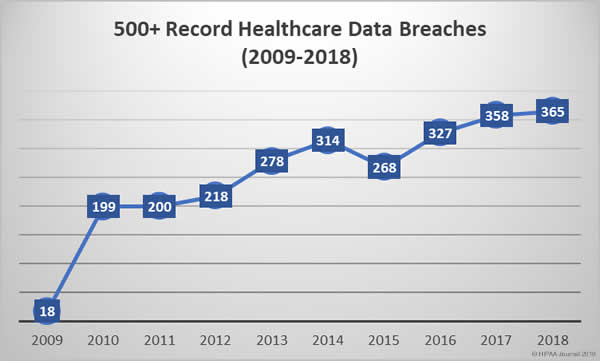
2009-2018 healthcare data breaches

In the letters, Warner cited a 2015 GAO report that estimated cyberattacks on the healthcare industry would result in $305 million in losses over a five-year period and a Trend Micro report in the same year which suggests 100,000 healthcare devices and systems have been exposed over the internet.

Healthcare data is of high value to cybercriminals and hospitals store vast quantities of patient data. Successful attacks can be extremely profitable, either through theft and resale of healthcare data or by preventing healthcare providers from accessing patient data through ransomware attacks. Cyberattacks cannot be prevented, but it is possible to improve resilience and stop most of those attacks from succeeding.

As a first step, Warner has asked each agency to supply details of the actions each has taken to identify and reduce vulnerabilities in the healthcare industry, and what each agency has done to develop a national strategy to reduce vulnerabilities. Warner wants to know whether each department and agency has been seeking input from private sector healthcare stakeholders to address vulnerabilities and any potential changes to current laws and regulations that would help to combat cyberattacks on healthcare entities.

Similar questions have been sent to healthcare associations and organizations including the Healthcare Information Management and Systems Society (HIMSS), the American Hospital Association (AHA), the American Medical Association (AMA), and the Health Information Sharing and Analysis Center (H-ISAC). They have been asked to explain the steps that they have taken to improve security awareness and their technical capabilities.

The sheer volume of successful cyberattacks has prompted state regulators to introduce new requirements for entities doing business in their respective states to improve security and privacy protections, but what is also required is a nationwide effort to improve privacy and security. Federal regulators and Congress are taking steps to develop a national cybersecurity strategy. Warner hopes that his efforts will help to speed up that process.

The post Senator Demands Answers from Government Agencies and Healthcare Associations on Healthcare Cybersecurity appeared first on HIPAA Journal.
Healthcare Associations Call for Safe Harbor for Breached Entities That Have Adopted Cybersecurity Best Practices

Several healthcare associations have requested a safe harbor for healthcare organizations that would prevent OCR and state attorneys general from issuing financial penalties for breaches of protected health information if the breached entity has met certain standards for safeguarding protected health information (PHI).

The suggestions were made in response to the Department of Health and Human Services’ request for information (RFI) on potential changes to HIPAA to reduce the burden on healthcare organizations and improve data sharing for the coordination of patient care. The HHS received more than 1,300 comments on possible changes prior to the February 12, 2019 deadline.

The safe harbor was suggested by the College of Healthcare Information Management Executives (CHIME), the Association for Executives in Healthcare Information Technology (AEHIT), the Association for Executives in Healthcare Information Security (AEHIS), the American Medical Association (AMA), and the American Hospital Association (AHA).

Healthcare organizations can adopt cybersecurity frameworks, create layered defenses to keep their networks secure, provide security awareness training to employees, and adopt cybersecurity best practices, yet still experience a data breach.

OCR has already made it clear that its area of focus for enforcement is egregious violations of HIPAA Rules, such as widespread noncompliance and HIPAA-covered entities that have little regard for HIPAA Rules. However, all breaches of 500 or more records are investigated, and if HIPAA violations are discovered, financial penalties could be issued.

It has been argued that entities that have made reasonable efforts to keep patient information private and confidential should not be at risk of significant penalties.

CHIME suggested OCR should create “A safe harbor for providers who have demonstrated they are meeting a set of best practices such as those developed under the public-private effort known as the Health Industry Cybersecurity Practices: Managing Threats and Protecting Patients (HICP).”

The AHA suggested healthcare organizations that experience cyberattacks should be provided with support and resources, and rather than punishing the breached entity, “Enforcement efforts should rightly focus on investigating and prosecuting the attackers.”

Most healthcare organizations take significant steps to prevent successful cyberattacks. The AHA said that when an attack occurs, an investigation is necessary to determine how access to systems and data was gained. Lessons can be learned, safeguards improved, and details of the vulnerabilities and threats should then be shared widely to allow other healthcare organizations to prevent similar attacks.

The AHA suggested there should be “A safe harbor for HIPAA covered entities that have shown, perhaps through a certification process, that they are in compliance with best practices in cybersecurity, such as those promulgated by HHS, in cooperation with the private sector.”

The AMA suggests that “OCR could revise [the HIPAA Security Rule] to include a new clause stating that covered entities that adopt and implement a security framework – such as the NIST Cybersecurity Framework – or take steps toward applying the Health Industry Cybersecurity Practices – the primary publication of the Cybersecurity Act of 2015 Task Group – are in compliance with the Security Rule.”

The AMA also suggests that OCR should change its approach to securing health information from issuing penalties for failures to providing positive incentives to encourage healthcare organizations to improve security and better protect health information.

CHIME stated that the current policy that calls for breaches to be reported and listed on the OCR breach portal in perpetuity is unduly punitive and that there should be a mechanism for removing breached entities from the listings once they have taken actions to correct vulnerabilities that contributed to the breach.

The HHS is now assessing all comments and feedback received in relation to its RFI and will determine which aspects of HIPAA Rules should be changed. A notice of proposed rulemaking will then be issued, although the HSS has not provided a time frame for doing so.

The post Healthcare Associations Call for Safe Harbor for Breached Entities That Have Adopted Cybersecurity Best Practices appeared first on HIPAA Journal.

New Cybersecurity Requirements for Ohio Health Insurers

From March 20, 2019, insurance companies in Ohio will be subject to a new law (Senate Bill 273) that requires them to develop and implement a written information security program to safeguard business and personal information.

The information security program must include a comprehensive internal risk assessment to identify risk and threats to systems and data. Following the risk assessment, safeguards must be implemented to protect all nonpublic information that would cause a material adverse impact to business operations or could cause harm to customers if the information were to be exposed or accessed by unauthorized individuals.

Nonpublic information includes financial information, health information, and identifiers such as Social Security numbers, driver’s license numbers, state ID cards, biometric information, account numbers, credit/debit card numbers, security/access codes that permit access to a financial account, and any information (except age or gender) that is created by or derived from a healthcare provider or consumer that could be used to identify an individual in relation to physical/mental health, the provision of healthcare, or payment for healthcare.

The security program must ensure the security of information and information systems is protected, that threats to the security and integrity of information and information systems are mitigated, safeguards must be implemented to prevent unauthorized data access, and a mechanism must be put in place to ensure nonpublic information is permanently destroyed when no longer required.

Licensees are required to designate a party to be responsible for the security program and must identify reasonably foreseeable threats that could threaten the confidentiality, integrity, and availability of nonpublic information. Risks must be assessed for the likelihood of a breach and potential damage that could be caused. Risks must be managed, and safeguards put in place to manage threats must be assessed to ensure they are sufficient. Safeguards’ key controls, systems, and procedures must be reassessed at least annually to ensure they remain effective.

The security program should reflect the size and complexity of the licensee, the nature of its activities, the use of third-party service providers, and the sensitivity of the data.

If a security event is experienced that results in unauthorized access to information systems or nonpublic information that has a reasonable likelihood of resulting in material harm to a consumer or could have an adverse effect normal business operations, the Ohio Superintendent of Insurance must be notified within three days of the discovery of incident if the Licensee is based in Ohio. The Ohio Superintendent of Insurance must also be notified of a security event that affects 250 or more Ohio residents or warrants a notification to a government agency. Notifications must also be issued to consumers affected by the security incident in accordance with other state laws.

The new law applies to all individuals and non-government entities that are licensed under insurance laws in Ohio that have 20 or more employees, more than $5 million in gross annual revenue, or more than $10 million in assets.

Entities that are in compliance with the Health Insurance Portability and Accountability Act (HIPAA) will be deemed to be in compliance with Senate Bill 273.

Licensees will be given one year to comply with the new requirements. The effective compliance date is therefore March 20, 2020.

The post New Cybersecurity Requirements for Ohio Health Insurers appeared first on HIPAA Journal.

NHS to Phase Out Pagers by End of 2021

The National Health Service (NHS) has commissioned a report on the costs of pagers and the extent of their use in NHS Trusts in the UK. The study revealed around 130,000 pagers are used in NHS Trusts – Approximately 10% of the world’s pagers – and the annual cost is around £6.6 million ($8.73 million).

Advantages and Disadvantages of Pagers in Healthcare

Pagers have served the healthcare industry well for several decades and they are still useful devices. Pagers are easy to use, they are small, easy to carry, and batteries can last months between charges. The pager system uses its own transmitters and frequencies and the signals can pass through structures. Consequently, coverage is excellent, and communication is fast and reliable. Pagers have one function and they perform that task very well.

However, there are many drawbacks to pagers in healthcare. Most of the pagers used by NHS Trusts do not support two-way communication. When a message is received, a doctor must find a phone and call a number to receive the message. When an immediate response is not possible, messages are often written down and they can be forgotten or lost. When responding to messages, doctors often find the number is engaged and so begins a time-consuming game of phone tag. Pages also do not convey the sense of urgency.

To investigate the use of pagers, the Department of Health commissioned a report from CommonTime, a digital solutions company. The firm concluded that the devices should not continue to be used in the NHS and that it was surprising for legacy equipment such as pagers to still be relied upon in emergency situations.

UK Health Secretary Matt Hancock is keen to see legacy technology such as pagers phased out. He views emails and mobile phones as a better option in terms of speed, security, and cost. Pagers are expensive to run. Switching to alternative, modern methods of communication could save the NHS millions each year. The report suggests that the use of mobile devices and mobile software in place of pagers could save the NHS around £2.7 million ($3.57 million) a year.

Messaging Apps and Secure Email to Replace NHS Pagers

Secure messaging apps on smartphones are a viable alternative to pagers and can be run at a fraction of the cost. The apps offer similar capabilities as WhatsApp and Skype, but with enhanced security and message accountability.

The West Suffolk NHS Foundation Trust trialed the use of a smartphone app in 2017 and replaced all of its pagers and found that it saved a considerable amount of time communicating with doctors and saved on costs. The app allowed two-way communications between doctors, could be used by healthcare professionals to communicate with each other, allowed group chats, and worked on smartphones, tablets and desktops.

Mobile technology may improve security and allow the NHS to cut costs, but the technology is not without drawbacks. There are often dead-spots in hospitals where signals cannot be received on mobile devices, mobile networks can face slowdowns which delay the delivery of urgent messages, and there is potential for mobile devices to interfere with hospital equipment. Those issues will need to be resolved over the coming two years, although NHS Trusts will be permitted to keep some pagers for emergency situations, such as when mobile networks go down or hospital Wi-Fi goes offline.

Fax Machines to be Phased Out by 2020

The latest report follows a 2018 study by the Royal College of Surgeons which revealed that the NHS was still using around 9,000 fax machines to send documents. In December 2018, the Department of Health announced that fax machines would be phased out and would be replaced by secure, encrypted email to improve patient safety and cybersecurity. NHS Trusts have not been permitted to buy new fax machines since January 2019 and fax machines will be completely phased out by April 2020.

These are just two of the initiatives that Hancock is pursuing to update the technology used by the NHS. As the May 2017 WannaCry ransomware attacks showed, it is not just legacy equipment that is a problem. A study conducted after the attacks revealed 60% of NHS Trusts were still using Windows XP, even though the operating system is a major security risk and is no longer supported. In May 2018, the UK government signed a £150 million ($1.98 million) deal with Microsoft to upgrade all Windows XP and Windows 7 machines to Windows 10. That process will be completed by January 14, 2020.

The post NHS to Phase Out Pagers by End of 2021 appeared first on HIPAA Journal.

January 2019 Healthcare Data Breach Report

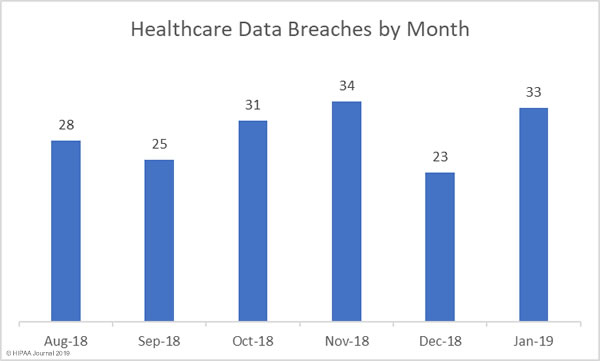
After a relatively quiet month for healthcare data breaches, breach numbers rose to more typical levels and were reported at a rate of more than one per day. There were 33 healthcare data breaches reported in January 2019.

Healthcare Data Breaches January 2019 - Month

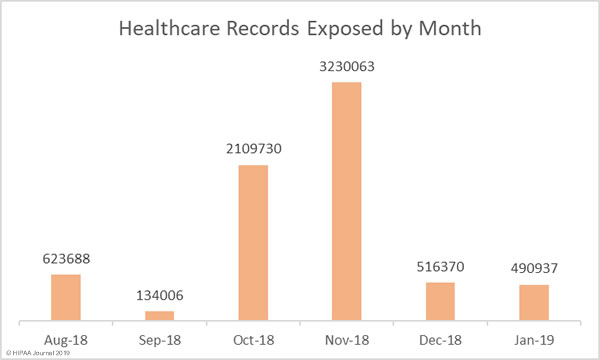
January was the second successive month where there was a fall in the number of individuals impacted by healthcare data breaches. January’s healthcare data breaches saw 490,937 healthcare records exposed, stolen or impermissibly disclosed.

Healthcare Data Breaches January 2019 - Records Exposed

Largest Healthcare Data Breaches in January 2019


Rank Name of Covered Entity Covered Entity Type Individuals Affected Type of Breach
1 Centerstone Insurance and Financial Services (BenefitMall) Business Associate 111589 Hacking/IT Incident
2 Las Colinas Orthopedic Surgery & Sports Medicine, PA Healthcare Provider 76000 Theft
3 Valley Hope Association Healthcare Provider 70799 Hacking/IT Incident
4 Roper St. Francis Healthcare Healthcare Provider 35253 Hacking/IT Incident
5 Managed Health Services Health Plan 31300 Hacking/IT Incident
6 EyeSouth Partners Business Associate 24113 Hacking/IT Incident
7 Dr. DeLuca Dr. Marciano & Associates, P.C. Healthcare Provider 23578 Hacking/IT Incident
8 Critical Care, Pulmonary and Sleep Associates, PLLP Healthcare Provider 23377 Hacking/IT Incident
9 Valley Professionals Community Health Center Healthcare Provider 12029 Hacking/IT Incident
10 Cambridge Healthcare Services, LLC Business Associate 10866 Theft

Causes of January 2018 Healthcare Data Breaches

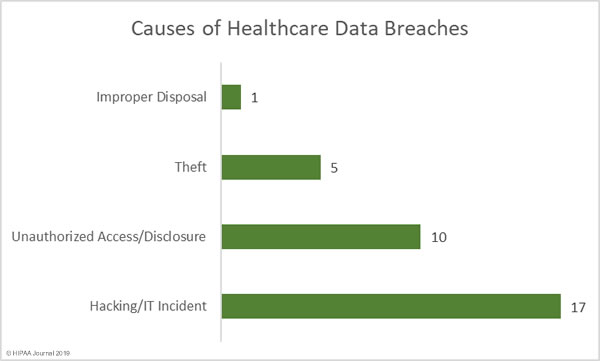
Hacking and other IT security incidents such as ransomware and malware attacks were the biggest cause of healthcare data breaches in January 2019, accounting for 51.52% of the month’s data breaches (917 incidents) and the largest reported breach of the month. Hacking/IT incidents also accounted for the most breached records: 74.07% of all breached records in January (363,631 records).

Healthcare Data Breaches January 2019 - Causes

Unauthorized access and impermissible disclosure incidents were in second place with 10 incidents (30.30%), although they involved only a small percentage of the month’s breached records – 19,500 or 3.97% of the month’s total.

There were 5 theft incidents reported in January which involved the protected health information of 106,006 individuals – 21.59% of the records exposed in January – and one improper disposal incident that saw 1,800 paper records accidentally discarded with regular trash.

Location of Breached Protected Health Information

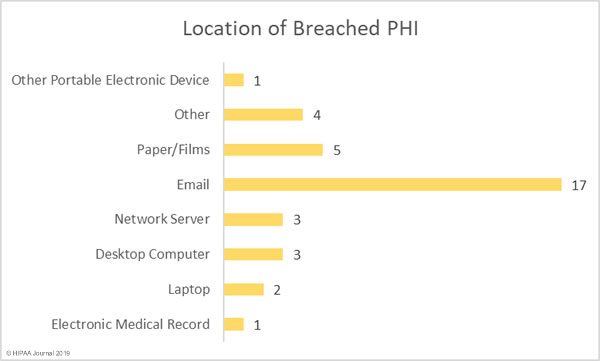
Healthcare organizations are still having difficulty preventing phishing attacks and other email-related breaches. As has been the case in the past few months, email-related data breaches have dominated the breach reports. Most of the email breaches in January were due to phishing attacks.

51.52% of healthcare data breaches in January 2019 involved PHI stored in emails and email attachments (17 incidents). Physical PHI, such as paper records, charts, and films was exposed in 15.15% of breaches in January (5 incidents).

Healthcare Data Breaches January 2019 - Location PHI

Healthcare Data Breaches by Covered Entity Type

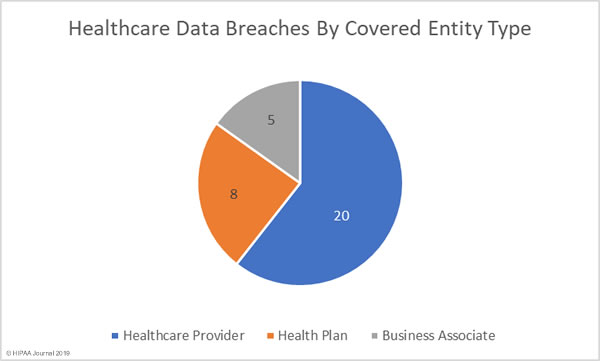
Healthcare providers were the worst affected by healthcare data breaches in January 2019 with 20 reported incidents, six of which ranked in the top ten breaches of the month.

8 health plans reported breaches in January and there were five breaches reported by business associates of HIPAA-covered entities, including the largest data breach of the month. A further 6 data breaches had some business associate involvement but were reported by the HIPAA-covered entity.

Healthcare Data Breaches January 2019 - By Covered Entity

Healthcare Data Breaches by State

HIPAA covered entities and business associates based in 20 different states reported healthcare data breaches in January 2019. The worst affected state was Texas with four reported breaches. Georgia, Indiana, and Kentucky each had 3 breaches in January and there were two breaches reported in each of California, Connecticut, Florida, Kansas.

Colorado, Illinois, Michigan, Minnesota, North Carolina, Nebraska, New Jersey, Pennsylvania, Rhode Island, South Carolina, Tennessee, and Washington each experienced one healthcare data breach in January.

Penalties for Noncompliance and HIPAA Violations

The Department of Health and Human Services’ Office for Civil Rights (OCR) did not issue any financial penalties in January 2019 or agree to any settlements to resolve HIPAA violations; however, OCR did announce in late January that a further settlement had been agreed with a HIPAA covered entity in December 2018 – Too late for inclusion in our December 2018 Healthcare Data Breach Report.

In December 2018, Cottage Health agreed to settle its HIPAA violation case with OCR for $3,000,000. OCR investigated Cottage Health over two breaches experienced in 2013 and 2015 which saw the protected health information of 62,500 patients exposed online.

OCR also announced that 2018 had been a record year for HIPAA enforcement. OCR’s HIPAA fines and settlements totaled $28,683,400 in 2018, beating the previous record of $23,505,300 set in 2016 by 22%. 2018 also saw the largest ever HIPAA settlement agreed. Anthem Inc., agreed to pay OCR $16,000,000 to resolve HIPAA violations discovered during the investigation of its 78.8 million-record data breach of 2015.

OCR closed out 2018 with 10 settlements to resolve HIPAA violations and one civil monetary penalty, beating last year’s total by one.

There was one HIPAA violation case closed by a state attorney general in January 2019. The California Attorney General agreed to settle a case with health insurer Aetna for $935,000. The financial penalty resolved violations of HIPAA and state laws that contributed to the impermissible disclosure of plan members’ PHI. In two separate 2017 mailings, PHI was visible through the windows of envelopes. The mailings were sent to individuals who had been diagnosed with Afib in one mailing, and patients who were receiving HIV medications in the other. The impermissible disclosures affected 1,991 California residents.

This was the sixth state attorney general financial penalty Aetna has agreed to pay in relation to the mailing errors. In 2018, Aetna settled cases with New York, New Jersey, Washington, Connecticut, and the District of Columbia. The latest financial penalty brings the total financial penalties over the HIPAA violations to $2,725,172.

The post January 2019 Healthcare Data Breach Report appeared first on HIPAA Journal.

NIST NCCoE Releases Mobile Device Security Guidance

The National Cybersecurity Center of Excellence (NCCoE) has released final guidance on mobile device security to help organizations secure mobile devices and prevent data breaches.

Mobile devices offer convenience and allow data to be accessed from any location. Not only do they allow healthcare organizations to make cost savings, they are vital for remote workers who need access to patients’ health information. Mobile devices allow onsite and offsite workers to communicate information quickly and they can help to improve patient care and outcomes.

However, mobile devices introduce security risks. Stolen devices can be used to gain access to corporate email accounts, contacts, calendars, and other sensitive information stored on the devices or accessible through them.

There have been many cases where mobile healthcare devices have been lost or stolen causing the exposure of patients’ protected health information. Mobile device security failures have resulted in several financial penalties for HIPAA covered entities, including a $4,348,000 civil monetary penalty for University of Texas MD Anderson Cancer Center in 2018.

In healthcare, securing mobile devices and protecting sensitive data can be a major challenge. To help businesses and healthcare organizations improve mobile device security, NIST/NCCoE developed a Mobile Device Security Practice Guide.

The Guide – NIST Special Publication 1800-4 Mobile Device Security: Cloud & Hybrid Builds – gives practical advice on how commercially available technologies can be used to create an enterprise mobility management system that ensures mobile devices can be used to securely access sensitive information from inside and outside the corporate network while minimizing the impact on the user experience.

By using the guide, organizations can ensure that employees can access vital information safely and security from almost any location, over any network, on a range of mobile devices, while minimizing mobile device security risks.

The guide can be used to securely implement BYOD and COPE deployment models and leverage cloud services to improve security, enhance visibility for system administrators, provide instant alerts about security events, and push policies out to mobile devices and enforce them through operating systems or mobile applications.

The guide includes several how to examples that demonstrate how standards-based technologies can be used in real world situations to reduce the risk of unauthorized data access and intrusions while saving on research and proof of concept costs.

The guide can be viewed or downloaded from NIST/NCCoE on this link.

The post NIST NCCoE Releases Mobile Device Security Guidance appeared first on HIPAA Journal.

Maryland Considers Tougher Penalties for Ransomware Attacks

Following a spate of ransomware attacks on businesses and hospitals in Maryland, a new bill (Senate Bill 151) has been introduced which seeks to increase the penalties for ransomware attacks. It is hoped that tougher penalties for ransomware attacks would discourage individuals from conducting attacks in the state.

The bill defines ransomware as a computer or data contaminant, encryption, or lock that is introduced without authorization on a computer, computer network, or computer system that restricts access to the computer, data, network, or system and is accompanied by a demand for payment to remove the contaminant, encryption or lock.

Currently in Maryland, a ransomware attack is classed as a misdemeanor if the attacker causes losses of less than $10,000 and a felony if the attack results in losses of $10,000 or more.

The bill seeks to reclassify a ransomware attack as a felony if it results in aggregate losses of more than $1,000. Aggregate losses include “the value of any money, property, or service lost, stolen, or rendered unrecoverable by the crime,” along with reasonable costs of verifying whether a system has been altered, acquired, damaged, deleted, disrupted, or destroyed.

The penalty for a ransomware attack that results in more than $1,000 in losses would increase to a maximum fine of $100,000 and up to 10 years imprisonment. If the attack results in aggregate losses of less than $1,000, the crime would be a misdemeanor and could result in a fine of up to $25,000 and up to 5 years imprisonment.

Even being in possession of ransomware (for non-research purposes) could result in a hefty fine and prison term, even if no attacks have been conducted. Possession with intent could result in a fine of up to $10,000 and up to 10 years imprisonment.

It would also be possible for a person who has suffered a specific and direct injury as a result of a ransomware attack to bring a civil action against the attacker and for damages to be awarded and the cost of legal action to be recovered.

Ransomware poses a threat to all businesses, but healthcare organizations are especially vulnerable. Ransomware attacks on hospitals not only causes financial losses but could also potentially cause harm to patients. Loss of access to healthcare systems and encryption of patient data can disrupt medical services which could lead to fatalities.

Research conducted at Vanderbilt university in 2017 suggests ransomware attacks on hospitals could potentially result in 2,000 deaths a year. The financial losses can also be considerable. The ransomware attack on Maryland-based Medstar Health in 2016 is believed to have caused more than $30 million in losses.

The post Maryland Considers Tougher Penalties for Ransomware Attacks appeared first on HIPAA Journal.

Free Decryptor for GandCrab Ransomware v5.1 Released

A free decryptor for GandCrab ransomware has been released that allows victims to recover files encrypted by versions 5.0.4 to 5.1 of the ransomware. Previous decryptors have only worked on version 1, 4, and some of the early version 5 variants.

The new GandCrab ransomware decryptor was developed by the Romanian police with assistance provided by Bitdefender, Europol, and law enforcement agencies in Austria, Belgium, Cyprus, France, Germany, Italy, the Netherlands, UK, Canada and the United States.

GandCrab ransomware was first used in attacks in January 2018. The first version of the ransomware was somewhat crude and a free decryptor was rapidly developed and released in February. Latter variants were more advanced and more adept at evading detection; however, in October, a second GandCrab ransomware decryptor was released that worked on version 4 of the ransomware.

According to Europol, those decryptors have been downloaded more than 400,000 times and have allowed around 10,000 users to decrypt their files free of charge.

To date, GandCrab ransomware has been used in more than 500,000 attacks, including several on U.S. healthcare providers. Ransom demands vary but are typically in the range of $300 to $6,000, depending on the extent of the attack and the number of devices that have been encrypted.

GandCrab ransomware was the biggest ransomware threat in 2018 is now the most widely used ransomware variant. Part of its success is due to regular updates. When decryptors are developed, new versions are rapidly released. The threat actors behind the ransomware are also rather adept at marketing the ransomware and recruiting affiliates to run ransomware campaigns. GandCrab now dominates the ransomware-as-a-service market.

Multiple threat actors are using the ransomware and various methods are used to infect end users. Spam email campaigns are common, although recently the ransomware has been installed using stolen RDP credentials and through exploitation of vulnerabilities in software and operating systems. Managed service providers (MSPs) have also been targeted and privileged access to clients’ systems has been abused to download the ransomware onto clients’ workstations.

The latest free decryptor for GandCrab ransomware is certainly good news and will help healthcare providers recover files without having to pay the ransom demand. However, version 5.2 of the ransomware is expected to be released soon. The latest decryptor will not work on the new version.

“If you have a security solution, make sure it is up-to-date and has layered defenses against ransomware. The better it is at detection, the lower your chances of infection. Also make sure you are running the latest version of your OS and third-party software,” wrote Bitdefender. “If you don’t have a security solution, get one now. It helps a lot, and it’s way less expensive than a $600 ransom payment.”

The free decryptor for GandCrab ransomware works for versions 1, 4, and most version 5 variants, and can be downloaded from the No More Ransom website.

The post Free Decryptor for GandCrab Ransomware v5.1 Released appeared first on HIPAA Journal.

Data Access and Sharing Risks Identified at National Institutes of Health

The Department of Health and Human Services’ Office of Inspector General (OIG) has published a report of the findings of an audit of the National institutes of Health (NIH). The NIH is the primary government biomedical and public health research agency in the United States and one of the foremost medical research centers in the world.

The audit was conducted to determine whether adequate controls had been implemented for permitting and monitoring access to sensitive NIH data. OIG reviewed internal controls, policies, procedures, and supporting documentation, and conducted interviews with internal staff.

While controls had been implemented at NIH to restrict access to sensitive data, OIG identified several areas where improvements could be made to bolster security and several recommendations were made.

OIG recommended NIH should develop a security framework, conduct risk assessments, implement additional security controls to safeguard sensitive data, and should start working with an organization that has expertise and knowledge of misuse of scientific data. NIH did not concur with any of those recommendations.

OIG also recommended that mechanisms should be implemented to ensure that its data security policies remain current and reflect the rapidly changing threat landscape and that security awareness training and security plans should be made a requirement.

NIH concurred with those recommendations but did not agree to implement controls to ensure that training and security plan requirements are fulfilled. NIH explained that it had already established a working group to address risks and vulnerabilities to the confidentiality of intellectual property and protect the integrity of the peer review process.

OIG maintained that the findings of its auditors were accurate and the recommendations were valid. Detailed information on potential actions that could be taken to address its findings and recommendations was provided to NIH. OIG recommended that if NIH decides not to strengthen its controls that the decision should be documented in line with Federal regulations and guidance.

The post Data Access and Sharing Risks Identified at National Institutes of Health appeared first on HIPAA Journal.