A practice owner who cannot define a Security Risk Analysis, has never read the HIPAA Security Rule, and does not know what a Business Associate Agreement must contain can still operate a practice with a complete, documented, provable HIPAA compliance program. The expertise does not have to live in the practitioner’s head. It has to live in the program. A purpose-built compliance program encodes what HIPAA requires and translates a practice owner’s knowledge of their own practice into a complete compliance record. The practitioner does not need to become a compliance expert. They need a structured program built specifically for them.
What HIPAA Actually Requires a Small Practice to Have
HIPAA’s requirements for a small independent practice are extensive, but they are not open-ended. The HIPAA compliance obligations for a covered entity resolve into four documented outputs that the HHS Office for Civil Rights will look for in any investigation or audit.
The first is a current Security Risk Analysis. The Security Rule requires covered entities to conduct an accurate and thorough assessment of the risks and vulnerabilities to electronic Protected Health Information across every system, device, and workflow the practice uses. The SRA must be current. A practice that completed one two years ago and has since changed its EHR system, added a telehealth platform, or hired new staff has an outdated assessment and a documented gap.
The second is a set of written policies and procedures tailored to the practice. The HIPAA Privacy Rule and Security Rule both require written policies that address each applicable standard. Generic templates do not satisfy this requirement. The HHS Office for Civil Rights treats policies that do not reflect how the practice actually operates as evidence that a compliance program exists on paper only, not in practice.
The third is documented workforce training. The HIPAA training requirement applies to every member of the workforce, including staff who do not directly handle patient records. Training records must show who completed training, what was covered, and when. The record of completion is the compliance artifact. An investigator will ask for documentation, not recollections.
The fourth is a signed Business Associate Agreement with every vendor that creates, receives, maintains, or transmits Protected Health Information on behalf of the practice. This includes EHR vendors, billing services, cloud storage providers, transcription services, and any other third party with access to PHI. A breach involving a vendor without a current agreement exposes the practice to enforcement action regardless of where the fault lies.
These are not judgment calls or matters of interpretation. A practice either has all four, documented and current, or it does not. An OCR investigator will request each of them.
Why Most Small Practices Have Gaps They Cannot See
Most small practices are not non-compliant on purpose. They completed a training session, filed some policies, and reasonably concluded they were covered. The gap between that conclusion and actual compliance is where enforcement actions originate.
Three specific failure patterns appear consistently in OCR investigations of small practices.
The first is the generic template problem. A policy downloaded from a template library describes a hypothetical organization with hypothetical workflows. It does not describe the practice’s actual intake process, its specific EHR configuration, or how its staff handles verbal disclosures in shared clinical spaces. When an investigator asks a staff member to describe their workflow and the answer does not match the written policy, the program is treated as non-implemented. The document existed. The compliance program did not.
The second is the one-time SRA problem. Many practices completed a Security Risk Analysis once, often at the recommendation of their EHR vendor or an IT provider, and have not revisited it since. An SRA is not a one-time obligation. Every material change to the practice’s technology, physical environment, or service delivery model requires a reassessment. A practice that added telehealth after a prior SRA has a gap that the original assessment does not cover. OCR currently maintains an active enforcement initiative targeting incomplete and outdated risk analyses, and the SRA is the first document requested when an investigation opens.
The third is the partial completion problem. Training without a current SRA is partial compliance. Policies without documented training are partial compliance. A signed BAA for the EHR vendor but not the billing service is partial compliance. HIPAA penalties do not recognize partial effort. OCR does not award credit for the components a practice completed. The program must be complete to function as a defense, and partial compliance is treated the same as no compliance when an investigation surfaces a gap.
What Compliance Expertise Actually Consists Of, and Why a Program Can Carry It
A compliance expert knows which safeguards apply to a two-provider dental practice versus a multi-location behavioral health group. They know which questions a Security Risk Analysis must answer for a practice that uses a cloud-based EHR versus one with on-premises servers. They know when a vendor arrangement creates PHI storage exposure the practice has not assessed, and they know how the HIPAA Breach Notification Rule applies to a misdirected fax versus a ransomware incident.
That knowledge is not trivial. It takes years to develop and requires ongoing attention as the regulations change. The argument here is not that it is unimportant. The argument is that a practice owner should not have to carry it personally to operate a compliant practice.
A purpose-built compliance program encodes that expertise into a guided workflow. The practitioner answers questions about their practice: how many locations, which systems, what types of staff, which vendors. The program translates those answers into a practice-specific Security Risk Analysis, practice-specific policies, role-based training assignments, and a managed vendor agreement inventory. The practitioner brings knowledge of the practice. The program brings knowledge of HIPAA.
This is not a theoretical model. Practices with no prior compliance background and no dedicated compliance staff have built and maintained complete, audit-ready programs this way. The expertise is in the platform, not in the practitioner.
What a Complete, Practice-Specific Compliance Program Produces
A complete compliance program generates four outputs that correspond directly to what an OCR investigation will request.
The Security Risk Analysis produced by a purpose-built program is tailored to the practice’s actual systems, locations, workflows, and vendor relationships. It routes around questions that do not apply to a single-location practice and focuses on the vulnerabilities that do. It produces a documented risk register that identifies each vulnerability, assigns a risk level, and records the remediation action and timeline. An SRA without a corresponding risk management plan tells an investigator that risks were identified and ignored. A complete program produces both.
The policies and procedures generated by the program reflect how the practice actually operates, because they are built from the practice’s own SRA responses. They are not generic. They describe real workflows, real staff responsibilities, and real system configurations. When an investigator asks a staff member to describe their role and then compares the answer to the written policy, the two should match. A purpose-built program makes that alignment the default rather than an administrative aspiration.
The training records maintained by the program document completion at the individual level, with timestamps and role-specific assignments. Staff turnover, multiple start dates, and varying training schedules are tracked automatically. The program generates the documentation an investigator will request, not a spreadsheet assembled after the fact.
The Business Associate Agreement inventory tracks every vendor relationship, the date each agreement was executed, and when renewal review is due. Agreements that lapse because no one was tracking the renewal date are one of the most common findings in OCR investigations. A managed inventory with automated reminders eliminates that specific gap.
A practice that can produce all four on demand has a program it can prove. That is the only standard an OCR investigation applies.
The Difference Between Doing Some of It and Having All of It
The cost argument for a complete program is direct. Once a breach occurs, the costs that follow are largely fixed. Patient notification, breach response, reputational damage, and civil liability attach at the moment the breach is confirmed. The one cost that documentation and good-faith compliance can prevent is the government fine.
HIPAA civil penalties are tiered by culpability. A violation attributable to reasonable cause carries a substantially lower maximum penalty than one attributable to willful neglect. A complete, documented compliance program is the evidence of reasonable cause that determines which tier applies. For a small practice, the difference between those tiers can represent tens or hundreds of thousands of dollars. The fine is the cost that prior documentation prevents.
The time investment required to stand up a complete program through purpose-built software is measured in hours, not weeks. Maintenance thereafter requires a few minutes a month to keep the program current as the practice changes. That investment is not proportional to the regulatory risk it eliminates.
Partial completion does not reduce the fine. A practice that completed training but has no current SRA is exposed to the same willful neglect finding as a practice that did nothing, if the SRA gap surfaces during an investigation triggered by a breach. Every component of the program must be in place, documented, and current.
What to Look for in a Compliance Program
Not all HIPAA compliance software produces a complete, provable program. Three criteria distinguish a program that protects a practice during an investigation from one that generates paperwork without building a defense.
The first is practice-specific generation rather than templates. The program must produce documentation that reflects the actual practice, built from the practice’s own responses to guided questions. A policy library or downloadable template set requires the practice to implement, maintain, and update documents that were not written for them. A purpose-built program generates policies from the SRA and keeps them current as the practice changes.
The second is a complete program in a single plan. Partial compliance is not compliance, and a program that places the SRA, policies, training management, or BAA tracking behind separate service tiers or paid add-ons creates the same internal gap the practice is trying to close. Everything HIPAA requires should be included without requiring the practice to choose between cost and completeness.
The third is access to compliance experts. A software workflow handles the structured outputs: the SRA, the policies, the training records, the vendor agreements. It cannot handle the judgment calls that arise when a situation falls outside the structured workflow. How should the practice respond to a patient complaint that may or may not involve an impermissible disclosure? Does a specific cloud storage arrangement create PHI exposure that the SRA must address? Does a particular incident qualify as a notifiable breach under the four-factor harm analysis? Direct access to compliance experts, included in the program rather than billed separately, is what covers those situations. A practice that can call a compliance expert at the moment an unusual situation arises is not navigating HIPAA alone. A practice that cannot is.
The Standard an Investigation Applies
An OCR investigation does not assess how much the practice owner understands about HIPAA. It assesses what the practice can produce: a current Security Risk Analysis, written policies that match actual workflows, training records for every workforce member, and signed Business Associate Agreements with every covered vendor. Those are documents. They are generated by a program, not by regulatory expertise.
A practice owner who cannot define an SRA but runs their compliance program through purpose-built software will produce better documentation than a practice owner who has read the regulations in full but manages compliance manually through binders and spreadsheets. OCR does not see the effort. It sees the record.
The program does not replace the practitioner’s knowledge of their practice. It replaces the requirement that the practitioner also carry expertise in federal health information law. That expertise is already built in. The practice owner’s job is to answer the questions accurately and follow the guidance the program provides. The program does the rest.
The post Why You Don’t Need to Understand HIPAA to Make Your Practice HIPAA Compliant appeared first on The HIPAA Journal.


 What other features should you consider for your HIPAA compliance solution?
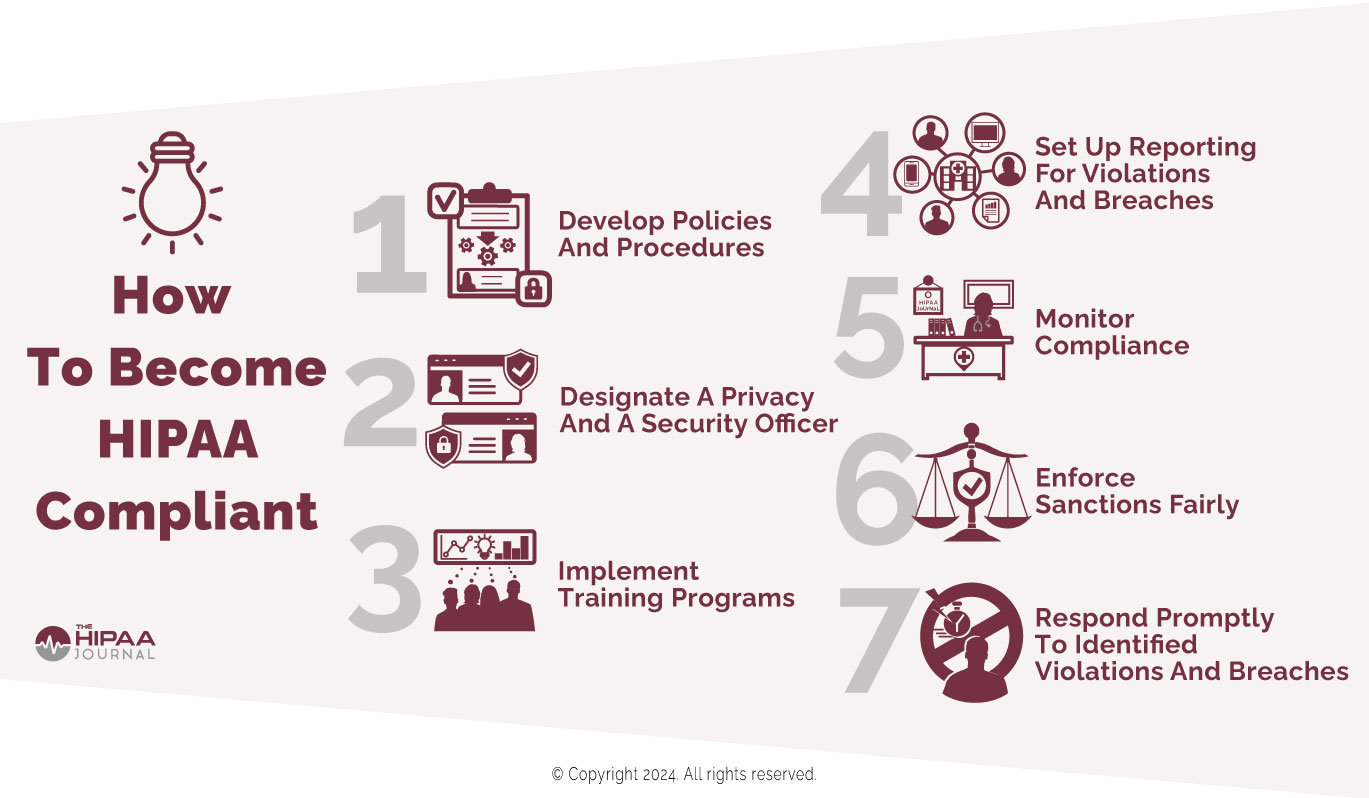
 When considering how to become HIPAA compliant, one of the simplest approaches is to adopt HHS’s “Seven Fundamental Elements of an Effective Compliance Program.” This will help you address compliance challenges identified in a HIPAA risk assessment. It can also be beneficial to take advantage of HIPAA compliance software that is built around The Seven Fundamentals in order to maintain a compliant workplace.