Healthcare Cybersecurity

Vulnerabilities Identified in Philips IntelliBridge, Patient Information Center and Efficia Patient Monitors

Five vulnerabilities have been identified that affect the IntelliBridge EC 40 and EC 80 Hub, Philips Patient Information Center iX, and Efficia CM series patient monitors.

IntelliBride EC 40 and EC 80 Hub

Two vulnerabilities have been identified that affect C.00.04 and prior versions of the IntelliBridge EC 40 and EC 80 Hub. Successful exploitation of the vulnerabilities could allow an unauthorized individual to execute software, change system configurations, and update/view files that may include unidentifiable patient data.

The first vulnerability is due to the use of hard-coded credentials – CVE-2021-32993 – in the software for its own inbound authentication, outbound communication to external components, or the encryption of internal data. The second vulnerability is an authentication bypass issue – CVE-2021-33017. While the standard access path of the product requires authentication, an alternative path has been identified that does not require authentication.

Both vulnerabilities have been assigned a CVSS v3 severity score of 8.1 out of 10.

Philips has not yet issued an update to correct the vulnerabilities but expects to fix the flaws by the end of the year. In the meantime, Philips recommends only deploying the products within Philips authorized specifications, and only using Philips-approved software, software configuration, system services, and security configurations. The devices should also be logically or physically isolated from the hospital network.

Patient Information Center iX and Efficia CM Series Patient Monitors

Three vulnerabilities have been identified that affect the Philips Patient Information Center iX and Efficia CM series patient monitors. The flaws could be exploited to gain access to patient data and to conduct a denial-of-service attack. While exploitation has a low attack complexity, the flaws could only be exploited via an adjacent network.

The vulnerabilities affect the following Philips products:

  • Patient Information Center iX (PIC iX): Versions B.02, C.02, C.03
  • Efficia CM Series: Revisions A.01 to C.0x and 4.0

Vulnerable versions of the PIC iX do not adequately validate input to determine whether the input has the properties to be processed safely and correctly. The vulnerability is tracked as CVE-2021-43548 and has been assigned a CVSS severity score of 6.5 out of 10.

A hard-coded cryptographic key has been used which means it is possible for encrypted data to be recovered from vulnerable versions of the PIC iX. The flaw is tracked as CVE-2021-43552 and has a CVSS score of 6.1.

A broken or risky cryptographic algorithm means sensitive data may be exposed in communications between PIC iX and Efficia CM Series patient monitors. The vulnerability is tracked as CVE-2-21-43550 and has a CVSS score of 5.9.

CVE-2021-43548 has been remediated in PIC iX C.03.06 and updates to fix the other two vulnerabilities are due to be released by the end of 2022.

To reduce the potential for exploitation of the vulnerabilities, the products should only be used in accordance with Philips authorized specifications, which include physically or logically isolating the devices from the hospital local area network, and using a firewall or router that can implement access control lists restricting access in and out of the patient monitoring network for only necessary ports and IP addresses.

Philips-issued hardware has Bitlocker Drive Encryption enabled by default and this should not be disabled. Prior to disposal, NIST SP 800-88 media sanitization guidelines should be followed. Patient information is not included in archives by default, so if archives are exported that contain patient information, the information should be stored securely with strong access controls.

The post Vulnerabilities Identified in Philips IntelliBridge, Patient Information Center and Efficia Patient Monitors appeared first on HIPAA Journal.

Iranian APT Actors Actively Exploiting Microsoft Exchange and Fortinet Vulnerabilities

A joint cybersecurity advisory has been issued by the Federal Bureau of Investigation (FBI), Cybersecurity and Infrastructure Security Agency (CISA), Australian Cyber Security Centre (ACSC), and the United Kingdom’s National Cyber Security Centre (NCSC) warning of ongoing attacks by an Iranian Advanced Persistent Threat (APT) actor on critical infrastructure sectors including the healthcare and public health sector.

Cyber actors known to be associated with the Iranian government have been exploiting vulnerabilities in the Fortinet FortiOS operating system since at least March 2021, and have been leveraging a Microsoft Exchange ProxyShell vulnerability since October 2021 to gain access to targets’ networks.

The attacks appear to be focused on exploiting the vulnerabilities rather than any specific sector. Once the vulnerabilities have been exploited to gain a foothold in networks, the threat actor can perform a range of follow-on operations, which have included data exfiltration and data encryption.

The threat actors are exploiting three vulnerabilities in Fortinet Devices – CVE-2018-13379, CVE-2019-5591, and CVE-2020-12812, and the CVE-2021-34473 in Microsoft Exchange. Patches have been released to fix the flaws that are being exploited, but many organizations have been slow to apply the patches and remain vulnerable.

Post-exploitation, the threat actors use legitimate tools to achieve their objectives, including Mimikatz for credential theft, WinPEAS for privilege escalation, SharpWMI, WinRAR for archiving data of interest, and FileZilla for transferring files. They are known to make modifications to the Task Scheduler and establish new user accounts on domain controllers, servers, workstations, and active directories. In some attacks, the accounts have been created to look similar to genuine accounts on the network to reduce the risk of detection. Data of interest have been exfiltrated via File Transfer Protocol (FTP) transfers over port 443.

The alert provides Indicators of Compromise (IoCs) for organizations using Fortinet devices and/or Microsoft Exchange, and several mitigations that will reduce the risk of compromise, the most important of which is to apply the patches to fix the above vulnerabilities as soon as possible.

The post Iranian APT Actors Actively Exploiting Microsoft Exchange and Fortinet Vulnerabilities appeared first on HIPAA Journal.

82% Of Healthcare Organizations Have Experienced an IoT Cyberattack in the Past 18 Months

A new study conducted by Medigate and CrowdStrike has highlighted the extent to which healthcare Internet of Things (IoT) devices are being targeted by threat actors and warns about the worrying state of IoT security in the healthcare industry.

The number of IoT devices being used in healthcare has increased significantly in recent years as connected health drives a revolution in care delivery. Healthcare providers are increasingly reliant on IoT devices to perform a range of essential functions, and while the devices offer huge clinical benefits, full consideration should be given to cybersecurity.

Cyber threat actors have disproportionately targeted healthcare organizations for many years due to the high value of healthcare data, the ease at which it can be monetized, and the relatively poor cybersecurity defenses in healthcare compared to other industry sectors. The rapid adoption of IoT devices has resulted in a major increase in the attack surface which gives cyber actors even more opportunities to conduct attacks. Further, IoT devices often have weaker cybersecurity controls than other devices and can provide an easy entry point into healthcare networks.

The study included a survey of healthcare organizations to determine what threats they have faced over the past 18 months. 82% of surveyed healthcare organizations said they have experienced at least one form of IoT cyberattack in the past 18 months, with 34% of respondents saying the attack involved ransomware. The situation is likely to get worse as the number of IoT devices in healthcare grows. According to the report, spending on connected medical devices has been predicted to increase at a CAGR of 29.5% through 2028.

One of the main problems with securing IoT devices is a lack of visibility into all connected devices, which is especially poor in the healthcare industry. IoT security risks can be managed and reduced to a low and acceptable level, but if healthcare organizations do not have visibility into the IoT devices that connect to the network, essential security enforcement systems will not be able to perform at the required levels.

Healthcare organizations need to have a clear picture of the security posture of each device and be aware of network status, location, and device utilization. There could be 100 or more devices in use, so keeping track of those devices and the security status of each can be a major challenge and will only get worse as the number of devices increases.

The researchers make several recommendations about improving IoT security, including endpoint detection and response (EDR), orchestrated visibility, and network segmentation to allow attacks to be easily contained. It is also important to ensure insurance policies have sufficient coverage.

“HDOs must have an intimate understanding of their entire connected landscapes, otherwise, threat intelligence cannot be accurately processed or correlated to the right devices, and remediations will not deliver the desired impact,” explained the researchers. “Processes that continuously improve visibility and its orchestration, EDR, and containment capability must be in place, or these additional defense layers cannot perform at their highest intended levels.

In order to scale the delivery of connected health, the researchers say security and asset management practices must converge. The researchers recommend creating a common reference foundation, “not only to modernize existing infrastructure where possible but to ensure the performance of future investments in layered capabilities.”

The post 82% Of Healthcare Organizations Have Experienced an IoT Cyberattack in the Past 18 Months appeared first on HIPAA Journal.

Patients Unaware of the Extent of Healthcare Cyberattacks and Data Theft

A recent survey conducted by the unified asset visibility and security platform provider Armis has explored the state of cybersecurity in healthcare and the security risks that are now faced by healthcare organizations.

The survey was conducted by Censuswide on 400 IT professionals at healthcare organizations across the United States, and 2,000 U.S. patients to obtain their views on cybersecurity and data breaches in healthcare.

The survey confirmed cyber risk is increasing, with 85% of respondents saying cyber risk has increased over the past 12 months. Ransomware gangs have targeted the healthcare industry over the past 12 months, and many of those attacks have succeeded. 58% of the surveyed IT professionals said their organization had experienced a ransomware attack in the past 12 months.

Ransomware attacks were viewed as a cause of concern by 13% of IT security pros, indicating most are confident that they will be able to recover data in the event of an attack. However, data breaches that result in the loss of patient data were a major worry, with 52% of IT pros rating data loss as a top concern, with attacks on hospital operations rated as a major concern by 23% of healthcare IT pros.

Defending against cyberattacks is becoming increasingly difficult due to the expanding attack surface. Armis says there are now 430 million connected healthcare devices worldwide, and that number is continuing to rise. When asked about the riskiest systems and devices, building systems such as HVAC were the biggest concern with 54% of IT professionals rating them as a major cybersecurity risk. Imaging machines were rated as among the riskiest by 43% of respondents, followed by medication dispensing equipment (40%), check-in kiosks (39%), and vital sign monitoring equipment (33%). While there is concern about the security of these systems and medical devices, 95% of IT professionals said they thought their connected devices and systems were patched and running the latest software.

The increase in cyberattacks on the healthcare sector is influencing healthcare decisions. 75% of IT professionals said recent attacks have had a strong influence on decision making and 86% of respondents said their organization had appointed a CISO; however, only 52% of respondents said their organization was allocating more than sufficient funds to cover IT security.

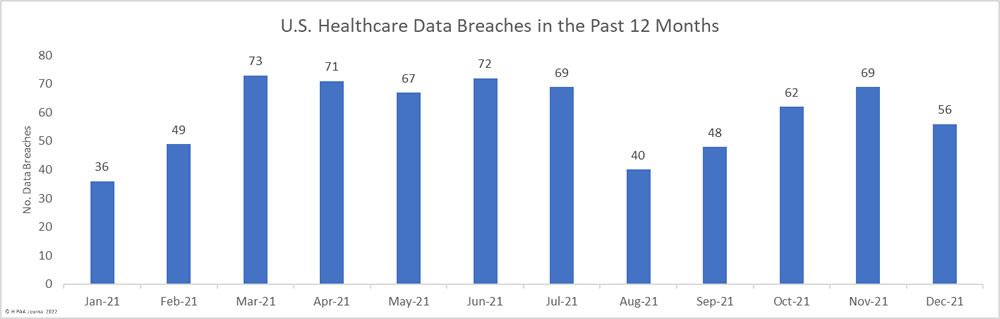
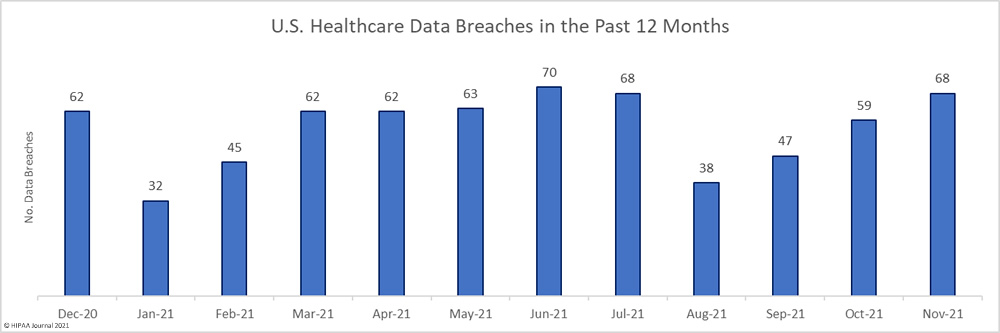
The survey of patients revealed a third had been the victim of a healthcare cyberattack, and while almost half of patients (49%) said they would change healthcare provider if it experienced a ransomware attack, many patients are unaware of the extent of recent cyberattacks and how frequently they are now being reported. In 2018, healthcare data breaches were reported at a rate of 1 per day. In the past year, there have been 7 months when data breaches have been reported at a rate of more than 2 per day.

Despite extensive media reports about healthcare data breaches and vulnerabilities in medical devices, 61% of potential patients said they had not heard about any healthcare cyberattacks in the past two years, clearly showing many patients are unaware of the risk of ransomware and other cyberattacks. However, patients are aware of the impact those attacks may have, with 73% of potential patients understanding a cyberattack could impact the quality of care they receive.

When potential patients were asked about their privacy concerns, 52% said they were worried a cyberattack would shut down hospital operations and would potentially affect patient care, and 37% said they were concerned about the privacy of information accessible through online portals.

There certainly appears to be trust issues, as only 23% of potential patients said they trusted their healthcare provider with their sensitive personal data. By comparison, 30% said they trusted their best friend with that information.

The post Patients Unaware of the Extent of Healthcare Cyberattacks and Data Theft appeared first on HIPAA Journal.

Medical Devices Affected by 13 Siemens Nucleus RTOS TCP/IP Stack Vulnerabilities

13 vulnerabilities have been identified in the Siemens Nucleus RTOS TCP/IP stack that could potentially be exploited remotely by threat actors to achieve arbitrary code execution, conduct a denial-of-service attack, and obtain sensitive information.

The vulnerabilities, dubbed NUCLEUS:13, affect the TCP/IP stack and related FTP and TFTP services of the networking component (Nucleus NET) of the Nucleus Real-Time Operating System (RTOS), which is used in many safety-critical devices. In healthcare, Nucleus is used in medical devices such as anesthesia machines and patient monitors.

One critical vulnerability has been identified that allows remote code execution which has a CVSS v3 severity score of 9.8 out of 10. Ten of the vulnerabilities are rated high severity flaws, with CVSS scores ranging from 7.1 to 8.8. There are also two medium-severity flaws with CVSS scores of 6.5 and 5.3.

The vulnerabilities were identified by security researchers at Forescout Research Labs, with assistance provided by researchers at Medigate.

The vulnerabilities affect the following Nucleus RTOS products:

  • Capital VSTAR: All versions
  • Nucleus NET: All versions
  • Nucleus ReadyStart v3: All versions prior to v2017.02.4
  • Nucleus ReadyStart v4: All versions prior to v4.1.1
  • Nucleus Source Code: All versions

Identifying where vulnerable code has been used is a challenge. The researchers attempted to estimate the impact of the vulnerabilities based on evidence collected from the official nucleus website, the Shodan search engine, and the Forescout device cloud. Healthcare is the worst affected industry, with 2,233 vulnerable devices. 1,066 government devices were identified as vulnerable, with other vulnerable devices found in retail (348), financial (326), manufacturing (317), with 1,176 vulnerable devices found in other industry sectors. 76% of the vulnerable devices are used for building automation, 13% are used in operational technology, 4% for networking, 5% IoT, and 2% were computers running Nucleus.

The vulnerabilities were reported to Siemens under responsible disclosure guidelines and Siemens has made patches available to fix all of the identified vulnerabilities. Siemens said some of the flaws had been identified and addressed in previously released versions, but no CVEs were issued.

Applying patches to fix the vulnerabilities can be a challenge, especially for embedded devices and those of a mission-critical nature, such as devices used in healthcare settings.

If patches cannot be applied, Forescout and Siemens recommend implementing mitigating measures to reduce the potential for exploitation. Siemens recommends protecting network access to devices with appropriate mechanisms and ensuring the devices operate within protected IT environments that have been configured in accordance with Siemens’ operational guidelines.

Forescout has released an open-source script that uses active fingerprinting to detect devices running Nucleus for discovery and inventory purposes. After identifying devices, Forescout recommends enforcing segmentation controls and practicing proper network hygiene, including restricting external communication paths and isolating or containing vulnerable devices in zones until they can be patched.

In addition, all network traffic should be monitored for malicious traffic and progressive patches released by vendors of affected devices should be monitored. A remediation plan should be developed for all vulnerable assets that balances risk with business continuity requirements.

Specific mitigations recommended by Forescout are detailed in the table below:

Nucleus 13 Mitigations recommended by Forescout.

The post Medical Devices Affected by 13 Siemens Nucleus RTOS TCP/IP Stack Vulnerabilities appeared first on HIPAA Journal.

DOJ Indicts 2 REvil Ransomware Gang Members: State Department Now Offering $10 Million Reward for Information

The United States Department of Justice (DoJ) has unsealed indictments charging two individuals for their roles in multiple REvil/Sodinokibi ransomware attacks on organizations in the United States.

Ukrainian national, Yaroslav Vasinskyi, 22, has been indicted on multiple charges related to the ransomware attacks, including the supply chain attack that saw Kaseya’s Virtual System/Server Administrator (VSA) platform compromised. That attack involved ransomware being deployed on the systems of around 40 managed service providers and 1,500 downstream businesses.

Russian national, Yevgeniy Igoryevich Polyanin, 28, has been indicted for his role in multiple ransomware attacks, including attacks on government entities in Texas. The DoJ says it seized $6.1 million in ransom payments that were paid to cryptocurrency wallets linked to Polyanin.

The DoJ has indicted several individuals believed to have been involved in cyberattacks in the United States; however, those individuals can only face trial if they are located, arrested, and extradited to the United States. Many ransomware threat actors are believed to reside in Russia, where there is no extradition treaty, so there is little chance of them facing justice unless they leave Russia.

International arrest warrants have been issued for both individuals and Vasinskyi was arrested in October at the Polish border. Poland signed an extradition treaty with the United States in 1996 and the U.S. is currently seeking Vasinskyi’s extradition. Polyanin has yet to be apprehended.

“Ransomware can cripple a business in a matter of minutes. These two defendants deployed some of the internet’s most virulent code, authored by REvil, to hijack victim computers,” said Acting U.S. Attorney Chad E. Meacham for the Northern District of Texas. “In a matter of months, the Justice Department identified the perpetrators, effected an arrest, and seized a significant sum of money. The Department will delve into the darkest corners of the internet and the furthest reaches of the globe to track down cybercriminals.”

State Department Offers $10 Million Reward for Information on Leaders of REvil and DarkSide Ransomware Operations

Individuals with information about Polyanin, other leaders of the REvil and DarkSide ransomware groups, or affiliates who conducted attacks, are being encouraged to come forward. The U.S. State Department has announced a reward of up to $10 million for information about that leads to the identification or location of leaders of the REvil/DarkSide ransomware groups, with up to $5 million paid for information that leads to the arrest and conviction of any individual who conspired to participate or attempted to participate in a REvil/DarkSide ransomware attacks. The size of the rewards being offered for information clearly shows how focused the United States is on bringing ransomware threat actors to justice.

The pressure being put on ransomware gangs appears to be having some effect. Chris Inglis, U.S. National Cyber Director, recently told House lawmakers that there has been a discernable decrease in Russia-based cyberattacks. and the DoJ says it expects there to be several more arrests in relation to the REvil and DarkSide ransomware attacks in the coming weeks.

Global Law Enforcement Effort Results in Multiple Arrests

The United States is not the only country to be laser-focused on bringing ransomware threat actors to justice. An international law enforcement operation dubbed GoldDust involving 17 nations has recently resulted in the arrest of 7 hackers believed to be involved in the REvil and GandCrab ransomware operations. The Europol, Eurojust, and INTERPOL-coordinated operation saw three individuals arrested in South Korea, two in Romania, one in Kuwait, and one in an unnamed European country, with the latest takedown occurring on November 4 in Romania and Kuwait.

The three individuals in South Korea were previously arrested in February, April, and October for their role in the GandCrab ransomware attacks, which is believed to be the predecessor of REvil/Sodinokibi. The GoldDust operation has been active since 2018 and was launched in response to the GandCrab ransomware attacks.

The previous week, Europol announced 12 individuals had been arrested in raids in Ukraine and Switzerland over their suspected involvement in ransomware attacks involving LockerGoga and other ransomware attacks. Those individuals are believed to have had specialist roles in various stages of the attacks, from infiltration to cashing out and laundering millions in ransom payments.

In September, a French National Gendarmerie, Ukrainian National Police, Europol, and INTERPOL operation resulted in the arrest of 2 individuals suspected to be members of two prolific ransomware operations. That operation also saw $375,000 in cash and luxury vehicles seized, and the asset freezing of $1.3 million in cryptocurrency.

In addition, a 30-month operation, dubbed Operation Cyclone, which involved law enforcement agencies in multiple countries resulted in the arrest of 6 individuals believed to be involved in the Clop ransomware operation, with those arrests occurring in June 2021. The operation saw searches conducted at 20 locations and resulted in the seizure of $185,00 in cash and computer equipment suspected of having been used to conduct the attacks. The Clop ransomware gang had conducted many attacks in the United States, including those on the University of Colorado, Stanford Medicine, University of California, and the University of Maryland Baltimore.

While these arrests will cause some disruption to the activities of ransomware gangs, they represent just a fraction of the individuals involved in ransomware attacks, many of whom can be easily replaced. The core members of the ransomware operations are believed to reside in Russia where they remain untouchable.

The post DOJ Indicts 2 REvil Ransomware Gang Members: State Department Now Offering $10 Million Reward for Information appeared first on HIPAA Journal.

HS3: Cobalt Strike Penetration Testing Framework Increasingly Used in Cyberattacks on Healthcare Organizations

The HHS’ Health Sector Cybersecurity Coordination Center (HC3) has issued a threat brief for the healthcare industry warning about the use of the Cobalt Strike penetration testing tool by cyber threat actors.

Cobalt Strike is a powerful red team tool used by penetration testers when conducting risk and vulnerability assessments, but it can also be abused and is increasingly being used by cyber threat actors in attacks on the healthcare and public health sector.

Cobalt Strike can be used for reconnaissance to gain valuable information about the target infrastructure to allow threat actors to determine the best use of their time when attacking healthcare networks. The system profiler function can be used to discover client-side applications used by a target and provides version information. The system profiler starts a local web server, fingerprints visitors, identifies internal IP addresses behind a proxy, and obtains reconnaissance data from the weblog, applications, and provides information on targets.

Cobalt Strike includes a spear phish tool that can be used to create and send fake emails using arbitrary message templates. If a message is imported, Cobalt Strike will replace links/text and create and send convincing phishing emails and track users that click.

The Beacon tool is used to discover client-side applications and versions and allows the loading of malleable command and control profiles, uses HTTP/HTTPS/DNS to egress a network, and named pipes to control Beacons, peer-to-peer, over SMB for covert communications. Beacon can also be used for post-exploitation and can execute PowerShell scripts, log keystrokes, take screenshots, download files, and spawn other malicious payloads. Cobalt Strike also uses attack packages to allow attacks to progress through their many stages and has the capability to transform innocent files into a Trojan horse.

Cobalt Strike uses browser pivoting, which can be used to bypass 2-factor authentication and access sites as the target. Cookies, authenticated HTTP sessions, and client SSL certifications can be leveraged to hijack a compromised user’s authenticated web sessions. Using the Cobalt Strike team server, attackers can share data, communicate in real-time, and take full control of compromised systems.

Cobalt Strike is a powerful penetration testing tool and since it is an entire framework, it has many more capabilities than most malware variants, which makes it a valuable tool for black hat hackers, and many nation-state hacking groups and cybercriminal organizations have been using Cobalt Strike in attacks on the healthcare sector in the United States.

Given the extent to which the framework is used in cyberattacks, healthcare organizations should work on the assumption that Cobalt Strike will be used in an attack and should therefore focus on prevention and detection strategies and follow the MITRE D3FEND framework.

Cobalt Strike is delivered by many different infection vectors, so defending against attacks can be difficult. There is also no single containment technique that is effective against the framework as a whole.

Cobalt Strike is often delivered via malware downloaders such as BazarLoader, which are often delivered using phishing emails containing malicious Office files. It is therefore important to implement advanced email security defenses that can block phishing threats and provide ongoing security awareness training to the workforce to teach employees to identify malicious messages containing malware downloaders such as BazarLoader.

Threat actors often exploit known vulnerabilities in software and operating systems to gain access to healthcare networks. It is therefore important to ensure a full inventory of devices and software is maintained, and patches or other mitigating measures are implemented to address vulnerabilities promptly. Healthcare organizations should also improve their defenses against attacks abusing their remote access capabilities.

Detecting Cobalt Strike once installed can be a challenge. HC3 recommends using signatures for intrusion detection and endpoint security systems and Yara Rules. Further information can be found in the HC3 Cobalt Strike White Paper.

The post HS3: Cobalt Strike Penetration Testing Framework Increasingly Used in Cyberattacks on Healthcare Organizations appeared first on HIPAA Journal.

3 Medium Severity Vulnerabilities Identified in Philips MRI Solutions

Three medium severity vulnerabilities have been identified in Philips MRI products which, if exploited, could allow an unauthorized individual to run software, modify the device configuration, view and updates files, and export data, including protected health information, to an untrusted environment.

Aguilar found insufficient access controls which fail to restrict access by unauthorized individuals (CVE-2021-3083), the software assigns an owner who is outside the intended control sphere (CVE-2021-3085), and sensitive data is exposed to individuals who should not be provided with access (CVE-2021-3084). Each of the vulnerabilities has been assigned a CVSS V3 base score of 6.2 out of 10.

The vulnerabilities were identified by Secureworks Adversary Group consultant, Michael Aguilar, and affect Philips MRI 1.5T: Version 5.x.x, and MRI 3T: Version 5.x.x. Aguilar reported the flaws to Philips and a patch has been scheduled for release by October 2022. In the meantime, Philips recommends implementing mitigating measures to prevent the vulnerabilities from being exploited.

The mitigations include only operating the Philips MRI machines within authorized specifications, ensuring physical and logical controls are implemented. Only authorized personnel should be allowed to access the vicinity where the MRI machines are located, and all instructions for using the machines provided by Philips should be followed.

Philips has not received any reports of the vulnerabilities being exploited, nor have there been any reports of incidents from the clinical use of the product in relation to the three vulnerabilities.

The post 3 Medium Severity Vulnerabilities Identified in Philips MRI Solutions appeared first on HIPAA Journal.

Chinese APT Group Compromised Healthcare Organizations by Exploiting Zoho Password Management Platform Flaw

An advanced persistent threat (APT) actor has been conducting an espionage campaign that has seen the systems of at least 9 organizations compromised. The campaign targeted organizations in a range of critical sectors, including healthcare, energy, defense, technology, and education.

The campaign was identified by security researchers at Palo Alto Networks and while the identity of the hacking group has yet to be confirmed, the researchers believe the attacks were most likely conducted by the Chinese state-sponsored hacking group APT27, aka Iron Tiger, Emissary Panda, TG-3390, and LuckyMouse based on the use of hacking tools and techniques that match previous APT27 activity.

The campaign exploited a critical vulnerability (CVE-2021-40539) in ManageEngine ADSelfService Plus, an enterprise password management and single sign-on solution developed by Zoho. Successful exploitation of the flaw allows remote attackers to execute arbitrary code and take full control of vulnerable systems.

On September 17, 2021, the U.S. Cybersecurity and Infrastructure Security Agency (CISA) issued a security advisory warning exploits for the flaw were in the public domain and being used by APT actors to install web shells on vulnerable servers to gain persistent access.

Palo Alto Networks said a second campaign was then identified that involved extensive scans for vulnerable servers using leased infrastructure in the United States. Vulnerable systems that had not been patched against the vulnerability started to be attacked from September 22, 2021, with those attacks continuing throughout October.

The attackers deployed a web shell called Godzilla, with a subset of victims also having a new backdoor called NGlite installed. The backdoor or web shell was then used to run commands and move laterally within victims’ environments, with sensitive data exfiltrated from victims’ systems. When the attackers located a domain controller, they installed a new credential-stealing tool dubbed KdcSponge, and harvested credentials and exfiltrated files such as the Active Directory database file (ntds.dit) and the SYSTEM hive from the registry.

Palo Alto Networks said its scans indicate there are currently around 11,000 servers running the Zoho software, although it is unclear how many of them have been patched against the CVE-2021-40539 vulnerability. The researchers said the APT group attempted to compromise at least 370 Zoho ManageEngine servers in the United States alone.

The post Chinese APT Group Compromised Healthcare Organizations by Exploiting Zoho Password Management Platform Flaw appeared first on HIPAA Journal.