Healthcare Cybersecurity

HIPAA Enforcement in 2019

It has been another year of heavy enforcement of HIPAA compliance. HIPAA enforcement in 2019 by the Department of Health and Human Services’ Office for Civil Right (OCR) has resulted in 10 financial penalties. $12,274,000 has been paid to OCR in 2019 to resolve HIPAA violation cases.

2019 saw one civil monetary penalty issued and settlements were reached with 9 entities, one fewer than 2018. In 2019, the average financial penalty was $1,022,833.

HIPAA Enforcement in 2019 by the HHS' Office for Civil Rights


Particularly egregious violations will attract financial penalties, but some of the HIPAA settlements in 2019 provide insights into OCRs preferred method of dealing with noncompliance. Even when HIPAA violations are discovered, OCR prefers to settle cases through voluntary compliance and by providing technical assistance. When technical assistance is provided and covered entities fail to act on OCR’s advice, financial penalties are likely to be issued.

This was made clear in two of the most recent HIPAA enforcement actions. OCR launched compliance investigations into two covered entities after being notified about data breaches. OCR discovered in both cases that HIPAA Rules had been violated. OCR chose to provide technical assistance to both entities rather than issue financial penalties, but the covered entities failed to act on the guidance and a financial penalty was imposed.

Sentara Hospitals disagreed with the guidance provided by OCR and refused to update its breach report to reflect the actual number of patients affected. West Georgia Ambulance was issued with technical guidance and failed to take sufficient steps to address the areas of noncompliance identified by OCR.

If you are told by OCR that your interpretation of HIPAA is incorrect, or are otherwise issued with technical guidance, it pays to act on that guidance quickly. Refusing to take corrective action is a sure-fire way to guarantee a financial penalty, attract negative publicity, and still be required to change policies and procedures in line with the guidance.

There were two important HIPAA enforcement updates in 2019. OCR adopted a new interpretation of the Health Information Technology for Economic and Clinical Health (HITECH) Act’s requirements for HIPAA penalties and a new enforcement initiative was launched.

The HITECH Act of 2009 called for an increase in the penalties for HIPAA violations. On January 25, 2013, the HHS implemented an interim final rule and adopted a new penalty structure. At the time it was thought that there were inconsistencies in the language of the HITECH Act with respect to the penalty amounts. OCR determined that the most logical reading of the HITECH Act requirements was to apply the same maximum penalty of $1,500,000 per violation category, per calendar year to all four penalty tiers.

In April 2019, OCR issued a notice of enforcement discretion regarding the penalties. A review of the language of the HITECH Act led to a reduction in the maximum penalties in three of the four tiers. The maximum penalties for HIPAA violations were changed to $25,000, $100,000, and $250,000 for penalty tiers, 1, 2, and 3. (subject to inflationary increases).

2019 saw the launch of a new HIPAA Right of Access enforcement initiative targeting organizations who were overcharging patients for copies of their medical records and were not providing copies of medical records in a timely manner in the format requested by the patient.

The extent of noncompliance was highlighted by a study conducted by Citizen Health, which found that 51% of healthcare organizations were not fully compliant with the HIPAA Right of Access. Delays providing copies of medical records, refusals to send patients’ PHI to their nominated representatives or their chosen health apps, not providing a copy of medical records in an electronic format, and overcharging for copies of health records are all common HIPAA Right of Access failures.

The two HIPAA Right of Action settlements reached so far under OCR’s enforcement initiative have both resulted in $85,000 fines. With these enforcement actions OCR is sending a clear message to healthcare providers that noncompliance with the HIPAA Right of Access will not be tolerated.

Right of Access violations aside, the same areas of noncompliance continue to attract financial penalties, especially the failure to conduct a comprehensive, organization-wide risk analysis. 2019 also saw an increase in the number of cited violations of the HIPAA Breach Notification Rule.

HIPAA Compliance Issues Cited in 2019 Enforcement Actions

Noncompliance Issue Number of Cases
Risk Analysis 5
Breach Notifications 3
Access Controls 2
Business Associate Agreements 2
HIPAA Right of Access 2
Security Rule Policies and Procedures 2
Device and Media Controls 1
Failure to Respond to a Security Incident 1
Information System Activity Monitoring 1
No Encryption 1
Notices of Privacy Practices 1
Privacy Rule Policies and Procedures 1
Risk Management 1
Security Awareness Training for Employees 1
Social Media Disclosures 1

OCR’s HIPAA enforcement in 2019 also clearly demonstrated that a data breach does not have occurred for a compliance investigation to be launched. OCR investigates all breaches of 500 or more records to determine whether noncompliance contributed to the cause of a breach, but complaints can also result in an investigation and compliance review. That was the case with both enforcement actions under the HIPAA Right of Access initiative.


The post HIPAA Enforcement in 2019 appeared first on HIPAA Journal.
FBI Issues Warning Following Spate of LockerGaga and MegaCortex Ransomware Attacks

The FBI has issued a TLP:Amber alert in response to a spate of cyberattacks involving the ransomware variants LockerGaga and MegaCortex. The threat actors using these ransomware variants have been targeting large enterprises and organizations and typically deploy the ransomware several months after a network has been compromised.

LockerGaga was first detected in January 2019 and MegaCortex ransomware first appeared in May 2019. Both ransomware variants exhibit similar IoCs and have similar C2 infrastructure and are both used in highly targeted attacks on large corporate networks.

LockerGaga was used in the ransomware attacks on the U.S. chemical companies Hexion and Momentive, the aluminum and energy company Norsk Hydro, and the engineering consulting firm, Altran Technologies. MegaCortex ransomware was used in the attacks on the accounting software firm Wolters Kluwer and the cloud hosting firm iNSYNQ, to name but a few. The threat actors are careful, methodical, and attempt to cause maximum damage to increase the probability that their victim’s will pay. The ransom demands are often of the order of hundreds of thousands of dollars or more.

The initial compromise is achieved through a variety of methods including the exploitation of unpatched vulnerabilities, phishing attacks, SQL injection, brute force tactics on RDP, and the use of stolen credentials. Once compromised, the attackers run batch files to stop processes and services used by security solutions to ensure their presence is not detected. The attackers move laterally to compromise as many devices as possible using a penetration testing tool named Cobalt Strike, living-of-the-land Windows binaries, and legitimate software tools such as Mimikatz. A beacon is added to each compromised device on the network, which is used to execute PowerShell scripts, escalate privileges, and spawn a new session to act as a listener on the victim’s system, according to the FBI warning, as reported by Bleeping Computer which obtained a copy of the alert.

In contrast to many other threat actors who deploy ransomware soon after a system is compromised, the threat actors behind these attacks often wait several months before the ransomware encryption routine is triggered. It is unclear what the threat actors do during that time, but it is likely the time is used to steal sensitive data. The ransomware is deployed in the final stage of the attack once all useful data has been obtained from the victims.

The advice offered by the FBI to improve defenses is standard for preventing ransomware and other cyberattacks. Cybersecurity best practices should be followed, including backing up data regularly; storing backup copies on non-networked devices; testing backups to ensure file recovery is possible; setting strong passwords; patching promptly; enabling multi-factor authentication, especially on admin accounts; ensuring RDP servers can only be accessed via a VPN; disabling SMBv1; and to scan for open ports and block them to prevent them from being accessible.

The FBI also recommends auditing the creation of new accounts and monitoring Active Directory for changes to authorized users; enabling PowerShell logging and monitoring for unusual commands, including the execution of Base64 encoded PowerShell; and ensuring only the latest version of PowerShell is installed.

The post FBI Issues Warning Following Spate of LockerGaga and MegaCortex Ransomware Attacks appeared first on HIPAA Journal.

November 2019 Healthcare Data Breach Report

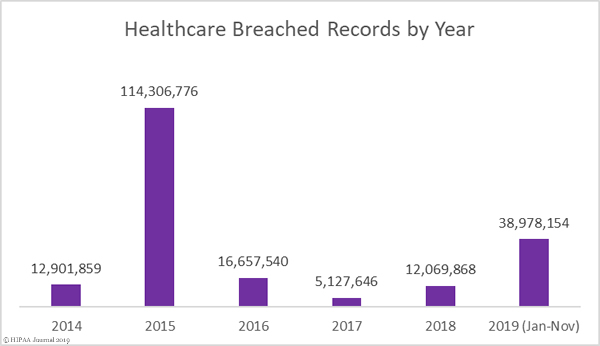
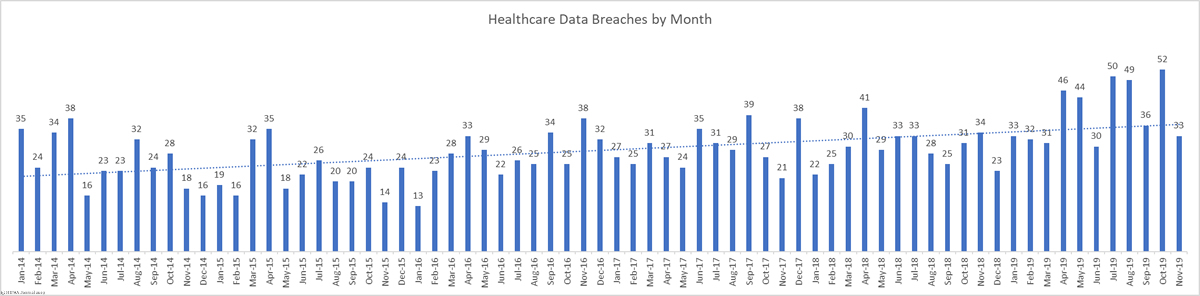
In November 2019, 33 healthcare data breaches of 500 or more records were reported to the Department of Health and Human Services’ Office for Civil Rights (OCR). That represents a 36.5% decrease in reported breaches from October – The worst ever month for healthcare data breaches since OCR started listing breaches on its website in October 2009. The fall in breaches is certainly good news, but data breaches are still occurring at a rate of more than one a day.

600,877 healthcare records were exposed, impermissibly disclosed, or stolen in November. That represents a 9.2% decrease in breached healthcare records from October, but the average breach size increased by 30.1% to 18,208 records in November.

Largest Healthcare Data Breaches in November 2019

Name of Covered Entity Covered Entity Type Individuals Affected Type of Breach Location of Breached PHI
Ivy Rehab Network, Inc. and its affiliated companies Healthcare Provider 125000 Hacking/IT Incident Email
Solara Medical Supplies, LLC Healthcare Provider 114007 Hacking/IT Incident Email
Saint Francis Medical Center Healthcare Provider 107054 Hacking/IT Incident Electronic Medical Record, Network Server
Southeastern Minnesota Oral & Maxillofacial Surgery Healthcare Provider 80000 Hacking/IT Incident Network Server
Elizabeth Family Health Healthcare Provider 28375 Theft Paper/Films
The Brooklyn Hospital Center Healthcare Provider 26312 Hacking/IT Incident Network Server
Utah Valley Eye Center Healthcare Provider 20418 Hacking/IT Incident Desktop Computer
Loudoun Medical Group d/b/a Comprehensive Sleep Care Center (“CSCC”) Healthcare Provider 15575 Hacking/IT Incident Email
Choice Cancer Care Healthcare Provider 14673 Hacking/IT Incident Email
Arizona Dental Insurance Services, Inc. d.b.a. Delta Dental of Arizona Health Plan 12886 Hacking/IT Incident Email

Causes of Healthcare Data Breaches in November 2019

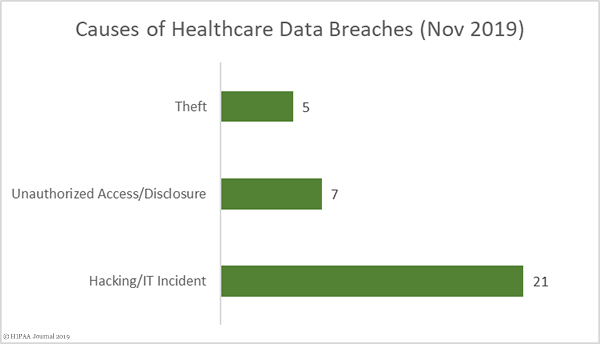
Hacking/IT incidents dominated November’s breach reports and accounted for 63.6% of data breaches reported in November and 90.75% of the breached records (545,293). The average breach size was 25,966 records and the median breach size was 3,977 records.

There were 7 unauthorized access/disclosure breaches reported in November involving 16,586 healthcare records. The mean breach size was 2,369 records and the median breach size was 996 records.

There were 4 incidents involving the theft of 38,998 individuals’ protected health information. Two of the incidents involved electronic devices and two involved paper records. The mean breach size was 7,799 records and the median breach size was 3,237 records.

Phishing continues to be the most common cause of healthcare data breaches. 17 of the healthcare data breaches reported in November involved PHI stored in email accounts. The majority of those breaches were due to phishing attacks.

November 2019 Healthcare Data Breaches by Covered Entity Type

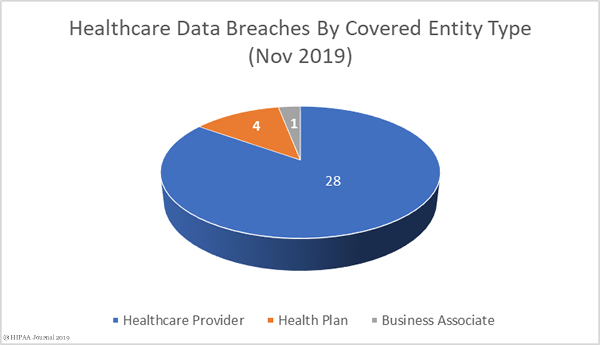
There were 28 healthcare provider data breaches reported in November and four breaches were reported by health plans. It was a good month for business associates, with only one breach reported, although a further two breaches had some business associate involvement.


November 2019 Healthcare Data Breaches by State

Data breaches were reported by covered entities in 19 states. California was the worst affected with 4 breaches, followed by Illinois, Missouri, New York, and Texas with three breaches each. Two breaches were reported by covered entities in Florida, North Carolina, and Pennsylvania, and there was one reported beach in each of Alaska, Arizona, Colorado, Connecticut, Indiana, Maryland, Michigan, Minnesota, Nebraska, Utah, and Virginia.

HIPAA Enforcement in November 2019

There were three financial penalties imposed on HIPAA-covered entities in November to resolve HIPAA violations.

University of Rochester Medical Center (URMC) settled its HIPAA violation case with OCR for $3,000,000. OCR launched an investigation after receiving two notifications about breaches due to lost or stolen devices. OCR investigated URMC in 2010 after the first device was lost and provided technical assistance. At the time, URMC recognized the high risk of storing ePHI on devices and the need for encryption, yet this was not implemented, and unencrypted portable electronic devices continued to be used. When OCR investigated the subsequent theft of a laptop computer, its investigators found URMC had failed to conduct an organization-wide risk analysis, risks had not been reduced to a reasonable and appropriate level, and URMC had not implemented appropriate device media controls.

Sentara Hospitals agreed to settle its HIPAA violation case with OCR for $2,175,000. OCR launched a compliance investigation in response to a complaint from a patient in April 2017. The patient had received a bill from Sentara containing another patient’s protected health information. Sentara Hospitals reported the breach as affecting 8 individuals, but OCR found that 577 letters had been misdirected to 16,342 different guarantors. Sentara Hospitals refused to update its breach report with the new total. OCR also found Sentara Hospitals had failed to enter into a business associate agreement with one of its vendors.

A substantial financial penalty was also imposed on The Texas Department of Aging and Disability Services (DADS). DADS had reported a breach of 6,617 patients’ ePHI to OCR in 2015. An error in a web application allowed ePHI to be accessed over the internet by individuals unauthorized to view the data. ePHI had been exposed for around 8 years. OCR investigated and found that DADS had failed to conduct an organization-wide risk analysis, there was a lack of access controls, and DADS failed to monitor information system activity. DADS settled the HIPAA violation case and paid a penalty of $1.6 million.

The post November 2019 Healthcare Data Breach Report appeared first on HIPAA Journal.

Poor RSA Encryption Implementation Opens Door to Attacks on Medical Devices and Implants

Encryption renders data inaccessible to unauthorized individuals, provided the private key to decrypt data is not compromised and strong encryption is used.

Not all algorithms provide the same level of protection. The strength of encryption relies on the length of the key. The longer the key, the more computational power is required to break the encryption. When strong encryption is used, the computing power and time required to break the encryption renders the data virtually inaccessible.

DES was once considered a strong form of encryption but the computing power now available makes cracking the encryption possible even on relatively inexpensive computers. DES used 56-bit keys, which were fine in the 1970’s, but today the keys are nowhere near long enough. Strong encryption today is generally considered to require 256-bit keys, such as those generated by the AES algorithm. With AES-256, for the time being at least, sensitive data can be adequately secured. Providing the key is not disclosed, encrypted data cannot be accessed.

RSA is an alternative encryption standard that is commonly used to protect sensitive data. It uses an asymmetric cryptographic algorithm using two keys – A private key and a public key. The public key can be given to anyone, as it cannot be used on its own to decrypt data. For that the private key is also required.

The keys are generated by multiplying two random prime numbers. RSA keys are long and cannot easily be guessed or brute forced due to the level of computing power required. However, if errors are made implementing RSA encryption, keys can easily be cracked.

One of the problems that can arise is when RSA keys are not encrypted using truly random prime numbers. Errors in randomness weakens the encryption. A recent analysis of RSA certificates by Keyfactor has shown that in many IoT devices, the factors used to generate the keys are not entirely random, which makes it much easier to deduce the private key.

In such cases, a considerable amount of computing power is still required, but not enough to make cracking the encryption sufficiently difficult. According to Keyfactor, all it would take is around $3,000 of compute time on a single Azure virtual machine to crack these weak keys. At such a low cost, threat actors may find it well worth the investment.

Using a scalable GCD algorithm on their Azure VM, the researchers collected 175 million RSA certificates from the internet. 75 million of those keys were actively used to encrypt traffic and 100 million were publicly available keys. Keyfactor’s analysis identified 435,000 RSA certificates that shared the same factor. That equates to around 1 in 172 RSA certificates. Keyfactor was able to break all 435,000 certificates for less than $3,000 in Azure compute time.

Shared factors are mostly used in lightweight IoT devices. This is because they do not have sufficient entropy to generate truly random numbers as they lack the necessary processing power. The random numbers used are therefore predictable.  Discover the two prime numbers used to generate the key and the private key can be derived.

“Lightweight IoT devices are particularly prone to being in low entropy states due to the lack of input data they might receive, as well as the challenge of incorporating hardware-based random number generation economically,” explained Keyfactor. “Keys generated by lightweight IoT devices are therefore at risk of not being sufficiently random, increasing the chance that two keys share a factor and allow the key to be broken.”

One example they found involved an 8,192-bit RSA key. That key was extremely large, so it should not have been possible to guess it no matter how much time was devoted to the task. Yet guess that key they did. The length of the key was fine, but since the factor used was not entirely random, the length of the key was irrelevant.

A threat actor with the derived private key cannot be distinguished by the genuine private key holder, which opens the door to man-in-the-middle attacks, data tampering, and data theft.

This has major implications for a wide range of industries that use large numbers of IoT devices. Healthcare for example. In healthcare, many medical devices and implants have low entropy, so the encryption could be cracked and data obtained for a relatively small investment.

“The findings are alarming. The research finds inordinate rates of compromise impacting IoT devices with design constraints and limited entropy,” Keyfactor CTO Ted Shorter said. “These devices could include cars, medical implants and other critical devices, that if compromised, could result in life-impacting harm.”

Making existing IoT devices more secure is a major challenge. It may not be possible to patch affected IoT devices and if they lack sufficient processing power, they will remain insecure. The solution is to build sufficient entropy into the devices to ensure truly random factors are used to generate strong RSA keys.

The post Poor RSA Encryption Implementation Opens Door to Attacks on Medical Devices and Implants appeared first on HIPAA Journal.

15 Million Customers Potentially Impacted by Ransomware Attack on Large Canadian Medical Testing Company

A major data breach has been reported by one of Canada’s largest medical testing and diagnostics companies. Toronto-based LifeLabs said hackers have potentially gained access to the personal and health information of up to 15 million customers, most of whom are in British Columbia and Ontario. The number of people potentially affected makes this one of the largest healthcare ransomware attacks to date. The privacy commissioners in both provinces said the scale of the attack “extremely troubling.”

After gaining access to its systems, the attackers deployed ransomware and encrypted an extensive amount of customer data. The cyberattack is still under investigation, so it is unclear what, if any, data has been stolen. It has been confirmed that the attackers gained access to parts of the system that contained the test results of around 85,000 Ontarians. The test results were from 2016 and earlier. No evidence has been found to suggest more recent test results, or medical test results from customers in other areas, have been compromised.

Some of those test results include highly sensitive health information that could potentially be used for blackmail. Other sensitive data potentially accessed includes names, email addresses, health card numbers, dates of birth, usernames, and passwords. To date, it appears that the compromised information has not been misused and the data does not appear to have been disclosed online. Based on the initial findings of the investigation, the risk to customers is believed to be low.

It is unclear whether LifeLabs had viable backups to restore the data, but the decision was taken to pay the ransom. The amount of the ransom has not been publicly disclosed. “We wanted to get the data back,” said LifeLabs chief executive Charles Brown. “We thought it was the smart thing to do because it was just in the best interests of our customers.”

Cybersecurity and computer forensics experts were engaged to secure its systems and determine the full scope of the attack. It may take some time to discover whether any customer data has been stolen by the attackers.

The attack is believed to have started on or before November 1, 2019, but the cyberattack was only disclosed to the public on December 17, 2019. Affected individuals are now being notified and have been offered one year of complimentary credit monitoring and identity theft protection services.

The post 15 Million Customers Potentially Impacted by Ransomware Attack on Large Canadian Medical Testing Company appeared first on HIPAA Journal.

Blue Cross Blue Shield of Minnesota Starts Correcting 200,000 Critical and Severe Vulnerabilities

Blue Cross Blue Shield of Minnesota, the largest health insurer in the state, is now taking steps to fix around 200,000 unaddressed vulnerabilities on its servers that, in some cases, are more than a decade old.

In August 2018, Tom Yardic, a cybersecurity engineer at BCBS Minnesota discovered patches were not being applied on its servers, even though the vulnerabilities were rated critical or severe. The engineer met with executives at BCBS Minnesota to raise the alarm, yet no action appeared to be taken.

Around a month later, Yardic alerted the BCBS Minnesota board of trustees as a last resort to get action taken to address the flaws, according to a recent report in the Star Tribune.

According to the newspaper report, evidence was obtained that revealed vulnerabilities had not been addressed for many years. There were around 200,000 critical or severe vulnerabilities that had not been addressed on approximately 2,000 servers. Around 44% of the vulnerabilities were more than 3 years old and approximately 12% of the flaws dated back 10 or more years.

Approximately 3.9 million individuals are insured by BCBS Minnesota. The failure to correct the vulnerabilities in a reasonable time frame has placed their sensitive information at risk.

The Star Tribune spoke with officials at BCBS Minnesota who confirmed that work is now underway to correct the flaws and said it is trying to correct as many of the flaws as possible before the end of the year. According to the Star Tribune, “Minnesota Blue Cross did not dispute the accuracy of the number of past vulnerabilities” and said that the number of unaddressed vulnerabilities is now far lower and is much lower on workstations.

It is not surprising that a cybersecurity engineer has taken steps to get the flaws corrected. It is surprising that it took so long, especially following the cyberattacks on Anthem Inc., Premera Blue Cross, and Excellus BCBS in 2015 that resulted in the theft of the protected health information of more than 99.8 million Americans.

Surprisingly, given the sheer number of unaddressed vulnerabilities, BCBS Minnesota has never reported a data breach of its own systems since the HHS Office for Civil Rights started publishing summaries of data breaches on its breach portal in 2009.

The post Blue Cross Blue Shield of Minnesota Starts Correcting 200,000 Critical and Severe Vulnerabilities appeared first on HIPAA Journal.

Rep. Jayapal Seeks Answers from Google and Alphabet on Ascension Partnership

Pressure is continuing to be applied on Google and its parent company Alphabet to disclose information about how the protected health information (PHI) of patients of Ascension will be used, and the measures put in place to ensure PHI is secured and protected against unauthorized access.

The partnership between Google and Ascension was announced on November 11, 2019 following the publication of a story in the Wall Street Journal. A whistleblower at Google had shared information with the WSJ and expressed concern that millions of healthcare records had been shared with Google without first obtaining consent from patients. It was also alleged that Google employees could freely download PHI.

In its announcement, Google stated that the collaboration – named Project Nightingale – involved migrating Ascension’s infrastructure to the cloud and that it was helping Ascension implement G Suite tools to improve productivity and efficiency. Patient data was also being provided to Google to help develop AI and machine learning technologies to improve patient safety and clinical quality. When the migration of data has been completed, Google will have access to the health data of around 50 million patients.

Google has confirmed it is a business associate of Ascension and has signed a business associate agreement and is fully compliant with HIPAA regulations, but many privacy advocates are concerned about the partnership. Several members of Congress have also expressed concern and are seeking answers about the safeguards that have been put in place to secure patient data and how patient data will be used. The HHS’ Office for Civil Rights has also confirmed it is investigating Google and Ascension to make sure HIPAA Rules have not been violated.

Earlier this month, Rep. Pramila Jayapal (D-Washington), a member of the House Judiciary Subcommittee on Antitrust, Commercial, and Administrative Law, wrote to Google and Alphabet expressing concern about the partnership. She has demanded answers to several questions about how protected health information has been obtained, the measures put in place to protect patient data, and how Google will be using the PHI.

“As Google and parent company Alphabet have engaged in an ever-widening acquisition of the highly personal health-related information of millions of people, Americans now face the prospect of having their sensitive health information handled by corporations who may misuse it,” wrote Rep. Jayapal in her Dec 6, 2019 letter. “I am especially concerned that your company has not provided sufficient assurances that this sensitive data will be kept safe, and that patients’ data is being acquired by your companies without their consent and without any opt-out provision.”

Rep. Jayapal is particularly concerned about how that information will be used. Google is amassing huge quantities of healthcare data from several sources. Google’s healthcare-focused AI unit, Medical Brain, is actively acquiring health data, Alphabet has partnered with the Mayo Clinic, and Google has acquired the UK startup, DeepMind. NHS data has already been provided to Google. Google is also looking to acquire Fitbit, which holds health-related data on 25 million users of its wearable devices.

“The fact that Google makes the vast majority of its revenue through behavioral online advertising—creating an incentive to commoditize all user information—renders the company’s expansion into health services all the more troubling,” wrote Rep. Jayapal.

Rep. Jayapal also pointed out that Google does not have a blemish-free track record when it comes to protecting health and medical information, referencing one incident in which chest X-ray images from the National Institute of Health were almost posted online before Google realized they contained personally identifiable information. She also stated there is an active lawsuit that claims Google companies have obtained patient information from a major medical facility and DeepMind was found to have violated the Data Protection Act in the UK by using patient data to develop new apps.

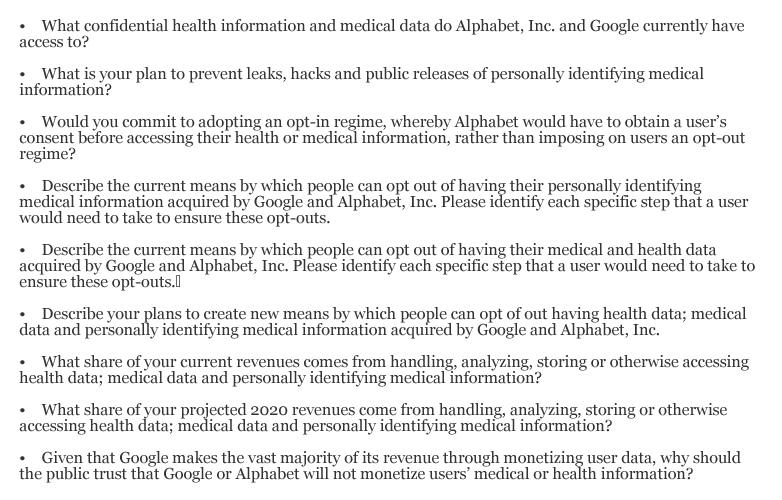
Rep. Jayapal has given Google and Alphabet until January 5, 2020 to answer her questions, as detailed below:

The post Rep. Jayapal Seeks Answers from Google and Alphabet on Ascension Partnership appeared first on HIPAA Journal.

SpamTitan Top Rated AntiSpam Solution on Business Software Review Sites

The 2018 Verizon Data Breach Investigations Report showed phishing to be the primary method used by cybercriminals to infect healthcare networks with malware and steal financial information. Email was the attack vector in 96% of healthcare data breaches according to the report.

All it takes is for one employee to respond to a phishing email for a data breach to occur, so it is essential for a powerful email security solution to be deployed that will catch phishing emails, malware, ransomware, and other email-based threats.

Email security solutions can vary considerably from company to company. Some may be excellent at blocking email threats but can be difficult to use, others may fall short at detecting zero-day threats, and some fail to block many spam and phishing emails. All of the companies offering email security solutions claim that their products provide excellent protection, so selecting the best solution for your organization can be a challenge. Making the wrong decision can be a costly mistake.

When choosing an email security solution, third party review sites are a godsend and can save you a lot of time in your search. Well respected business software review sites allow verified users of software solutions to provide their feedback on products and let other businesses know which are easy to implement, easiest to use, which are most effective at blocking threats and which companies provide great support when help is required.

It pays to check several different review sites to find the top-rated email security solutions by end users. Our search has highlighted one solution that is consistently rated highly across the leading review platforms: SpamTitan from TitanHQ.

Listed below are some of the many positive reviews from users of SpamTitan Email Security across the top review platforms:

G2 Crowd

G2 Crowd is the largest tech marketplace for business software. The site is used by IT decision makers to learn more about software solutions to help them realize their potential and protect their networks from the full range of cybersecurity threats.

On the G2 Crowd platform, SpamTitan is the top-rated email security solution with scores of 9.0 out of 10 for ease of admin, 9.1 for ease of use, 9.2 for ease of setup and quality of support, and 9.3 for ease of doing business with and meets requirements. The scores are based on 139 reviews from verified users. Across all reviews, SpamTitan achieved a score of 4.6 out of 5.

“I really like the customization that is available for this product. We have total control over the spam filter environment for all our customers. The environment is stable which is very important to us and our customers. The support staff was great when we were getting our environment configured. They were quick to reply to emails and reach out to assist us as needed. The spam filtering is top-notch and much better than other products we have used,” said Jeff Banks, Director of Technology.

Gartner Peer Insights

Gartner Peer Insights is a peer review site that is rigorously vetted by the leading research and advisory company, Gartner.  Gartner provides impartial advice on the top software solutions without bias and with no hidden agenda. Gartner Peer Insights just contains real reviews from real business IT users.

SpamTitan has been rated by 112 users and achieved an average review score of 4.9 out of 5.

“TitanHQ claims that SpamTitan “blocks 99.9% of spam, viruses, and other threats that come through” and I can’t argue against it. It’s been running on my machines for a couple of years now and works very well. Rarely does anything useless go through to my inbox.” Information Technology Specialist, Healthcare Industry.

Capterra

Capterra is an online marketplace vendor founded in 1999 and bought by Gartner in 2015. Capterra serves as an intermediary between software buyers and sellers and is one of the leading sites where decision makers can find out more about software solutions from verified users.

There are 379 reviews of SpamTitan on Capterra. SpamTitan received an overall score of 4.6 out of 5 with individual scores of 4.4 for ease of use, 4.4 for features, 4.5 for value for money, and 4.6 for customer service.

“Overall, we are very happy with the product and the customer support. We did have to put some time into this product but now we have a custom-fit solution, with fault-tolerance (two servers at two locations, both locations have both internet and private WAN access to the Exchange server) and we’re saving thousands of dollars versus the managed solution we used to use. We can tighten things up if we wish, we have a lot of flexibility with this product. I rate it an excellent value. So much power, flexibility and fault-tolerance, for so little money.” Mike D Shields, Director of IT and Telecom.

“It’s as close to “set it and forget it” as you can come in the IT field. Right out of the box support helped me set everything up in less than 20 minutes, no hardware to worry about, nothing like that. Literally all I have to do is check to see if something was blocked incorrectly once in a while, white list it, and done. I’ve been using spam titan for almost a year and in that time we have blocked over 200k spam/malicious emails for a 30 person company before they even hit employee mailboxes. I shut off the service for 48 hours just to make sure it easy legit, it was, and I haven’t shut it off again since.” Benjamin Jones, Director Of Information Technology

Google Reviews

112 business users of SpamTitan have submitted reviews of SpamTitan to Google. The email security solution achieved an average score of 4.9 out of 5.

“The Titan Spam filter is by far one of the best email filters I have ever used. It was simple to setup, it allows users to release their own emails from quarantine quick and easy. Thank you for making such a great quality product, and for having excellent technical support.” Joseph Walsh.

“Great product. Spam reduced to almost zero and no user complaints. Configuration is simple and support is awesome. Love it!” George Homme

Software Advice

379 users have left reviews of SpamTitan on the business software review site, Software Advice.  The solution achieved an average score of 4.58 out of 5

“Our previous product was not stable and didn’t filter out spam as well as we wanted. This tool exceeds out expectations!” Jeff, CatchMark Technologies.

Spiceworks

Spiceworks is a professional network specifically for the information technology, providing educational content, product reviews, and feedback from software users. Members of the Spiceworks community similarly rate SpamTitan very highly. The solution has been reviewed by 56 members and has achieved an average score of 4.6 out of 5.

SpamTitan is also the top-rated email security solution on SpamTitanReviews, with a score of 4.9 out of 5.

The post SpamTitan Top Rated AntiSpam Solution on Business Software Review Sites appeared first on HIPAA Journal.

MSPs and Healthcare Organizations Targeted with New Zeppelin Ransomware Variant

A new ransomware variant is being used in targeted attacks on managed service providers, technology, and healthcare firms, according to security researchers at Blackberry Cylance.

Attacks are being conducted on carefully selected, high profile targets using a new variant of VegaLocker/Buran ransomware named Zeppelin. VegaLocker has been around since early 2019 and all variants from this family have been used to attack companies in Russian speaking countries.

The campaigns were broad and used malvertising to direct users to websites hosting the ransomware. The latest variant is being used in a distinctly different campaign that is much more targeted. Attacks have only been detected on companies in Europe, the United States, and Canada so far. If the ransomware is downloaded onto a device in the Russian Federation, Ukraine, Belorussia, or Kazakhstan, the ransomware exits and does not encrypt files.

Ransomware variants from the VegaLocker family have all been offered as ransomware-as-a-service and there are indications that the same is true of Zeppelin ransomware, although the Blackberry Cylance researchers believe different threat actors are responsible for the attacks. There have only been a small number of attacks so far, so this could indicate a limited number of individuals are conducting attacks and targets are being selected carefully.

Zeppelin ransomware is highly customizable and can be deployed as an EXE or DLL file. Samples have also been found that are wrapped in PowerShell loaders. The ransom notes are also customizable and can be changed to suit different campaigns. Several have been detected that incorporate the name of the company being attacked, further demonstrating the highly targeted nature of the campaign.

Attacks have been conducted on multiple tech and health firms as well as managed service providers. Attacks on the latter see MSP files encrypted, and through their remote administration tools, the ransomware is deployed on the systems of their clients. Attacks on service providers are becoming far more common and several threat actors have adopted this tactic, including those behind Ryuk and Sodinokibi ransomware.

Zeppelin ransomware incorporates several layers of obfuscation to evade security solutions, including the use of encrypted strings, pseudo-random keys, and code of different sizes. The encryption routine can also be delayed avoid detection by heuristic analyses and fool sandboxes. The ransomware can also stop backup services and delete backup files and shadow copies to hamper recovery without paying the ransom.

After encryption the original file name and extension are retained. File tags are used that include the word Zeppelin. The encryption routine uses symmetric file encryption with randomly generated keys for each file, (AES-256 in CBC mode) along with asymmetric encryption for the session key, using a custom RSA implementation.

Some ransomware samples obtained by Blackberry Cylance researchers only encrypt the first 1000 bytes of a file. This is sufficient to render the files unusable but also speeds up the file encryption process so there is less chance of the attack being detected and stopped before file encryption has been completed.

As is common in these targeted attacks, a ransom note is dropped that provides email addresses for the victims to make contact with the attackers. This allows the attackers to set ransom payments on the perceived ability of the victim to pay.

It is unclear what methods are being used to distribute Zeppelin ransomware. The researchers have found a sample on water-holed websites, with the ransomware payload hosted on Pastebin but several distribution methods may be used.

Protecting against attacks requires a combination of security solutions and the adoption of cybersecurity best practices. Block open ports, change all default passwords, disable RDP if possible, use an advanced spam filtering solution, apply patches promptly, and keep operating systems and software up to date. Ensure staff are trained and are following security best practices and make sure backups are regularly created and tested to make sure file recovery is possible. It is also essential for one backup copy to be stored securely on a device that is not connected to the network.

The post MSPs and Healthcare Organizations Targeted with New Zeppelin Ransomware Variant appeared first on HIPAA Journal.