HIPAA Breach News

13 Accounts Compromised in Roper St. Francis Healthcare Phishing Attack

A large-scale phishing attack on Charleston, SC-based Roper St. Francis Healthcare has seen attackers gain access to the email accounts of 13 employees.

The phishing attack was detected on November 30, 2018 and action was taken to block access to a corporate email account. The investigation into the breach revealed further email accounts had been compromised. The affected accounts were accessed by the attacker between November 15 and December 1, 2018.

A third-party computer forensics firm was hired to investigate the breach, which revealed some of the compromised accounts contained patient information including names, medical record numbers, health insurance information, details about services received from Roper St. Francis Healthcare, and for a limited number of patients, Social Security numbers and financial information.

All affected patients were notified by mail on January 25, 2019 and have been offered complimentary credit monitoring services. While PHI was potentially accessed, no reports have been received to suggest any PHI has been misused.

The incident has yet to appear on the HHS’ Office for Civil Rights breach portal. It is currently unclear exactly how many patients have been affected.

Minnesota Department of Human Services Phishing Attack Impacts 3,000 Minnesotans

Minnesota Department of Human Services Commissioner Tony Lourey has announced that the email account of a county worker has been compromised as a result of a response to a phishing email.

The account was accessed by the attacker in September 2018. The account was used to send further phishing emails to the employee’s contacts.

An analysis of the compromised account revealed it included information such as names, phone numbers, email addresses, dates of birth, and information about child protection services. In total, the personal information of approximately 3,000 individuals was potentially compromised. 30 individuals also had their Social Security number, driver’s license number and/or financial information exposed.

The phishing attack was detected the following day and remote access to the account was blocked. The delay in issuing notifications was due to the time taken to analyze the emails in the account.

Since the attack occurred, a new tool has been deployed to block phishing emails and employees have received additional training.

The post 13 Accounts Compromised in Roper St. Francis Healthcare Phishing Attack appeared first on HIPAA Journal.

Aetna Settles HIV Status Breach Case with California AG for $935,000

Hartford, CT-based health insurer Aetna has agreed to pay the California Attorney General $935,000 to resolve alleged violations of state laws related to a 2017 privacy violation that exposed state residents’ HIV status.

On July 28, 2017, Aetna’s mailing vendor sent letters to plan members who were receiving HIV medications or pre-exposure prophylaxis to prevent them from contracting HIV. The letters contained instructions for their HIV medications; however, information about the HIV medications was clearly visible through the window of the envelopes, resulting in the impermissible disclosure of highly sensitive information to postal workers, friends, family members, and roommates.  Approximately 12,000 individuals were sent letter, 1,991 of whom lived in California.

The privacy breach was a violation of HIPAA Rules, and according to California Attorney General Xavier Becerra, also a violation of several California laws including the Unfair Competition Law, the Confidentiality of Medical Information Act, the Health and Safety Code (section 120980), and the State Constitution.

In addition to the financial penalty, the settlement agreement requires Aetna to designate an employee to implement and maintain its mailing program, oversee compliance with state and federal laws, and the management of external vendors to ensure they handle medical data in compliance with state and federal laws and Aetna’s policies and procedures. Aetna is also required to complete an annual privacy risk assessment to evaluate compliance with the terms of the settlement for the next three years.

“A person’s HIV status is incredibly sensitive information and protecting that information must be a top priority for the entire healthcare industry,” said Attorney General Bercerra. “Aetna violated the public’s trust by revealing patients’ private and personal medical information.”

The privacy violation has proven expensive for Aetna. In January 2018, Aetna settled a class action lawsuit filed on behalf of victims of the breach for $17,161,200. Also in January, Aetna agreed to pay the New York Attorney General $1,150,000 to settle its case and resolve alleged HIPAA violations and breaches of state law.

A further $640,170.59 was paid to settle a multi-state action by Attorneys General in New Jersey, Connecticut, Washington, and the District of Columbia. The latest settlement brings the total financial penalties issued to date in relation to the breach to $2,725,170.59.

The post Aetna Settles HIV Status Breach Case with California AG for $935,000 appeared first on HIPAA Journal.

FABEN Obstetrics and Gynecology Informs 6,092 Patients of Ransomware-Related Data Loss

Jacksonville, FL-based FABEN Obstetrics and Gynecology has experienced a ransomware attack which saw files encrypted on a server that housed patients’ protected health information (PHI).

The ransomware was detected on November 21, 2018 and resulted in widespread file encryption. An investigation was launched to determine the extent of the attack and whether any patients’ PHI was accessed or stolen by the attackers.

An analysis of the files on the server confirmed that files containing patients’ PHI had been encrypted. FABEN determined that the attackers had not accessed the files and that no data had been exfiltrated from the server.

The ransomware variant used in the attack was GandCrab. While free decryptors have been made available for some GandCrab ransomware variants, they do not work on the latest versions of the ransomware. A ransom demand was received by FABEN although the decision was taken not to pay the attackers for the key to decrypt the files.

The files that had been encrypted were created between January 2007 and April 10, 2017, and included clinical electronic medical records containing names, diagnosis information, treatment information, and other information related to medical services provided to patients, including visit dates, labor and delivery information.

FABEN reports that it was only possible to restore files that had been created between 2007 and April 2014. There was a problem recovering records from between September 11, 2014 and April 10, 2017. Those files have been permanently lost.

They included information such as names, blood sugar logs, blood pressure logs, medical records provided to FABEN by patients in paper form during the above time period, and documentation related to the Family and Medical Leave Act.

“Since the infected files were encrypted but not exfiltrated, there is no increased risk of identity theft, nor is there an increased risk that a third party may view your protected health information at this time as a result of the ransomware attack,” wrote FABEN in substitute breach notice uploaded to the FABEN website. Only patients whose information was unrecoverable are receiving breach notification letters.

The ransomware attack has been reported to law enforcement and the HHS’ Office for Civil Rights. The investigation into the attack is ongoing. FABEN is attempting to determine exactly how the ransomware was installed, the source of the attack, and its ultimate extent.

Private security consultants have been hired to assess security and additional security procedures have already been implemented. FABEN is also using additional backup servers to prevent further data loss, should another attack occur in the future.

The post FABEN Obstetrics and Gynecology Informs 6,092 Patients of Ransomware-Related Data Loss appeared first on HIPAA Journal.

Thieves Stole Devices Containing PHI of 7,200 Patients of Integrity House

A burglary at the offices of the addiction treatment services provider Integrity House has resulted in the exposure of patients’ protected health information.

Several electronic devices were stolen in the burglary, including desktop computers, laptop computers and tablets. An investigation by the Integrity House IT team confirmed that some patients’ protected health information was stored on the devices.

The burglary was discovered by staff on November 25, 2018. Law enforcement was notified but the stolen devices have not been recovered. The IT department determined that one of the stolen devices contained information such as names, birth dates, Social Security numbers, health insurance information, and a limited amount of treatment information.

While it is probable that the devices were stolen for their resale value rather than any sensitive information they contained, it is possible that patient information could be accessed and may be misused. Consequently, as a precaution, Integrity House has offered all affected individuals free identity theft protection and credit monitoring services.

The burglary has prompted Integrity House to implement additional safeguards to prevent further incidents of this nature from occurring and has taken steps to improve privacy protections for patients. These include augmenting physical security in all facilities, strengthening passwords, implementing additional policies concerning the handling of personal information, and the use of encryption on all hard drives.

“The privacy and protection of personal information is a top priority for Integrity House and we sincerely apologize for any concern or inconvenience that this may cause,” wrote Integrity House in its substitute breach notice.

All individuals affected by the breach have now been notified by mail and the incident has been reported to the Department of Health and Human Services’ Office for Civil Rights.

The breach summary on the OCR website indicates the PHI of 7,206 individuals was stored on the stolen devices.

The post Thieves Stole Devices Containing PHI of 7,200 Patients of Integrity House appeared first on HIPAA Journal.

PHI Exposed in Verity Health System Phishing Attack

Verity Health System, a Redwood City-based network of 6 hospitals in California, has announced that the protected health information of certain patients has potentially been compromised as a result of a November 27, 2018 phishing attack.

The Office 365 credentials of a Verity Health employee were obtained by a hacker as a result of a response to a phishing email. For a period of approximately one and a half hours, an unauthorized individual gained access to the employee’s email account and sent further phishing emails to Verity Health employees and other individuals in the employee’s contact list. The emails contained a hyperlink that directed the recipients to a malicious website. An investigation into the breach confirmed that none of the recipients of the phishing emails had disclosed their login credentials.

The aim of the attacker appeared to be to gain access to further account credentials rather than to obtain sensitive data contained in the compromised account; however, it is possible that some patients’ personal information was viewed or possibly obtained while account access was possible. Fortunately, fast detection and remediation of the security breach reduced the potential for information theft.

An analysis of the emails and email attachments in the account confirmed that they contained some protected health information, but it was not possible to determine whether any of the emails had been opened or copied. No messages in the account were forwarded to other email addresses and no reports have been received to suggest any patient information has been obtained and misused.

Patients whose protected health information has potentially been compromised have now been informed of the breach by mail. The breach notification letters state that the types of information contained in the account included names, phone numbers, addresses, dates of birth, Social Security numbers, dates of service, treatment information, medical conditions, billing codes, lab test results, health plan names and health insurance policy numbers, patient ID numbers, subscriber numbers, claims information, and information relating to payment for medical care.

Upon discovery of the breach, the email account was disabled and the user’s computer was disconnected from the network. All unauthorized emails sent through the compromised account were deleted from the email system and email recipients who had clicked the link in the email also had their email accounts disabled as a precaution.

All users who clicked the link in the phishing emails have received further training and a new training module has been developed for all employees to raise awareness of the threat from phishing. A project has also been created and launched to enhance email security, which includes disabling all unknown URLs sent via email.

While the risk of identity theft and fraud is believed to be low, all individuals affected by the breach have been offered one year of identity theft and credit monitoring services without charge.

The breach has been reported to the California Attorney General’s Office and other relevant authorities. The incident has yet to appear on the HHS’ Office for Civil Rights breach portal so it is currently unclear exactly how many individuals have been affected by the breach.

The post PHI Exposed in Verity Health System Phishing Attack appeared first on HIPAA Journal.

Analysis of 2018 Healthcare Data Breaches

Our 2018 healthcare data breach report reveals healthcare data breach trends, details the main causes of 2018 healthcare data breaches, the largest healthcare data breaches of the year, and 2018 healthcare data breach fines. The report was compiled using data from the Department of Health and Human Services’ Office for Civil Rights (OCR).

2018 Was a Record-Breaking Year for Healthcare Data Breaches

Since October 2009, the Department of Health and Human Services’ Office for Civil Rights has been publishing summaries of U.S. healthcare data breaches. In that time frame, 2,545 healthcare data breaches have been reported. Those breaches have resulted in the theft, exposure, or impermissible disclosure of 194,853,404 healthcare records. That equates to the records of 59.8% of the population of the United States.

The number of reported healthcare data breaches has been steadily increasing each year. Except for 2015, the number of reported healthcare data breaches has increased every year.

Healthcare data breaches 2009-2018

In 2018, 365 healthcare data breaches were reported, up almost 2% from the 358 data breaches reported in 2017 and 83% more breaches that 2010.

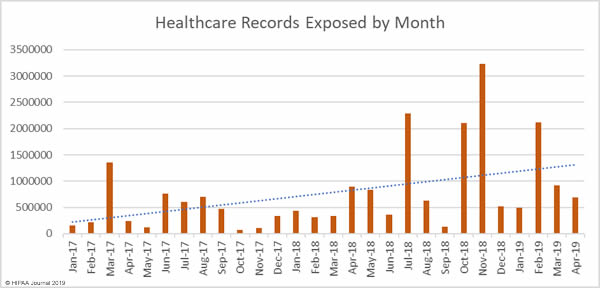
2018 was the worst year in terms of the number of breaches experienced, but the fourth worst in terms of the number of healthcare records exposed, behind 2015, 2014, and 2016. The last two years have certainly seen an improvement in that sense, although 2018 saw a 157.67% year-over-year increase in the number of compromised healthcare records.

healthcare records exposed 2009-2018

2018 Healthcare Data Breaches by Month

Healthcare data breaches in 2018 by month

Healthcare Records Exposed Each Month in 2018

records exposed in healthcare data breaches in 2018 by month

Largest 2018 Healthcare Data Breaches

Rank Name of Covered Entity Covered Entity Type Individuals Affected Type of Breach
1  AccuDoc Solutions, Inc. Business Associate 2,652,537 Hacking/IT Incident
2 Iowa Health System d/b/a UnityPoint Health Business Associate 1,421,107 Hacking/IT Incident
3 Employees Retirement System of Texas Health Plan 1,248,263 Unauthorized Access/Disclosure
4 CA Department of Developmental Services Health Plan 582,174 Theft
5 MSK Group Healthcare Provider 566,236 Hacking/IT Incident
6 CNO Financial Group, Inc. Health Plan 566,217 Unauthorized Access/Disclosure
7 LifeBridge Health, Inc Healthcare Provider 538,127 Hacking/IT Incident
8 Health Management Concepts, Inc. Business Associate 502,416 Hacking/IT Incident
9 AU Medical Center, INC Healthcare Provider 417,000 Hacking/IT Incident
10 SSM Health St. Mary’s Hospital – Jefferson City Healthcare Provider 301,000 Improper Disposal

Click for further information on the largest healthcare data breaches of 2018.

Causes of 2018 Healthcare Data Breaches

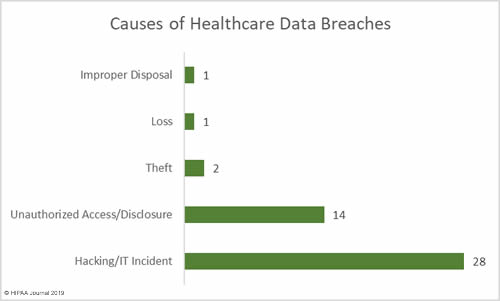
The biggest causes of healthcare data breaches in 2018 were hacking/IT incidents (43.29%) and unauthorized access/disclosures (39.18%), which together accounted for 82.47% of all data breaches reported in 2018. There were 42 theft incidents (11.5%) reported in 2018, 13 cases (3.56%) of lost PHI/ePHI, and 9 cases (2.47%) of improper disposal of PHI/ePHI.

Causes of 2018 Healthcare Data Breaches

There was a 5.33% annual increase in hacking/IT incidents – 158 breaches compared to 150 in 2017. While the number of hacking/IT-related breaches rose only slightly, the breaches were far more damaging in 2018 and resulted in the theft/exposure of 161.89% more healthcare records. The mean breach size of hacking/IT incidents in 2017 was 23,218 records and in 2018 it rose to 57,727 records in 2018 – A year-over-year increase of 148.63%.

2018 saw an even larger increase in unauthorized access/disclosure incidents. 14.4% more incidents were reported in 2018 than 2017 and 146.49% more healthcare records were exposed in unauthorized access/disclosure incidents than the previous year. The mean breach size of unauthorized access/disclosure incidents in 2017 was 9,893 records and 21,316 records in 2018 – An increase of 115.47%.

Loss, theft, and improper disposal incidents all declined in 2018. Loss incidents fell from 16 to 13 year-over-year (-18.75%), improper disposal incidents fell from 11 to 9 (-18.18%), and theft incidents fell from 56 in 2017 to 42 in 2018 (-25%).

While there was a reduction in the number of cases of theft and improper disposal year-over-year, the severity of those two types of breaches increased in 2018. The mean breach size of theft incidents rose from 6,908 records in 2017 to 16,605 records in 2018 – A rise of 140.37%. Improper disposal incidents increased from a mean of 2,802 records in 2017 to 37,794 records in 2018 – A rise of 1,248.82%.

There was a slight reduction in the severity of loss incidents, which fell from an average of 2,461 records in 2017 to 2,305 – A fall of 6.33%.

records exposed by breach cause

Location of Breached Protected Health Information

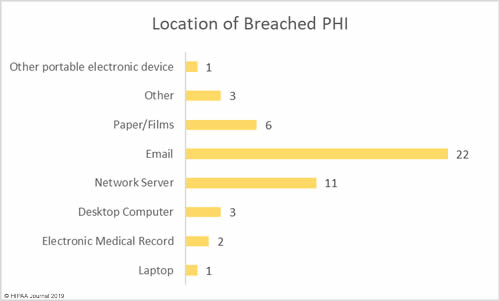
The breakdown of 2018 healthcare data breaches by the location of breached PHI highlights the importance of increasing email security and providing further training to healthcare employees. 33.42% of all healthcare data breaches in 2018 involved email. Those breaches include phishing attacks, other unauthorized email access incidents and misdirected emails.
While healthcare organizations may be focused on preventing cyberattacks and improving technical defenses, care must still be taken with physical records. There were 81 breaches of physical PHI such as charts, documents, and films in 2018. Paper/films were involved in 22.19% of breaches.

The next most common location of breached PHI was network servers, which were involved in 20.27% of breaches in 2018. These incidents include hacks, ransomware attacks, and malware-related breaches.

Location of Breached Protected Health Information

2018 Healthcare Data Breaches by Covered Entity Type

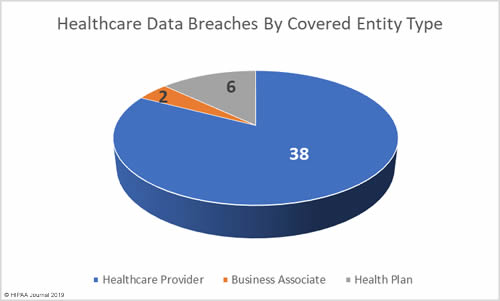
Given the relative percentages of healthcare providers to health plans, it is no surprise that more healthcare provider data breaches occurred. 74.79% of the year’s breaches affected healthcare providers, 14.52% occurred at health plans, and 10.68% affected business associates of HIPAA-covered entities.

2018 Healthcare Data Breaches by Covered Entity

Business associate data breaches were the most severe, accounting for 42% of all exposed/stolen records in 2018, followed by healthcare provider breaches and breaches at health plans.  The mean breach size for business associate data breaches was 140,915 records, 53,471 records for health plan data breaches, and 17,974 records for healthcare provider data breaches.

2018 Healthcare Data Breaches by Covered Entity (records)

States Worst Affected By 2018 Healthcare Data Breaches

Being the two most populated states, it is no surprise that California and Texas were the worst affected by healthcare data breaches in 2018. Only four states avoided healthcare data breaches in 2018 – New Hampshire, South Carolina, South Dakota, Vermont.

Number of Breaches State
38 California
32 Texas
19 Illinois
18 Florida
18 Massachusetts
16 New York
14 Missouri
11 Pennsylvania
10 Iowa, Michigan, Minnesota, Wisconsin
9 Maryland, Ohio, Oregon
8 Arizona, North Carolina, Virginia
7 Georgia, New Jersey, Tennessee, Washington
6 Colorado, Kansas, Nevada
5 Arkansas, Indiana, Nebraska, New Mexico, Utah
4 Connecticut, Kentucky
3 Alaska, Louisiana, Mississippi, Montana, Rhone Island
2 Alabama, District of Columbia, Oklahoma, Wyoming
1 Hawaii, Idaho, Maine, North Dakota, West Virginia
0 New Hampshire, South Carolina, South Dakota, Vermont

HIPAA Fines and Settlements in 2018

The HHS’ Office for Civil Rights is the main enforcer of HIPAA Rules and has the authority to issue financial penalties for violations of Health Insurance Portability and Accountability Act (HIPAA) Rules. State attorneys general also play a role in the enforcement of HIPAA compliance and can also issue fines for HIPAA violations.

In 2018, OCR issued 10 financial penalties to resolve HIPAA violations that were discovered during the investigation of healthcare data breaches and complaints.

Summary of 2018 HIPAA Fines and Settlements

The financial penalties issued by OCR in 2018 totaled $25,683,400, making 2018 a record-breaking year for HIPAA penalties.

2018 HIPAA fines and penalties total

12 financial penalties were issued by state attorneys general over violations of HIPAA Rules.

You can read more about the – HIPAA fines and settlements in 2018 here.

The post Analysis of 2018 Healthcare Data Breaches appeared first on HIPAA Journal.

23,300 Patients Affected by Critical Care, Pulmonary & Sleep Associates Email Hack

Critical Care, Pulmonary & Sleep Associates (CCPSA) in Colorado has experienced a data breach that has impacted more than 23,300 patients.

An email account breach was detected by CCPSA on November 23, 2018 when suspicious activity was detected related to an employee’s email account. The account appeared to have been used to send phishing emails to individuals in the employee’s contact list. Those emails attempted to convince the recipients to make fraudulent payments.

Action was promptly taken to lock the hacker out of the account and the entire email environment was secured. All users were required to set new, complex passwords. A third-party computer forensics firm was hired to investigate the attack and determine the scale of the breach. That investigation was concluded on December 14, 2018.

The investigation revealed the attacker had gained access to multiple email accounts between August 14 and November 23, 2018. The breach was determined to be limited to the email system. Its medical record system was unaffected.

An analysis of the compromised email accounts revealed they contained the electronic protected health information of more than 23,300 patients. In addition to patients’ names, the following information was also potentially compromised: Addresses, email addresses, phone numbers, dates of birth, dates of service, diagnoses, medical conditions, lab test results, information related to diagnostic studies, treatment information, insurance information, and for certain patients, costs of medical services, Social Security numbers, and driver’s license numbers.

Prior to the attack, CCPSA had implemented protections to prevent successful phishing attacks. Those protections have now been enhanced. Additionally, changes have been made to how authorized individuals can access the network and changes have also been made by the IT department to certain rules within its computer environment. Additional, mandatory security awareness training has also been provided to the entire workforce.

According to the breach summary posted on the Department of Health and Human Services’ Office for Civil Rights breach portal, the ePHI of 23,377 has been exposed.

The post 23,300 Patients Affected by Critical Care, Pulmonary & Sleep Associates Email Hack appeared first on HIPAA Journal.

Stolen Hard Drive Contained PHI of 76,000 Texas Patients

All-Star Orthopaedics is alerting patients of Irving, TX-based Las Colinas Orthopedic Surgery & Sports Medicine, PA, that some of their protected health information (PHI) was stored on a hard drive that has been stolen.

The hard drive contained X-ray and other diagnostic images of 76,000 patients, along with patients’ names and dates of birth. While the hard drive was not encrypted, special software is required to access the images. The image files would need to be opened in order to see patients’ names and dates of birth.

The hard drive was stolen on November 20, 2018. The theft was reported to the Department of Health and Human Services’ Office for Civil Rights on January 18, 2019 and breach notification letters have now been sent to all affected patients.

The theft has prompted All-Star Orthopaedics to implement new security protocols to prevent any further breaches of patients PHI and all portable hard drives will now be encrypted prior to transport.

Dermacare Brickell Data Breach Impacts 1,800 Patients

On November 20, 2018, the Miami medical practice Dermacare Brickell discovered paperwork containing the PHI of around 1,800 patients was missing.

The paperwork had been removed from a locked storage unit at The Vue Condominium, close to its office. The files related to patients who had received medical services at the practice between 2010 and 2013.

The medical practice determined that boxes of files had been mistakenly removed and disposed of a condominium association dumpster along with regular trash. The person responsible assured the practice that he did not read any of the files in the boxes and was unaware that the boxes contained patient files.

The improper disposal has been reported to the Miami Police Department and patients have been notified as a precaution, although no evidence has been uncovered to suggest any information has been viewed by unauthorized individuals or misused.

The files did not contain financial information or Social Security numbers, only names, birth dates, previous medical histories as provided by patients, and practice treatment notes.

All patient files will now be stored within its offices. The practice is in the process of transitioning to electronic medical records and all paper copies of records will be shredded once that process has been completed.

The post Stolen Hard Drive Contained PHI of 76,000 Texas Patients appeared first on HIPAA Journal.

Alaska Department of Health and Social Services Revises 2018 Breach Victim Total from 501 to 500K-700K

A laptop computer malware infection discovered by the Alaska Department of Health and Social Services (ADHSS) in April 2018 was initially thought to have potentially allowed hackers to gain access to the electronic protected health information (ePHI) of 501 individuals; however, the breach has been determined to be far more extensive than was initially thought.

On January 22, 2019, state officials said the malware potentially allowed the attackers to access and obtain the ePHI of between 500,000 and 700,000 individuals and that notification letters to the additional breach victims people had started to be sent. So far, letters have been sent to 87,000 individuals.

The malware variant used in the attack was a variant of the Zeus/Zbot Trojan – An information stealer. The individuals whose ePHI was potentially obtained by the hackers had interacted at some point with the Department of Public Assistance (DPA) through the DPA Northern regional offices.

Last year, ADHSS said the laptop had accessed sites in Russia, had unauthorized software installed, and other suspicious computer behavior was discovered that strongly indicated and malware infection. ADHSS was able to identify the virus and remove it, although the malware gave the attackers had access to the laptop between April 26 and April 30, 2018.

The malware was determined to have been inadvertently installed by an employee as a result of opening an email attachment. According to Shawnda O’Brien, director of the state’s Division of Public Assistance, the email appeared to be legitimate and sent from an applicant requesting assistance.

O’Brien explained that by the time the Trojan was identified and removed, it had got through several layers of security and the attackers gained full access to the laptop’s hard drive. The malware was not initially detected by anti-virus software as it was a day one attack – Conducted before the AV software had been updated with the Trojan’s signature.

The attack was investigated by ADHSS and the breach was reported to the Department of Health and Human Services’ Office for Civil Rights on June 28, 2018, although the investigation into the breach continued.

Due to the volume of data involved, assistance was sought from the FBI. The FBI’s analysis was extensive and took several months to complete. ADHSS has only recently received a list of the individuals whose PHI was stored on the laptop. The FBI investigation is continuing.

The laptop contained documents that included first and last names, dates of birth, phone numbers, Medicaid/Medicare billing codes, criminal justice information, health billing information, Social Security numbers, driver’s license numbers, pregnancy status, incarceration status, and other confidential information.

O’Brian said to KTVA, “We don’t have any reason to believe their information was compromised, but because their information could have been compromised, we had to let them know.”

While the virus made contact with sites in Russia, it could not be established whether the hackers were based in Russia or who was behind the attack.

Malicious emails can be highly convincing and can easily fool employees; however, this is not the only malware attack to have been experienced by AHDSS. Malware was discovered on two desktop computers in 2017. The breach was also reported to have affected 501 individuals. In 2009, a laptop computer was stolen that contained ePHI. That breach was also reported to have affected 501 individuals.

The 2009 breach was investigated by OCR which uncovered multiple HIPAA violation. The case was settled in 2012 and a financial penalty of $1.7 million was paid to OCR. The HIPAA violations included the failure to conduct a comprehensive risk analysis to identify vulnerabilities that could be exploited to gain access to PHI, insufficient device and media controls, and a lack of staff training on data security.

The post Alaska Department of Health and Social Services Revises 2018 Breach Victim Total from 501 to 500K-700K appeared first on HIPAA Journal.