HIPAA Breach News

One Brooklyn Health Dealing with Ongoing Cyber Incident

One Brooklyn Health System is currently dealing with a cyberattack that has caused disruption at its three hospitals – Interfaith Medical Center, Brookdale Hospital Medical Center, and Kingsbrook Jewish Medical Center. Little information has been released about the attack so far, which is believed to have occurred on or just before November 19. That was the date when the health system shut down its network, which has remained offline for more than a week.

The New York Post reports that the cyberattack has prevented hospital staff from accessing the electronic medical record system, so patient information has been recorded using pen and paper while the hospitals operate under emergency procedures. The decision was taken to reroute ambulances to other facilities, although communication with other hospitals in the area appears to have been non-existent. The health system also reportedly failed to notify New York Fire Department ambulance services that emergency cases were to be sent to alternative facilities.

“We are aware of the incident, and we are working with One Brooklyn Hospital Network to ensure patient safety. As this is an ongoing investigation, we cannot comment further,” said New York Department of Health spokesman Jeffrey Hammond.

The hospital has engaged third-party experts to help investigate the nature and scope of the attack and to assist with bringing IT systems back online. Some systems are now back online and there is now limited access to its electronic medical record system and some other clinical applications. One Brooklyn Health issued a statement confirming that patient care has been unaffected by the security breach and while ambulances were rerouted, appointments have not had to be canceled. At this stage of the breach response, it is too early to tell if, and to what extent, patient information has been affected.

Mena Regional Health System Breach Affects Almost 85,000 Patients

Mena Regional Health System (MRHS) in Arkansas announced on November 22, 2022, that an unauthorized third party gained access to its network and exfiltrated files containing the protected health information of 84,814 patients.

MRHS did not explain in its substitute breach notice when hackers first gained access to its network but said the intrusion was discovered on November 8, 2022. The investigation revealed files were exfiltrated from its network more than a year previously, on or around October 30, 2021. MRHS provided no explanation as to why it took so long to discover the breach.

The review of the files confirmed they contained full names, dates of birth, Social Security numbers, driver’s license/government identification numbers, financial account information, medical record/patient account numbers, medical diagnosis/treatment information, medical provider names, lab results, prescription information, and health insurance information.

MRHS said it is unaware of any attempted or actual misuse of patient information and that “out of abundance of caution” notification letters are being sent to affected individuals. That process commenced on November 22, 2022. Individuals whose Social Security numbers were compromised have been offered complimentary credit monitoring services. Security processes are being reviewed and will be updated to enhance the privacy and security of patient information.

Patient Information Stolen in Dallam Hartley Counties Hospital District Cyberattack

Dallam Hartley Counties Hospital District in Texas has recently confirmed that it suffered a cyberattack in late September and that the third party behind the attack was able to obtain files that contained the protected health information of 69,835 patients. The incident was detected on September 28, 2022, with the investigation confirming its network was first accessed by unauthorized individuals the previous day, with access continuing until its systems were secured on September 28.

A review of the files exfiltrated from its system confirmed they contained patient names, Social Security numbers, health insurance information, demographic information, and limited medical information. Medical records remained secure and were not accessed during the incident. Credit monitoring and identity theft protection services have been offered to affected individuals and steps are being taken to enhance the security of its IT systems. Notification letters were sent to affected patients on November 23, 2022.

The post One Brooklyn Health Dealing with Ongoing Cyber Incident appeared first on HIPAA Journal.
119 Pediatric Practices Affected by Breach at EHR Vendor – 2.2 Million Patients Affected

Connexin Software Inc., which provides electronic medical records and practice management software (Office Practicum) to pediatric physician practice groups has recently confirmed that it was the victim of a cyberattack in which an unauthorized third party gained access to its internal computer network.

While the electronic medical record system was not accessed in the attack, and none of its client databases, systems, or medical records were accessed, the threat actors did access parts of its network that contained the protected health information of patients of its clients. The substitute breach notice indicates 119 pediatric healthcare providers were affected by the breach.

Connexin Software reported the breach to the HHS’ Office for Civil Rights as affecting 2,216,365 million patients. At least one healthcare provider client has reported the breach (Forest Hill Pediatrics – 4,958 records), so the breach total may well be higher if other providers have also chosen to report the breach separately.

Connexin Software said a data anomaly was detected within its network on August 26, 2022, which prompted an immediate investigation into the suspicious activity. A third-party forensics company was engaged to assist with the investigation and determine the nature and scope of the incident. Connexin Software learned on September 13, 2022, that an unauthorized third party has accessed its network, which included an offline set of patient data that had been created for data conversion and troubleshooting. Some of that data was exfiltrated in the attack, although at the time of issuing notifications, no misuse of that data had been identified.

When the breach was detected, a password reset was performed for all corporate accounts. The offline data that was used for data conversion and troubleshooting has now been moved to a different part of the network that has greater security. Security and monitoring have also been stepped up to prevent similar breaches in the future.

Children’s protected health information is especially valuable to cybercriminals, as it can often be misused for long periods of time before that misuse is detected. Victims of this breach have been advised to closely monitor credit reports and statements from providers for signs of misuse. In cases where a child’s Social Security number was exposed or stolen, child identity monitoring services have been offered for 12 months.

Practices confirmed as being affected by the breach are detailed in the table below.

ABC Pediatrics Practice, PC Discovery Pediatrics, Inc. Honeygo Pediatrics, LLC Orland Children’s Center, Inc. Ruth Agwuna, M.D.
Academy Pediatrics, PA Dr. Michael J Ulich Pediatrics, LLC Jackson Pediatric Associates, PA Passaic Pediatrics II, PA Samuel R Williams, M.D., PA
Advanced Care Pediatric Centre, PLLC Drexel Hill Pediatric Associates, PC Jaleh Niazi, M.D., PC d/b/a New Day Pediatrics Pediatric Associates, PSC San Marino Pediatric Associates
Alice Tanner, M.D., PC Eastern Carolina Pediatrics, PA James A. Weidman, AMC Pediatric Associates of Lawrenceville, LLC SchoolCare, Inc. f/k/a CareDox, Inc.
All Star Pediatrics, LLC Eastern Shore Children’s Clinic, PC Jose F. Alvarado & Associates, PA Pediatric Care Center No. 2, Inc. SCS LLC d/b/a Bayshore Pediatrics
Angel Kids Pediatrics Ekta Khurana, M.D., PLLC Kate Bowers, M.D., PLLC d/b/a Firefly Pediatrics Pediatric Center for Wellness, PC Sistema Infantil Teleton USA, Inc. a/k/a CRITS
Arlington Pediatric Partners, PLLC d/b/a Kids Docs Pediatrics Emily B. Vigour, M.D., LLC d/b/a Vigour Pediatrics Kerrville Pediatrics, PLLC Pediatric Health Center of El Paso South River Pediatrics, LLC
Ascension Medical Group f/k/a Pediatric Associates, PA Ennis Pediatric and Adolescent Health Care, PA Kids First Pediatric Care, PA Pediatric Healthcare Associates of McKinney Springfield Medical, LLC
August Pediatrics, PA Forest Hill Pediatrics, LLC MD Kids Kare Pediatrics, PLLC Pediatric Medicine of Cartersville, PC Sumter Pediatrics, LLC
Austex Pediatrics, PA Fox Pediatrics, PLLC Kids World Pediatrics, LLC Pediatric MultiCare West, LLC Texoma Pediatrics, PLLC
Bristow Pediatrics, PLLC Fraser-Branche Medical, PLLC Kidswood Pediatrics, Inc. Pediatric Physicians of Reston, PC The Pediatric & Adolescent Clinic, Inc.
Cecilia A Nwankwo, M.D. FAAP, PC Gaurang Patel, M.D., LLC Kidzcare Pediatrics, PC Pediatrics East, PC The Pediatric Center of Frederick, LLC
Carolina Pediatrics and Adolescent Care, PA Gold Pediatrics, PA KION Pediatrics, PLLC Peds First Pediatrics Thomasville-Archedale Pediatrics, PLLC
Casey Thomas Mulcihy Austin Texas, PA Goldsboro Pediatrics, PA Kressly Pediatrics, PC Pensacola Pediatrics PA Thompson River Pediatrics and Urgent Care, LLC
Central Coast Pediatrics, Inc. Goodlettsville Pediatrics, PC Lilac City Pediatrics, PA Petoskey Pediatrics PC Valley Children’s Medical Group
Children’s Clinic, Ltd. Graham Pediatrics of Woodstock, LLC Madison Pediatric Associates, PC Phillips Pediatrics, PC Virginia Pediatric Group, Ltd.
Children’s Health Center of Columbus, Inc. Great Bend Children’s Clinic, PA Maria Luisa Lira, M.D., PA Premiere Pediatrics, PLLC Watch Us Grow Pediatrics, PC
Children’s Health of Ocala, PA Harbor Pediatrics, PS Mariano D. Cibran, M.D., Inc. d/b/a St. Petersburg Pediatrics QC Kidz Pediatrics, PLLC We Care Pediatrics, PC
Children’s Mercy – Pediatric Partners, Inc. Hatboro Pediatrics, PC Maryland Pediatric Care, LLC Rachel Z. Chatters, M.D., Inc Wee Tots Pediatrics, PA
Children’s Mercy – Shawnee Mission Pediatrics Hawthorne Pediatrics, LLC Maryvale Pediatric Specialists, LLC Raleigh Group, PC Westview Pediatric Care, LLC
Children’s Pediatric Center Northside, LLC Hebron Pediatrics, LLC Mayura Madani, M.D., PLLC Rankin Children’s Group, PLLC Winsted Pediatrics
Community Pediatrics, SC Heights Pediatrics, PC McComb Children’s Clinic, Ltd. Raza Ali, MD, PC Yazji Pediatrics
Cordova Pediatrics, PLLC Helena Pediatric Clinic, PC Northeast Pediatric Night Clinic, Inc. Reading Pediatrics, Inc. Zero Pediatrics, PLLC
Crockett Kids Pediatrics, PC Holmdel Pediatrics, LLC Oregon City Pediatrics Renaissance Pediatrics, P.C.

The post 119 Pediatric Practices Affected by Breach at EHR Vendor – 2.2 Million Patients Affected appeared first on HIPAA Journal.

Unsecured Database Exposed 16,000+ Children’s Records

A database containing the personally identifiable information (PII) of more than 16,000 children has been exposed over the Internet and could be accessed without a password or any other form of authentication. The database was found by security researcher Jeremiah Fowler and the Website Planet team and was traced to Tridas Group LLC. Tridas Group is the developer of Tridas eWriter, a web-based software solution that allows parents and teachers to rapidly complete interviews to facilitate the diagnosis and management of children with developmental and behavioral issues.

Fowler sampled 1,000 records and said all of the records contained at least some form of PII of children, with each of the records having a unique patient ID number. The records also included names, birth dates, home addresses, school attended, special needs, medical diagnoses, and details of behavioral or social problems. The records appeared to be questionnaires that had been completed by parents ahead of their first evaluation appointment.

According to the website planet report, the database could be accessed by anyone “through a misconfigured IP that showed the host domain, login portal, and where the data was stored.” The researchers were unable to determine for how long the records had been exposed or if those records had been accessed by unauthorized individuals. There were no indications that the database included test data or dummy records and, in many cases, the records recorded behavioral problems in great detail. According to the Trident website, the Trident Center closed on December 31, 2019. Further details can be found in the Website Planet report.

South Walton Fire District Ransomware Attack Affects Up to 25,331 Individuals

South Walton Fire District in Florida has recently announced that it was the victim of a ransomware attack in late May 2022. The fire district, which provides fire protection and emergency medical services, discovered on May 30 that an unauthorized third party had gained access to its computer network. Assisted by third-party cybersecurity experts, the fire district learned that the threat actor had access to parts of the network that contained information protected under HIPAA, including names, addresses, Social Security numbers, dates of birth, treatment dates, medical diagnostic and treatment information, and health insurance information.

The investigation and subsequent verification of contact information for affected individuals were completed in October 2022. Notification letters have now been sent to affected individuals, who have been offered complimentary credit monitoring and identity theft protection services. The fire department confirmed that it was able to secure its digital environment without paying the ransom demand and has implemented additional layers of security to prevent further incidents in the future.

The breach has been reported to the HHS’ Office for Civil Rights as affecting 25,331 individuals.

The post Unsecured Database Exposed 16,000+ Children’s Records appeared first on HIPAA Journal.

PHI Potentially Compromised in Ransomware Attacks at MD, TX, and FL Healthcare Providers

Woodlawn, MD-based Hope Health Systems Inc. (HHS) has recently announced that it was the victim of a ransomware attack. The attack was detected on June 20, 2022, and third-party forensics experts were engaged to investigate the incident and determine the scope of the attack.

The investigation revealed an unauthorized third party first accessed its systems on June 10, 2022, several days prior to using ransomware to encrypt files. While evidence of data theft was not identified, on or around August 24, 2022, the forensic investigation concluded that data theft was a possibility. It took until October 18, 2022, to review all files on the compromised part of the network to determine who had been affected.

HHS says the protected health information of up to 9,972 patients was stored on the compromised systems, and included names, addresses, dates of birth, Social Security numbers, driver’s license numbers, health insurance information, and medical information. HHS said it is evaluating its existing cybersecurity policies, procedures, and processes, to determine where improvements can be made to prevent similar incidents in the future.  Notifications were sent to affected individuals on November 21, 2022.

Ransomware Attack Affects Patients of Disability Services of the Southwest

The Texas-based home healthcare provider, Disability Services of the Southwest, has recently confirmed that unauthorized individuals gained access to its employment and training website and potentially obtained client information.

The website was operated by vendor Intermap Holdings. Unauthorized individuals gained access to the platform provider’s system on September 28, 2022, and used ransomware to encrypt files. Intermap Holdings was able to contain and block the attack on the same day; however, it is possible that during that short window of opportunity, sensitive data may have been viewed or obtained, although no evidence of unauthorized access or data theft was identified.

Affected individuals had either submitted an employment application, in which case their name, phone number, email address, and details of the job and location they were applying for may have been accessed. Current and past employee information may also have been compromised, such as name, address, phone number, employee ID, and training history. No financial information or Social Security numbers were affected as they were stored on a separate system.

Disability Services of the Southwest said the platform provider has removed the malware and is actively monitoring its platform for signs of intrusion. The incident has yet to appear on the HHS’ Office for Civil Rights breach portal, so it is currently unclear how many individuals have been affected.

Oceansview Optical Ransomware Attack Affects 2,000 Patients

Oceansview Optical in Sebastian, FL, has recently announced that part of its database was encrypted in a ransomware attack. The attack was detected on October 8, 2022, when its office software was shut down. The investigation revealed parts of its database had been encrypted using Venus ransomware, and two external hard drives and the backup server were corrupted. Paper charts had to be used for 9 days while systems were rebuilt.

The ransom was not paid, and without access to backups, it was not possible to restore the encrypted parts of the database from July 2021 to October 8, 2022. A copy of the encrypted database has been retained and it is hoped it can be recovered at some point in the future when a decryptor is made available for Venus ransomware.

In a detailed and honest breach notification, Jennifer L Loar OD said the intention of this attack appeared to be to corrupt data to prevent access, so data exfiltration is unlikely; however, the exfiltration of data could not be ruled out. The types of information potentially compromised included names, nicknames, addresses, phone numbers, email addresses, birth dates, ethnicity, preferred language, insurance information, diagnoses, medications, medication allergies, reports, and eyeglass and contact orders.

The attack has been reported to all appropriate authorities, including the HHS, CISA, and the FBI. New anti-ransomware software has been deployed along with new backup infrastructure, which the FBI has verified as providing very good security.

PHI Potentially Compromised in Cyberattack on The Stern Cardiovascular Foundation

The Stern Cardiovascular Foundation (SCF) has recently announced that it experienced a data security incident on September 6, 2022, that caused disruption to certain parts of its computer network. The Germantown, TN-based healthcare provider said it aggressively responded to the incident and engaged third-party technical experts to assist with the breach response and help mitigate and investigate the attack.

It was possible to quickly restore access to all computer systems and the attack did not disrupt patient services. On September 13, 2022, SCRF learned that the individuals behind the attack first gained access to its systems on September 4, 2022, and had access to the network until September 6. During that time, they may have viewed and/or exfiltrated data, including the personal and health data of patients and other individuals associated with SFC.

The investigation into the attack is ongoing, but there are no indications that the electronic medical record system has been accessed. At this stage, it has yet to be confirmed how many individuals have been affected or the exact types of information that may have been compromised. The breach has been reported to the HHS’ Office for Civil Rights as affecting 501 individuals – a placeholder until the full extent of the data breach is confirmed. SFC said it has been working with external cybersecurity experts to remediate the attack and harden its defenses.

University Medical Center of Southern Nevada Alerts Patients About Insider Data Breach

University Medical Center (UMC) of Southern Nevada has recently written to 1,861 patients to advise them that a former employee has accessed their medical records when there was no legitimate work reason for doing so. UMC identified the HIPAA breach during a September 2022 review of medical record access.

The investigation confirmed that the employee had accessed patient records on the electronic medical record system between May 19, 2021, and September 22, 2022. The records contained demographic, insurance, and clinical information. UMC said the individual is no longer employed by UMC and no evidence was found to indicate any information has been copied, misused, or further disclosed. Policies have since been updated to prevent similar incidents in the future and further training has been provided to the workforce.

PrimeCare Medical Affected by CorrectCare Integrated Health Breach

Pennsylvania-based PrimeCare Medical, a provider of healthcare services to inmates of correctional facilities, has confirmed that some of the patients it serves have been affected by a breach at its third-party administrator, CorrectCare Integrated Health. A misconfiguration of a web server resulted in two file directories being exposed to the public Internet, which contained patient data such as full names, birth dates, Social Security numbers, DOC IDs, and limited health information, such as a diagnosis and CPT codes.

The exposed files were discovered on July 6, 2022, and were secured within 9 hours. They had been exposed from as early as January 2022 and may have been accessed by unauthorized individuals during that time. Third-party experts have been helping CorrectCare improve the security of its systems to better protect client information.

PrimeCare Medical says the protected health information of 22,254 individuals was exposed. Those individuals received healthcare services between July 1, 2018, and July 7, 2022.

The post PHI Potentially Compromised in Ransomware Attacks at MD, TX, and FL Healthcare Providers appeared first on HIPAA Journal.

Gateway Rehabilitation Center Reports Cyberattack Affecting 130,000 Patients

Pennsylvania-based Gateway Rehabilitation Center (Gateway Rehab) has recently announced that it experienced “an incident disrupting access to certain systems.” The incident in question was detected by Gateway Rehab on June 13, 2022. Immediate action was taken to prevent further unauthorized access to its systems and a digital forensics firm was engaged to investigate the breach. The forensic investigation concluded on July 8, 2022, that the individuals behind the attack may have accessed or obtained patients’ information. The breach has recently been reported to the HHS’ Office for Civil Rights as involving the protected health information of up to 130,000 patients.

The types of information compromised in the attack included names, birth dates, Social Security numbers, driver’s license numbers, state ID numbers, financial account and/or payment card numbers, medical information, and health insurance information. While Gateway Rehab did not disclose the exact nature of the attack, it was a BlackByte ransomware attack. Samples of files stolen in the attack were posted on the group’s data leak site, as confirmed by databreaches.net.

According to Gateway Rehab, the review of all affected files was completed on September 21, 2022, and patients were notified on November 18, 2022. The substitute breach notice on the Gateway Rehab website makes no mention of credit monitoring and identity theft protection services. Gateway Rehab did state that steps have been taken to prevent similar incidents in the future.

Former Kaiser Permanente Employee Impermissibly Accessed Patient Information

Kaiser Foundation Health Plan of the Mid-Atlantic States, Inc. has recently announced that an employee was discovered to have impermissibly accessed the protected health information of certain Kaiser Permanente patients. The unauthorized access was detected on September 21, 2022, with the investigation confirming that parts of the medical records of 8,556 patients had been accessed by the employee outside the scope of their job functions.

The types of information accessed included demographic information such as names, medical record numbers, addresses, email addresses, telephone numbers, birth dates, and some medical information, including medical images. Social Security numbers and financial information were not viewed.

According to the substitute breach notice, the individual is no longer employed by Kaiser Permanente and the investigation found no evidence to suggest that any of the viewed information was copied, misused, or further disclosed. Kaiser Permanente says it is reviewing its policies and procedures concerning access to patients’ medical records.

Impermissible Disclosure of PHI Reported by Yakima Neighborhood Health Services

Yakima Neighborhood Health Services (YNHS) in Washington state has recently reported an incident that resulted in an impermissible disclosure of the protected health information of 2,689 individuals. On October 4, 2022, a file containing patient information was mistakenly distributed to an individual who was not authorized to receive the information. The file contained information such as names, birth dates, medical record numbers, and treatment locations.

YNHS said as soon as the incident was detected, steps were taken to ensure the misdirected file was deleted, and there are no indications that any of the information in the file has been misused. It took until November 10, 2022, to verify up-to-date contact information for affected individuals, and they have now been notified about the privacy breach. Steps have also been taken to prevent incidents such as this from occurring in the future.

DOCS Medical Group Victim of Ransomware Attack

DOCS Medical Group in Connecticut has recently confirmed the protected health information of up to 3,146 was potentially compromised in a ransomware attack. The attack was detected on September 7, 2022, and was rapidly blocked; however, the server that was attacked contained the protected health information of patients, including names, contact information, medical histories, reason for visiting, Social Security numbers, health insurance information, and some financial information. DOCS Medical Group said its electronic medical record and billing systems were not affected, and medical services were unaffected by the incident.

The post Gateway Rehabilitation Center Reports Cyberattack Affecting 130,000 Patients appeared first on HIPAA Journal.

Community Health Network Website Tracking Code Impermissibly Disclosed the PHI of up to 1.5 Million Patients

Indiana-based Community Health Network is the latest healthcare provider to confirm that the protected health information of patients has been impermissibly disclosed to Meta/Facebook and Google due to the use of their tracking code on its websites. According to the breach report submitted to the HHS’ Office for Civil Rights, the protected health information of up to 1.5 million patients has potentially been impermissibly disclosed.

Like many other healthcare organizations, Community Health Network added third-party tracking code to its websites for the purpose of identifying the trends of users as they navigated through its websites. Community Health Network said the code was added: “to improve access to information about critical patient care services and manage key functionalities of our patient-facing websites.”

The code collected certain information about website users’ interactions as they navigated through its websites. After learning of concerns about the use of this code by healthcare organizations, an internal investigation was launched to determine whether sensitive individually identifiable information had been transferred to third parties. The forensic investigation involved a highly detailed evaluation of all third-party tracking code on its websites and web applications.

Community Health Network said the investigation revealed the code had been added to various parts of the website, including the appointment scheduling pages and the MyChart patient portal. “When we learned of this, we immediately began working with our service providers to disable and/or remove certain technologies from our websites and applications as we continued our internal investigation in hopes of better understanding the nature of the information that these technologies were collecting and transmitting,” explained Community Health Network in substitute breach notice. Further investigation revealed on September 22, 2022, that the configuration of the code had inadvertently allowed “a broader scope of information to be collected and transmitted to each corresponding third-party tracking technology vendor (e.g., Facebook and Google) than Community had ever intended.”

The types of information transmitted varied from individual to individual based on their interactions on the websites and may have included computer IP address, dates, times, and/or locations of scheduled appointments, information about an individual’s health care provider, type of appointment or procedure scheduled, and communications that were made through the MyChart portal, which may have included first and last names, medical record numbers, whether an individual had insurance, and, if an individual had a proxy MyChart account, the name of the proxy.

Community Health Network said it has removed the third-party tracking code and has implemented enhanced evaluation and management processes for all website technologies moving forward. The decision was taken to issue notification letters to all individuals who had engaged with a Community provider or affiliated entity on or after April 6, 2017 – the date that the tracking code was added to the websites.

Other healthcare organizations that have been similarly affected after adding Meta Pixel and other third-party tracking code to their websites include Advocate Aurora Health, WakeMed Health and Hospitals, Novant Health, Medstar Health System, UCSF Medical Center, Dignity Health Medical Foundation, and Northwestern Memorial Hospital.

The post Community Health Network Website Tracking Code Impermissibly Disclosed the PHI of up to 1.5 Million Patients appeared first on HIPAA Journal.

Ransomware Attack on Puerto Rico Hospital Affects Almost 1.2 Million Patients

Doctors’ Center Hospital in Puerto Rico has recently notified the Department of Health and Human Services’ Office for Civil Rights (OCR) that it has experienced a hacking/IT incident in which the protected health information of 1,195,220 patients has potentially been compromised.

As of November 23, 2022, there is no notification on the hospital’s website so details of the nature of the attack have yet to be made public by Doctors’ Center Hospital, with all current indicators suggesting this was a recent attack, and one which the hospital is likely still attempting to recover from.

Databreaches.net investigated and identified an entry on the data leak site of a relatively unknown ransomware group called Project Relic, which has claimed responsibility for the attack. The Project Relic dark web data leak site indicates 211 GB of data was exfiltrated in the attack, of which 114 MB has been leaked online.

Blackpoint’s Adversary Pursuit Group has written a report on the group, which it claims is a new ransomware group that was unknown a month ago but has conducted multiple attacks. The group is only believed to have started operating in October 2022. According to Blackpoint, the ransomware is written in Go due to its portability, speed, and the minimal chance of it being detected by static analysis. The group is known to engage with victims via a custom chat application on the Tor network to negotiate ransoms and the group publishes stolen data if the ransom is not paid in a timely manner.

In an attack on one of Blackpoint’s partners, the gang claimed to have exfiltrated 400 GB of data and issued a ransom demand of 100 BTC, which is approximately $1,638,800. Blackpoint analyzed the ransomware, but has been unable to determine at this stage how access to victims’ networks is gained.

This post will be updated when further information becomes available.

The post Ransomware Attack on Puerto Rico Hospital Affects Almost 1.2 Million Patients appeared first on HIPAA Journal.

877,500 Individuals Affected by Ransomware Attack on Prosthetics & Orthotics Provider

The Rochester Hills, MI-based prosthetics, orthotics, and accessibility solution provider, Wright & Filippis, has recently announced that it was the victim of a ransomware attack on its network. The attack occurred between January 26 and January 28, 2022, and while the attack was detected by the firm’s endpoint security solution shortly after the ransomware was executed, it was not possible to prevent the encryption of certain files on its network.

Third-party security experts were engaged to investigate the nature and scope of the attack, with the investigation concluding on or around May 2, 2022, that files containing the protected health information of patients and employees may have been accessed and exfiltrated from its network. The investigation confirmed that its electronic health record system and its human resources systems were not affected by the attack.

A comprehensive review of all files potentially compromised in the attack revealed they contained the protected health information of 877,584 current and former patients, employees, and job applicants. Affected patients had their names, birth dates, patient numbers, Social Security numbers, financial account numbers, and/or health insurance information exposed. Current and former employees and job applicants have had their names, birth dates, Social Security numbers, driver’s license numbers, and/or state IDs exposed, as well as financial account numbers for a limited number of individuals.

Wright & Filippis said that at the time of issuing notification letters, no evidence had been found to suggest any actual or attempted misuse of the stolen information; however, out of an abundance of caution, affected individuals have been offered complimentary access to identity monitoring, fraud consultation, and identity theft restoration services. The delay in issuing notifications to affected individuals was due to the time-intensive process of investigating the breach, reviewing the affected files, and confirming contact information for affected individuals.

Wright & Filippis said the company has implemented additional endpoint detection and response software, reset all passwords, and rebuilt all the affected servers.

The post 877,500 Individuals Affected by Ransomware Attack on Prosthetics & Orthotics Provider appeared first on HIPAA Journal.

October 2022 Healthcare Data Breach Report

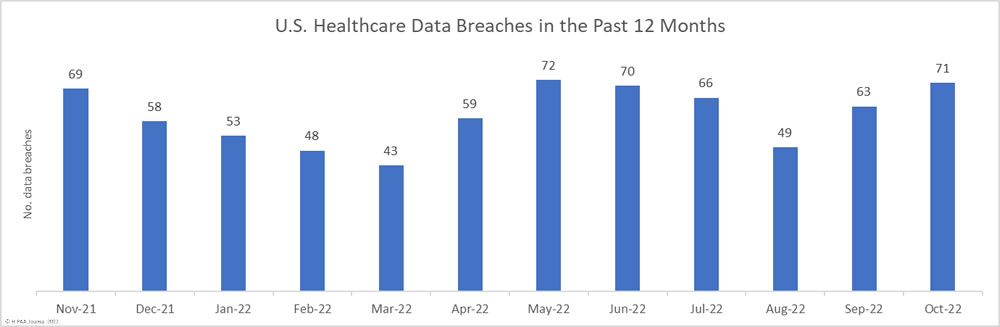
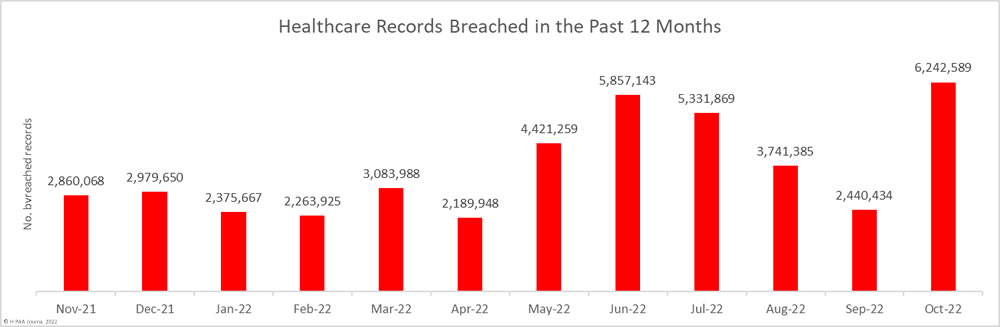
October was the worst month of the year to date for healthcare data breaches, with 71 breaches reported and more than 6 million records breached. The first half of the year was looking like 2022 would see a reduction in healthcare data breaches; however, that is looking increasingly unlikely. In 2021, 714 data breaches of 500 or more records were reported to the HHS’ Office for Civil Rights. 594 data breaches were reported between January 1 and October 31, and with an average of 60 data breaches being reported each month, 2022 looks set to end with a similarly high number.

Across the 71 reported breaches, the protected health information of 6,242,589 individuals was exposed or impermissibly disclosed, with around half of that total coming from a single breach. So far this year, the records of 37,948,207 individuals have been exposed or impermissibly disclosed.

Largest Healthcare Data Breaches Reported in October

In October, 28 data breaches of 10,000 or more records were reported by HIPAA-regulated entities. The largest healthcare data breach reported in October – by some distance – was due to the use of Meta Pixel code on the website and patient portal of Advocate Aurora Health, which resulted in the impermissible disclosure of the PHI of up to 3 million patients to Meta/Facebook. Advocate Aurora Health was not alone. WakeMed Health and Hospitals reported a similar breach involving the PHI of 495,808 patients. Dozens of other healthcare providers have also used the code on their websites and lawsuits are mounting. Attorneys for Meta claim the company does not collect healthcare data without consent; however, U.S. District Judge William Orrick, who is presiding over a consolidated class action lawsuit against Meta over these impermissible disclosures, has expressed skepticism about those claims.

The data breach at SightCare Inc was due to a hacking incident at business associate USV Optical, a subsidiary of U.S. Vision, which also affected Nationwide Optometry. More than 700,000 records were compromised in the incident.  The third largest breach of the month occurred at CorrectCare Integrated Health, Inc, which provides administrative services to healthcare providers that serve correctional facilities. A database was exposed over the Internet as a result of a misconfiguration that resulted in the exposure of the PHI of at least 612,490 inmates at correctional facilities across the country.

Two more eye care providers confirmed in October that they had been affected by the ransomware attack on their EHR vendor, Eye Care Leaders. The records of at least 3,649,470 patients are now known to have been compromised in that attack.

Name of Covered Entity State Covered Entity Type Individuals Affected Type of Breach Description
Advocate Aurora Health WI Healthcare Provider 3,000,000 Unauthorized Access/Disclosure Website Code Passed Patient Information to Meta/Facebook
SightCare, Inc. AZ Health Plan 637,999 Hacking/IT Incident Hacking incident at business associate (USV Optical)
OakBend Medical Center / OakBend Medical Group TX Healthcare Provider 500,000 Hacking/IT Incident Ransomware attack
WakeMed Health and Hospitals NC Healthcare Provider 495,808 Unauthorized Access/Disclosure Website Code Passed Patient Information to Meta/Facebook
CorrectCare Integrated Health, Inc. KY Business Associate 438,713 Unauthorized Access/Disclosure Exposure of PHI over the Internet
Keystone Health PA Healthcare Provider 235,237 Hacking/IT Incident Hacked network server
Louisiana Department of Public Safety and Corrections LA Healthcare Provider 85,466 Unauthorized Access/Disclosure Exposure of PHI over the Internet (CorrectCare Integrated Health)
Urology of Greater Atlanta, LLC GA Healthcare Provider 79,795 Hacking/IT Incident Hacking Incident (No information)
Nationwide Optometry, PC AZ Healthcare Provider 73,073 Hacking/IT Incident Hacking incident at business associate (USV Optical)
Ascension St. Vincent’s Coastal Cardiology GA Healthcare Provider 71,227 Hacking/IT Incident Ransomware attack
Valle del Sol, Inc. AZ Healthcare Provider 70,268 Hacking/IT Incident Hacked network server
CorrectCare Integrated Health, Inc. KY Business Associate 53,496 Unauthorized Access/Disclosure Exposure of PHI over the Internet
FOREFRONT DERMATOLOGY, SC WI Healthcare Provider 45,580 Theft Theft of an unencrypted portable electronic device at a business associate
VisionWeb Holdings, LLC TX Business Associate 35,900 Hacking/IT Incident Compromised email accounts
University of Michigan/Michigan Medicine MI Healthcare Provider 33,857 Hacking/IT Incident Compromised email accounts (phishing)
Aesthetic Dermatology Associates, PC PA Healthcare Provider 33,793 Hacking/IT Incident Hacked network server
Choice Health Insurance LLC SC Business Associate 32,064 Hacking/IT Incident Database exposed over the Internet (data theft confirmed)
PrimeCare Medical, Inc. PA Healthcare Provider 22,254 Unauthorized Access/Disclosure Exposure of PHI over the Internet (CorrectCare Integrated Health)
Administrative Fund of the Detectives’ Endowment Association, Inc., Police Department City of New York NY Health Plan 21,544 Hacking/IT Incident Compromised email accounts (Phishing)
Wenco Management, LLC Health and Welfare Benefit Plan OH Health Plan 20,526 Hacking/IT Incident Compromised email accounts
Gateway Ambulatory Surgery Center NC Healthcare Provider 18,479 Hacking/IT Incident Compromised email accounts (Phishing)
Alain A. Montiel, DDS CA Healthcare Provider 17,157 Theft Theft of an unencrypted laptop
St Luke’s Health – Texas TX Healthcare Provider 16,906 Hacking/IT Incident Compromised email accounts at business associate (Adelanto Healthcare Ventures)
Lifespire Services, Inc. NY Healthcare Provider 15,375 Hacking/IT Incident Hacked network server
HH/Killeen Health System, LLC doing business as Seton Medical Center Harker Heights TX Healthcare Provider 15,056 Hacking/IT Incident Compromised email accounts at an unspecified business associate
Massengale Eye Care OK Healthcare Provider 15,000 Hacking/IT Incident Ransomware attack on a business associate (Eye Care Leaders)
Wisconsin Department of Health Services WI Health Plan 12,358 Unauthorized Access/Disclosure Compromised email accounts
Somnia Pain Mgt of Kentucky NY Healthcare Provider 10,848 Hacking/IT Incident Hacked network server

Causes of October 2022 Data Breaches

Across all industry sectors, ransomware attacks have decreased slightly this year; however, the healthcare industry continues to be a target for ransomware gangs, with Hive, LockBit 2.0, Lorenz, and the Venus ransomware gangs among those that are attacking healthcare organizations. According to Check Point Research, healthcare was the most targeted industry sector in Q3, 2022, and saw the second-highest percentage increase in attacks out of all industry sectors, with 60% more attacks than in Q3, 2021. The largest confirmed ransomware attack was on OakBend Medical Center, which saw half a million records compromised.

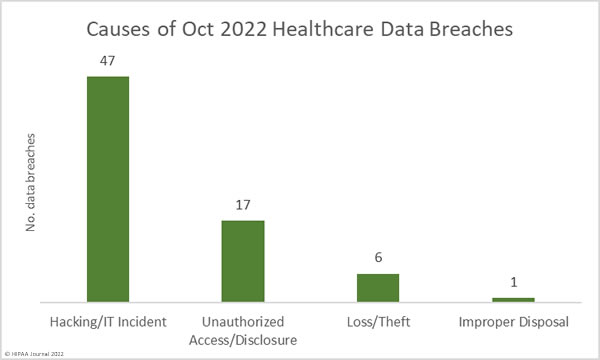
As has been the case for several months, hacking incidents outnumber all other types of data breaches. In October, 47 hacking incidents were reported – 66% of the month’s data breaches – and 2,025,704 records were exposed in those incidents. The average breach size was 43,100 records and the median breach size was 6,594 records. October saw an increase in unauthorized access/disclosure incidents, due in part to the data breach that occurred at CorrectCare Integrated Health that exposed the PHI of inmates of correctional facilities. 7 of the 17 reported unauthorized access/disclosure incidents were due to this incident. Unsurprisingly, given the 3 million-record data breach reported by Advocate Aurora Health, 66% of the breached records were due to unauthorized access/disclosure incidents. 4,145,396 records were compromised in these incidents. The average breach size was 243,847 records and the median breach size was 7,000 records.

There were 6 loss/theft incidents reported in October (4 theft, 2 loss), all but one of which involved portable electronic devices that had not been encrypted. 67,244 records were exposed or stolen across these incidents. The average breach size was 11,207 records and the median breach size was 1,396 records. There was also one incident involving the improper disposal of paperwork that contained the PHI of 4,245 patients.

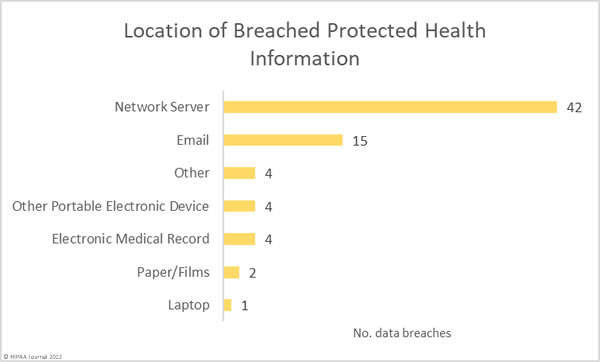
The most common location of breached PHI was network servers due to the high number of hacking incidents. Email accounts are also commonly targeted, with 15 incidents reported in October that involved compromised email accounts. Good password management and multifactor authentication can significantly improve defenses against these attacks, although phishing attacks that bypass MFA are increasing. The increase in these attacks prompted CISA to issue guidance on implementing phishing-resistant MFA this month.

Healthcare Data Breaches by HIPAA-Regulated Entity Type

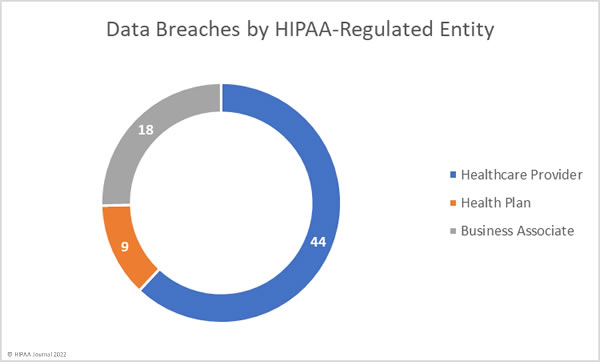
55 breaches were reported by healthcare providers in October; however, 11 of those data breaches occurred at business associates. 10 data breaches were reported by health plans, with one of those breaches occurring at a business associate. Business associates self-reported 6 breaches. The chart below shows the breaches broken down by where they occurred rather than the entity that reported the data breach.

Healthcare Data Breaches by State

Data breaches of 500 or more records were reported by HIPAA-regulated entities in 30 states, with New York the worst affected state with 11 reported breaches. This was due to a data breach at a New York-based management company that affected multiple anesthesiology service providers.

State Number of Reported Data Breaches
New York 11
Texas & Wisconsin 5
Florida & New Jersey 4
Arizona, California, Georgia, Kentucky, North Carolina, Pennsylvania & Virginia 3
Delaware, Maryland & Oregon 2
Colorado, Connecticut, Illinois, Indiana, Kansas, Louisiana, Maine, Michigan, Minnesota, Nebraska, New Mexico, Ohio, Oklahoma, South Carolina & Washington 1

HIPAA Enforcement Activity in October

No HIPAA enforcement actions were reported in October by the HHS Office for Civil Rights or State Attorneys general.

The post October 2022 Healthcare Data Breach Report appeared first on HIPAA Journal.