Latest HIPAA News

Future of HIPAA: Reflections at the 25th Anniversary of HIPAA

The Health Insurance Portability and Accountability Act is now 25 years old. How effective has this healthcare law been and what is the future of HIPAA?

It is now exactly 25 years to the day since the Health Insurance Portability and Accountability Act (HIPAA) was signed into law by President Clinton. On August 21, 1996, when President Clinton added his signature to the legislation, few people would have realized how HIPAA would evolve and grow into the comprehensive national health privacy law that it is today.

It is difficult to argue that HIPAA has not been an overall success, but the legislation has attracted a fair amount of criticism over the years, especially initially due to the considerable administrative burden it placed on healthcare organizations. On balance, the improvements to healthcare that have come from compliance with HIPAA more than outweigh the negatives.

The biggest successes are the improvements to patient privacy and data security, the rights given to patients with respect to their healthcare data, greater efficiency in the healthcare system, and changes that have helped to reduce waste and healthcare fraud. The improvements have generally been made for relatively little cost.

HIPAA certainly has its strengths, but there are also limitations that have become increasingly apparent in recent years and even now, 25 years after the legislation was first introduced, there is still confusion about what compliance entails.

In this article we will explore the strengths and limitations of HIPAA, assess how effective HIPAA has been, and will explore the future of HIPAA and what can be expected in terms of updates to the legislation. First, however, it is useful to provide a brief recap of the history of HIPAA and how the legislation has evolved over the years.

A Brief History of HIPAA

HIPAA was initially introduced to improve the portability of health insurance coverage for employees between jobs, to combat waste, fraud and abuse in health insurance and healthcare delivery, to promote the use of medical savings accounts by introducing tax breaks, and to simplify the administration of health insurance. The legislation was later augmented with new Rules covering the privacy and security of healthcare data.

Initially, HIPAA only applied to a limited number of entities in the healthcare industry – healthcare providers, health plans, and healthcare clearinghouses, and only those that transmit healthcare data in electronic form for certain transactions for which the HHS maintains standards. The Health Information Technology for Economic and Clinical Health (HITECH) Act expanded the scope of HIPAA to cover business associates of HIPAA covered entities – third-party firms that require access to protected health information (PHI) to provide services or products to covered entities.

Important updates to HIPAA are detailed below:

  • HIPAA Signed into Law by President Bill Clinton – August 1996
  • Effective Date of the HIPAA Privacy Rule – April 2003
  • Effective Date of the HIPAA Security Rule – April 2005
  • Effective Date of the HIPAA Enforcement Rule – March 2006
  • Effective date of HITECH and the Breach Notification Rule – September 2009
  • Effective Date of the Final Omnibus Rule – March 2013

HIPAA’s Strengths and Weaknesses

There are many positives that have come from HIPAA, the best known of which are improving privacy protections for patients and improving the security of healthcare data. HIPAA limits the uses and disclosures of patient data to those related to treatment, payment, or healthcare operations and all covered entities and business associates must implement appropriate administrative, physical, and technical safeguards to ensure patient data are appropriately protected from internal and external threats.

Importantly, HIPAA gave individuals new rights with respect to their healthcare data. Prior to the introduction of the HIPAA Privacy Rule, patients were not even permitted to see their medical files. HIPAA gave individuals the right to obtain and inspect a copy of their healthcare data and request errors be corrected. HIPAA made sure patients are informed about how their healthcare data will be used and disclosed, gave patients the right to further limit disclosures of their health data, and also allowed them to view an “accounting of disclosures” to see who has been provided with their healthcare data.

HIPAA has improved the portability of health insurance for employees between jobs and has helped to prevent discrimination against people with pre-existing conditions when receiving health insurance coverage. Efficiency in healthcare has been improved by standardizing transactions through the use of standard code sets and has helped to significantly reduce waste and fraud in healthcare.

However, it has not all been plain sailing. One of the initial requirements of HIPAA was to create a national patient identifier system, but 25 years on and that requirement has still failed to be implemented. Without a national patient identifier system, it can be difficult identifying patients which can result in medical record mismatching. One ONC study in 2014 suggested between 50% and 60% of records are mismatched when shared between different healthcare providers.

Another weakness of HIPAA is its coverage of healthcare data, which is limited to healthcare data collected, held, processed, stored, or transmitted by HIPAA-covered entities and business associates. If a non-HIPAA-covered entity or non-business associate collects the exact same data, HIPAA protections do not apply.

The HIPAA Rules are not clear in places due to the flexibility built into the legislation, so there is potential for misinterpretation of the requirements and there is still confusion among some HIPAA covered entities and business associates when it comes to compliance.

One criticism often made by patients is the lack of a private cause of action. It is not possible to sue for a HIPAA violation, even if the HIPAA Rules have clearly been violated and harm has been suffered. Legal action can only be taken under state laws.

Has HIPAA Been Effective?

In the early years following the introduction of the HIPAA Privacy and Security Rules, questions were asked about how effective the legislation has been. HIPAA certainly looked good on paper but was less effective in practice and noncompliance was widespread. Even the introduction of the HIPAA Enforcement Rule in 2006, which gave the HHS’ Office for Civil Rights the authority to impose financial penalties and sanctions for noncompliance, failed to have a major effect at spurring covered entities into compliance. Enforcement was also very slow at first. It took until 2008 for the first enforcement action to result in a financial penalty, then there was only one financial penalty in 2009 and just two in 2010.

The first phase of HIPAA compliance audits conducted in 2011/2012 highlighted just how many covered entities had ineffective HIPAA compliance programs. The audits uncovered many violations of both the HIPAA Privacy and Security Rules. Even those violations, some of which were serious, did not result in any financial penalties. Some of the fiercest criticism of HIPAA in the early years was it was all bark and no bite.

The introduction of the HITECH Act was a major turning point in the history of HIPAA. Prior to the HITECH Act, business associates were not covered to a large extent by HIPAA, even though they were frequently provided with PHI. The HITECH Act made the HIPAA Rules directly applicable to business associates, which could then be fined directly if they did not also comply with the HIPAA Rules. Business associates include a huge range of third-party companies such as accountants, attorneys, billing companies, collection agencies, consultants, data analysts, and IT firms, so the HITECH Act, and subsequent Omnibus Rule, addressed that major gap.

The introduction of the HITECH Act also saw the penalties for noncompliance significantly increased and OCR also increased its HIPAA enforcement activities. With major fines issued for HIPAA violations, HIPAA compliance became a major focus for HIPAA-covered entities and business associates.

Enforcement of compliance has been critical to the success of HIPAA and while there are still many cases each year of noncompliance, on the whole the requirements of HIPAA have been largely implemented and the benefits of HIPAA are being realized.

Issues with Patient Access to PHI

Since the 2000 HIPAA Privacy Rule was introduced, patients have been given the right to obtain a copy of their own healthcare data, or to have that data sent to their nominated representative. The HITECH Act updated that right and helped individuals obtain a copy of their health data in electronic form, due to the increasing use of electronic health record systems.

While healthcare organizations have implemented policies that allow patients to exercise their access rights, many patients have experienced problems obtaining a copy of their healthcare data. They have either been refused access, requests have been delayed, and patients have been charged excessive fees for exercising their access rights – HIPAA only permits covered entities to charge a reasonable, cost-based fee for providing records.

One of the requirements of the 21st Century Cures Act, introduced in 2016, was to call on the Government Accountability Office to report on the barriers to patient medical record access and following assessments the HHS’ Office for Civil Rights launched a new HIPAA enforcement initiative targeting violations of the HIPAA Right of Access of the HIPAA Privacy Rule in the fall of 2019. That enforcement initiative is still active and, up until the end of July 2021, OCR has imposed 19 financial penalties on healthcare providers found to have been in violation of the HIPAA Right of Access.

Prior to the OCR enforcement initiative, only one financial penalty had been imposed for violations of this important right and that was the $4,300,000 financial penalty imposed on Cignet Health of Prince George’s County in 2011 for denying 741 patients access to their medical records.

HIPAA has Improved Healthcare Data Security

Prior to the introduction of the HIPAA Security Rule, healthcare organizations only had to comply with state laws covering data security. The Security Rule set new minimum standards for data security to ensure the confidentiality, integrity, and availability of electronic PHI. The Security Rule requires risk analyses to be conducted and risks reduced to a reasonable and acceptable level. Access controls are required to prevent unauthorized access to healthcare data, logs must be maintained and checked to identify unauthorized access, backups of data must be made, measures must be implemented to protect against reasonably anticipated, impermissible uses or disclosures, and staff must be provided with security awareness training.

Data security has improved, but data breaches are now occurring at records levels. For the past 5 months, data breaches have been reported by healthcare organizations and business associates at a rate of over 2 per day, but without the Security Rule requirements, far more breaches would be likely to occur.

The HIPAA Security Rule does have weaknesses. To remain relevant the HIPAA Security Rule had to be technology agnostic, so specific measures for security are generally not stipulated. It is left to the discretion of each entity to determine what constitutes “reasonable” protections. If the Security Rule was more specific with regard to required security protections, many more data breaches could be prevented.

The Security Rule also only applies to HIPAA covered entities and business associates, not to any other entity. It therefore has limited reach, and does not cover health data collected by health apps, or the huge volumes of data collected and sold by data brokers. There is therefore considerable scope for improvement to better protect all health data.

The HIPAA Security Rule also calls for security awareness training for staff but does not stipulate how frequently it should be provided. With the threat landscape constantly changing, regular training must be provided to the workforce to ensure employees are kept aware of the latest threats and are taught how to avoid them. Many covered entities and business associates are compliant with this requirement yet fail to provide training regularly enough to prevent cyberattacks and the associated privacy violations.

How Has HIPAA Fared with Changing Technology?

No legislative act will be able to maintain pace with the pace at which technology has evolved, especially one covering the healthcare industry. This is why HIPAA provided a framework rather than specifics and incorporated flexibility to accommodate for changes to healthcare technology and evolving privacy and security best practices.

Updates have been made over the years which have amended HIPAA to maintain relevance, such as the 2008 Genetic Information Non-discrimination Act (GINA) which restricts the use of individuals’ genetic data by health insurers and employers and the American Recovery and Reinvestment Act, of which the HITECH Act was part, which strengthened HIPAA in relation to the adoption of EHRs.

However, many new technologies have emerged over the years that are not covered by HIPAA. Personal electronic devices are extensively used which can collect huge amounts of personal and health data, such as fitness trackers and other wearable devices and smartphones have made it much easier for individuals to obtain, use, and share healthcare data.

Many of these devices collect data that would fall under the category of PHI if created or collected by a HIPAA-covered entity but are not within the scope of HIPAA, even though the same data are often collected by those devices. The extent to which these devices are now being used, and the sheer volume of digital health and wellness data being generated outside the healthcare system by individuals, is a growing cause of concern. Without the protections of HIPAA, healthcare data may not be properly protected and could be shared extensively or sold on with ease.

The HIPAA Privacy Rule does not adequately cover the collection of healthcare data, as it only covers uses and disclosures by certain entities. It does not apply to health data itself, and this could be argued is one of the biggest failures of HIPAA. The same is true of the HIPAA Security Rule, which also has a restrictive scope and only calls for administrative, physical, and technical safeguards for the healthcare data held, received, or transmitted by HIPAA-covered entities and their business associates.

Healthcare data is extremely valuable, and not only to bad actors such as cybercriminals. Cybercriminals can use healthcare data for fraud and identity theft, but it also has tremendous value to a wide range of businesses. Healthcare and wellness data can be used by insurers to gauge risk – which can affect insurance premiums. Employers can use health data to make decisions about potential new hires, and all manner of other businesses can use the data to make decisions about individuals that could have significant consequences for the data subjects.

The question about whether HIPAA should be updated to cover all healthcare data has yet to be fully answered. Many attempts have been made to introduce legislation to cover all healthcare data, but each has failed to make it through the Senate.

The scope of HIPAA could be expanded to include individually identifiable health information collected, used, transmitted, or maintained by non-HIPAA covered entities and non-business associates. Alternatively, new separate legislation is required to cover healthcare data not currently regulated by HIPAA. The solution could well be to leave HIPAA as it is and to instead introduce a national privacy law akin to the EU’s General Data Protection Regulation (GDPR) or the California Consumer Privacy Act (CCPA).

HIPAA Training and Education Need to Improve

HIPAA is not perfect and there are still significant gaps in the legislation, something that the coronavirus pandemic has highlighted. HIPAA doesn’t extend to the army of contact tracers and the data they collect, nor does it adequately cover exposure notification apps and may disclosures of COVID-19 related data. This is an area, like personal health apps, that needs to be addressed as there is considerable potential for privacy violations.

Vaccination programs have highlighted several areas where education needs to be improved. There have been many cases of HIPAA being cited as a reason not to disclose or share vaccination data, when HIPAA does not place restrictions on disclosures of vaccination information by individuals to employers or others.

Training remains a key issue with HIPAA and is often a much bigger weakness than technology or the HIPAA text itself. It is often uninformed people, and not healthcare technology and privacy and security controls, that are the reason for security breaches and privacy violations. While updates to HIPAA are needed, improvements need to be made to training programs to ensure all individuals with access to PHI or systems containing PHI are aware of their responsibilities and are trained how to be HIPAA-compliant employees.

Training needs to be appropriate to the role of each individual and training needs to be reinforced. Regular training sessions need to be provided to the workforce to make sure that the requirements of HIPAA are fully understood and are not forgotten over time. At many covered entities and business associates, employee training on HIPAA is not provided frequently enough.

Proposed Updates to the HIPAA Privacy Rule

Ahead of the 25-year anniversary of the HIPAA Privacy Rule, a significant update was proposed by the HHS. The proposed update published by the HHS in 2020 is intended to address several aspects of the Privacy Rule that are hampering care coordination and adding an unnecessary administrative burden on healthcare providers.

One of the main reasons for the update, according to then HHS Secretary Alex Azar, was to “break down barriers that have stood in the way of common sense care coordination and value-based arrangements for far too long.” The proposed update will improve care coordination and case management for patients, allow families and caregivers to become more involved in the provision of care to individuals, improve patients’ access to their health data, and will introduce new flexibilities covering disclosures of PHI in emergency and threatening situations, while also reducing the administrative burden on healthcare organizations. These updates have been long overdue but there has been criticism that the updates do not go far enough, and that some of the suggested updates are ill-advised.

One of the aspects addressed in the update will make it easier for patients to obtain a copy of their electronic healthcare data, but there are potential privacy and security risks with the change. Patients will be given the “right to direct the transmission of certain protected health information in an electronic format to a third party.” This right will help patients share their healthcare data with research organizations, but there are concerns that this change could have a negative impact on patients. Patients could request their health data be sent to anyone they choose, when the transmission of data to an entity not covered by the protections of HIPAA carries a security risk. The new right will certainly give patients much greater access and control over their personal data, but potentially it increases the risks that PHI may fall into the hands of bad actors.

The Future of HIPAA

HIPAA has been a great success, but it is far from perfect. There are still areas that require tweaking to improve usability and remove some of the administrative burden placed on HIPAA-covered entities. Proposed updates to the HIPAA Privacy Rule go some way to addressing some of the issues, but for many, the new HIPAA regulations that have been proposed do not go nearly far enough and some of the proposed changes have potential to cause privacy issues.

Overall, for legislation that is 25 years old, HIPAA has, with its various amendments, survived the test of time and is even more relevant and useful now than it was when it was first signed into law in 1996. HIPAA should be viewed as a work in progress though, and as far as the Future of HIPAA is concerned, there are likely to need to be further updates to ensure it remains relevant and effective.

Future of HIPAA FAQs

Does HIPAA cover all healthcare data?

HIPAA covers identifiable healthcare data, which is any healthcare data created, collected, transmitted, or maintained by a HIPAA-covered entity or business associate for treatment, payment for healthcare, or healthcare operations relating to the past, present, or future health status of an individual. Health data is not covered by HIPAA if it is created, stored, or transmitted by a non-HIPAA-covered entity or non-business associate.

Who does HIPAA apply to?

HIPAA applies to HIPAA-covered entities and their business associates. HIPAA-covered entities are healthcare providers, health plans, and healthcare clearinghouses that conduct electronic transactions involving PHI for which the HHS has developed standards. Business associates are vendors that provide products or services to HIPAA-covered entities that requires contact with PHI. HIPAA does not apply to other entities such as reporters, senators, individuals, and most employers.

Are there privacy risks associated with health apps?

Health apps, fitness trackers, and other wearable devices are not generally covered by HIPAA, nor are the data they collect or transmit. Without the protection of HIPAA, health app developers may use, disclose, or sell health data collected through the apps, and the security measures implemented may not meet HIPAA standards. There may be privacy and security risks associated with the use of these apps and devices.

Does HIPAA prevent disclosures of COVID-19 vaccination information?

Many people hide behind HIPAA and use the regulation as an excuse not to answer questions. One of the most notable recent examples, of which there are many, came from Marjorie Taylor Greene when asked about her vaccination status and cited HIPAA as the reason she could not disclose the information. HIPAA does not prevent such discloses. It only places restrictions on uses and disclosures by healthcare providers, health plans, healthcare clearinghouses, and business associates of those entities.

How often does HIPAA training need to be provided?

HIPAA training must be provided to all healthcare employees within a reasonable period of time after the person joins the covered entity’s workforce, as well as when functions are affected by a material change in policies or procedures and following any updates to the HIPAA Rules. HIPAA refresher training should also be provided at least annually, and no later than every two years. Annual training is the best practice.

The post Future of HIPAA: Reflections at the 25th Anniversary of HIPAA appeared first on HIPAA Journal.
CISA Publishes Guidance on Protecting Sensitive Data and Responding to Double-Extortion Ransomware Attacks

Ransomware attacks dramatically increased in 2020 and cyberattacks using the file-encrypting malware are showing no sign of abating. Attacks have continued to increase this year to the point where there were almost half the number of attempted ransomware attacks in Q2, 2021 as there were all of 2019.

Most threat actors conducting ransomware attacks are now using double extortion tactics, where ransoms must be paid to obtain the keys to decrypt files but also to prevent the publication of data stolen in the attacks. The theft of data prior to file encryption has not only helped ransomware gangs demand huge ransom payments, but the threat of leaking data has greatly increased to probability of the ransom being paid. Many victims end up paying the ransom to prevent data leakage, even though they have valid backups that will allow them to restore the encrypted data for free.

To help public and private sector organizations deal with the threat of these double-extortion ransomware attacks, the Cybersecurity and Infrastructure Security Agency (CISA) has published new guidance, which includes best practices for preventing cyber threat actors from gaining access to networks, steps that can be taken to ensure sensitive data are protected, and procedures that should be followed when responding to a ransomware attack.

“Ransomware is a serious and increasing threat to all government and private sector organizations, including critical infrastructure organizations,” explained CISA in the guidance. “All organizations are at risk of falling victim to a ransomware incident and are responsible for protecting sensitive and personal data stored on their systems.”

There are several measures outlined in the document that are important not only preventing ransomware attacks but also limiting their severity. It is essential to maintain offline, encrypted backups of data and to regularly test the backups to make sure file recovery is actually possible. It is also vital that a basic cyber incident response plan, resiliency plan, and associated communications plan are created and maintained, and exercises are conducted to ensure that a rapid response to an attack is possible. To block attacks, steps must be taken to address the key attack vectors, which are phishing, RDP compromises, and the exploitation of internet-facing vulnerabilities and misconfigurations. Naturally, all organizations should also ensure good cyber hygiene practices are followed.

In order to protect sensitive data, organizations must know where sensitive data reside and who has access to those data repositories. It is also important to ensure that sensitive data are only retained for as long as is strictly necessary. Physical and cybersecurity best practices must be implemented, including restricting access to physical IT assets, encrypting sensitive data at rest and in transit, and to implement firewall and network segmentation to hamper attempts at lateral movement within networks. CISA also recommends ensuring the cyber incident response and communications plans include response and notification procedures for data breach incidents.

A rapid and effective response to a ransomware attack is critical for limiting the harm caused and keeping costs down. The cyber incident response plan should detail all the steps that need to be taken, and the order that they should be taken. The first step is determining which systems have been impacted and immediately isolating them to secure network operations and stop additional data loss. The next step should only be taken if affected devices cannot be removed from the network or the network cannot be temporarily shut down, and that is to power down infected devicesto avoid further spread of the ransomware infection.

Then, triage impacted systems for restoration and recovery, confer with the security team to develop and document an initial understanding of what has occurred, then engage internal and external teams and stakeholders and provide instructions on how they can assist with the response and recovery processes. Organizations should then follow the notification requirements outlined in their cyber incident response plan.

The guidance document – Protecting Sensitive and Personal Information from Ransomware-Caused Data Breachescan be found on this link.

The post CISA Publishes Guidance on Protecting Sensitive Data and Responding to Double-Extortion Ransomware Attacks appeared first on HIPAA Journal.

1.4 Million Individuals Affected by St. Joseph’s/Candler Ransomware Attack

Around 4 a.m. on Thursday June 17, 2021, St. Joseph’s/Candler (SJ/C) hospital system in Savannah, GA suffered a ransomware attack. Upon detection of suspicious network activity, SJ/C immediately took steps to isolate and secure its systems. The attack prevented access to computer systems and emergency protocols were implemented, with staff reverting to pen and paper to record patient data.

SJ/C notified law enforcement about the security breach and launched an investigation. Assisted by third party cybersecurity firms, SJ/C determined the hackers first gained access to its systems on December 18, 2020 and continued to have access to those systems until June 17, 2021, when the ransomware was deployed.

“Patient care operations continue at our facilities using established back-up processes and other downtime procedures,” explained SJ/C in a statement shortly after the attack was detected. “Our physicians, nurses and staff are trained to provide care in these types of situations and are committed to doing everything they can to mitigate disruption and provide uninterrupted care to our patients.”

As the investigation into the breach continued it became clear that the parts of the network accessible to the hackers contained files that included patients’ protected health information. A comprehensive review of those files was conducted and determined the files contained patient information such as names, addresses, dates of birth, Social Security numbers, driver’s license numbers, patient account numbers, billing account numbers, financial information, health insurance plan member IDs, medical record numbers, dates of service, provider names, and medical and clinical treatment information regarding care received from SJ/C.

SJ/C has now confirmed the protected heath information of 1,400,000 patients was potentially compromised in the ransomware attack. Notification letters started to be sent to affected individuals on August 10, 2021 and complimentary credit monitoring and identity theft protection services are being offered. SJ.C said additional safeguards and technical security measures are being implemented to further protect and monitor its systems.

The post 1.4 Million Individuals Affected by St. Joseph’s/Candler Ransomware Attack appeared first on HIPAA Journal.

Study Reveals Extent of Cybersecurity Vulnerabilities at Major Pharmaceutical Firms

Reposify, a provider of an external attack surface management platform, has published the findings of a study of security vulnerabilities at pharmaceutical firms which shows the vast majority of pharma firms have unresolved vulnerabilities that are putting sensitive data and internal systems at risk of compromise.

The study was conducted to assess the prevalence of exposures of services, sensitive platforms, unpatched CVEs and other security issues. Data analyzed for the Pharmaceutical Industry: 2021: The State of the External Attack Surface Report were collected over a two-week period in March 2021 and covered 18 of the leading pharmaceutical companies worldwide and more than 900 of their subsidiaries.

Pharmaceutical companies hold vast amounts of sensitive personal data and extremely valuable drug and vaccine research data. That has made them an attractive target for cybercriminals. During the COVID-19 pandemic, nation state hackers targeted pharma and biotech firms to gain access to sensitive COVID-19 research and vaccine development data.

According to the 2020 Cost of a Data Breach Report from IBM Security/Ponemon Institute, pharma and biotech firms had a high rate of security incidents in 2020, with 53% of them resulting from malicious activity. The average cost of a pharma data breach in 2020 was $5.06 million and the average time to identify and contain a breach was 257 days.

“With the pandemic causing a rush to scale and digitize, pharmaceutical companies’ digital footprints have further expanded creating many new blind spots where attackers could and did easily break in to access confidential, highly sensitive data,” explained Reposify.

In 2020 there were hundreds of mergers and acquisitions, with larger pharmaceutical firms buying up smaller companies in the sector. These smaller firms were typically focused on fast innovation and agility, which often meant insufficient resources were put into cybersecurity. M&A transactions therefore had significant potential to introduce major security risks.

Reposify researchers analyzed 2020 M&A transactions and found in 70% of cases, the newly acquired subsidiary had a negative impact on the security posture of the parent company. The vulnerabilities introduced were often considerable, “adding tens, or in some cases, hundreds of sensitive exposed and unpatched services.”

The researchers analyzed the prevalence of key risks which are visible externally and could potentially be exploited by cyber threat actors, including misconfigured databases and cloud services and unpatched software vulnerabilities. The median number of high severity security issues per company was 269, with a median of 125 critical severity issues per company.

Key findings from the report include:

  • 92% of pharmaceutical companies had at least one exposed database which was potentially leaking data.
  • 76% had an exposed RDP service.
  • 69% of exposed services discovered were classified as being a part of the unofficial network perimeter.
  • 50% of pharma firms had an exposed FTP with anonymous authentication.
  • 46% of pharma firms had an exposed SMB service.

“Pharmaceutical companies must harden their security and make it more difficult for attackers to gain a foothold in their systems”, said Reposify. “This effort must begin with gaining a clear view of their external attack surface and continuous monitoring and elimination of risky attack vectors.” The report also highlighted the importance of performing pre-acquisition cybersecurity due diligence, including mapping and analysis of the acquisition target’s external attack surface.

The post Study Reveals Extent of Cybersecurity Vulnerabilities at Major Pharmaceutical Firms appeared first on HIPAA Journal.

NIST Updates Guidance on Developing Cyber Resilient Systems

The National Institute of Standards and Technology (NIST) has released a major update to its guidance on developing cyber-resilient systems.

A draft version of the updated guidance – NIST Special Publication 800-160, Volume 2, Revision 1: Developing Cyber-Resilient Systems: A Systems Security Engineering Approach – has been released which includes updates to reflect the changing tactics, techniques, and procedures (TTPs) of cyber threat actors, who are now conducting more destructive attacks, including the use of ransomware.

Organizations used to be able to focus their resources on perimeter defenses and penetration resistance; however, these measures are no longer as effective as they once were at preventing attacks. A modern approach is now required which requires more resilience to be built into IT systems, which requires measures to be taken to limit the ability of an attacker to damage infrastructure and move laterally within networks.

“The document provides suggestions on how to limit the damage that adversaries can inflict by impeding their lateral movement, increasing their work factor, and reducing their time on target,” explained NIST.

Hackers can gain access to internal networks even with sophisticated perimeter defenses in place, as recent cyberattacks on Colonial Pipeline, JBS Foods, and Kaseya have shown. The initial attack vector could be a phishing email, the exploitation of an unpatched software vulnerability, or even a supply chain attack. All these methods could be used to bypass traditional defenses and gain a foothold in the network. It is therefore critical for safeguards to be implemented to limit the harm that can be caused, which for many organizations will require improvements to their detection, response, and recovery capabilities.

The approach now advocated by NIST is more in line with zero trust, where it must be assumed that an attacker has already gained access to the network, applications, and systems. Organizations therefore need to build in resiliency into their IT systems to ensure that they will continue to function to a sufficient degree to continue to support mission critical business operations.

“What we want to achieve is a system that we call ‘cyber resilient’ or a system that is sufficiently resilient where it can continue to operate and support critical missions in business operations – even if it’s not in a perfect state or even in somewhat of a degraded state,” said NIST fellow Ron Ross.

The updates to the guidance cover three key areas:

  • Updated controls that support cyber resiliency, in line with the recommendations detailed in NIST Special Publication SP 800-53, Revision 5 – Security and Privacy Controls for Information Systems and Organizations.
  • The creation of a single threat taxonomy for organizations in line with MITRE’s Adversarial Tactics, Techniques, and Common Knowledge [ATT&CK] framework.
  • The addition of detailed mapping and analysis of cyber resiliency implementation which support NIST SP 800-53 controls and the MITRE ATT&CK framework techniques, mitigations, and candidate mitigations.

NIST’s cyber resiliency techniques were combined with the MITRE ATT&CK framework because of the high level of adoption of the MITRE ATT&CK framework, with the aim being to simplify the approach to building more resilient systems.

The guidance document was updated by NIST Fellow Ron Ross, NIST supervisory computer scientist Victoria Pillitteri, and Richard Graubart, Deborah Bodeau, and Rosalie McQuaid of MITRE.

NIST is seeking feedback on the draft version of the guidance document until September 20, 2021. The final version of the guidance is due to be published before year end.

The post NIST Updates Guidance on Developing Cyber Resilient Systems appeared first on HIPAA Journal.

Healthcare Industry has Highest Number of Reported Data Breaches in 2021

Data breaches declined by 24% globally in the first 6 months of 2021, although breaches in the United States increased by 1.5% in that period according to the 2021 Mid-Year Data Breach QuickView Report from Risk-Based Security.

Risk Based Security identified 1,767 publicly reported breaches between January 1, 2021 and June 30, 2021. Across those breaches, 18.8 billion records were exposed, which represents a 32% decline from the first 6 months of 2020 when 27.8 billion records were exposed. 85% of the exposed records in the first half of 2021 occurred in just one breach at the Forex trading service FBS Markets.

The report confirms the healthcare industry continues to be targeted by cyber threat actors, with the industry having reported more data breaches than any other industry sector this year. Healthcare has been the most targeted industry or has been close to the top since at least 2017 and it does not appear that trend will be reversed any time soon. 238 healthcare data breaches were reported in the first 6 months of 2021, with finance & insurance the next most attacked sector with 194 reported incidents, followed by information with 180 data breaches.

The report shows there have been significant shifts in data breach trends in 2021. While data breaches have declined globally and have remained fairly constant in the United States, there has been a marked increase in ransomware attacks. Risk Based Security recorded 352 ransomware attacks in the first 6 months of 2021 and, if that pace continues, the number of attacks will be significantly higher than 2020.

Ransomware attacks are extremely costly in healthcare due to the long period of downtime, and without access to medical records patient safety is put at risk. This is of course known to ransomware gangs. The reliance on access to data and the high cost of downtime increases the probability of the ransom being paid.

In 2020, data breaches started to take longer to be reported and that trend has continued in 2021. This is in part due to the increase in ransomware attacks, which can take longer to investigate, but even taking that into account there were many cases when breach notifications took an unusually long time to be issued and that has started to attract attention from regulators.

“Ransomware attacks continue at an alarming pace, inflicting serious damage on the victim organizations that rely on their services,” said Inga Goddijn, Executive Vice President at Risk Based Security. “The slow pace of reporting brought on by lengthy incident investigations has not improved and attackers continue to find new opportunities to take advantage of changing circumstances.”

The majority of reported breaches (67.97%) were hacking incidents, with only 100 (5.66%) due to viruses, and just 45 email incidents (2.55%). There were 76 web breaches reported (4.30%); however, they resulted in the highest number of records being breached.

Data breaches that exposed access credentials such as email addresses and passwords have remained consistent with other years, with email addresses exposed in 40% of breaches and passwords in 33%. The majority of reported breaches in 2021 were the result of external threat actors (78.66%), with 13.75% caused by insiders. Out of the confirmed insider breaches, the majority were accidental (58.85%), with 18.52% caused by malicious insiders.

Risk Based Security also notes that breach severity is increasing. Large numbers of data breaches have been reported in 2021 that involved sensitive data, which is a particularly worrying trend.

The post Healthcare Industry has Highest Number of Reported Data Breaches in 2021 appeared first on HIPAA Journal.

Multiple Critical Vulnerabilities Identified in Pneumatics System Used in 2,300 U.S. Hospitals

Nine critical vulnerabilities have been identified in the Nexus Control Panel of Swisslog Healthcare Translogic Pneumatic Tube System (PTS) stations, which are used in more than 80% of major hospitals in the United States. Pneumatic tube systems are used to rapidly send test samples and medications around hospitals and the vulnerable PTS stations are present in 3,000 hospitals worldwide, including 2,300 in the United States.

The vulnerabilities, collectively named ‘PwnedPiper’, were discovered by researchers at Armis Security. In total, 9 critical flaws were identified in the Nexus Control Panel and the firmware of all current models of Translogic PTS stations are affected.

The vulnerabilities identified by the researchers are common in Internet of Things (IoT) devices but are far more serious in pneumatic tube systems, which are part of hospitals’ critical infrastructure. The Armis researchers pointed out that these systems are prevalent in hospitals, yet they have never been thoroughly analyzed or researched.

The flaws could be exploited by a threat actor to cause denial of service, harvest sensitive data such RFID credentials of employees, and to perform reconnaissance to identify the functions or location of the stations and gain an understanding of the physical layout of the PTS network. The vulnerabilities could also be exploited in a ransomware attack.

The flaws include the use of hard-coded passwords, memory corruption vulnerabilities, privilege escalation flaws, unencrypted connections, unauthenticated firmware updates, and remote code execution vulnerabilities. If exploited, an attacker could gain full control of all Nexus stations in a hospital.

“This research sheds light on systems that are hidden in plain sight but are nevertheless a crucial building block to modern-day healthcare,” said Nadir Izrael, Armis co-founder and CTO. “Understanding that patient care depends not only on medical devices, but also on the operational infrastructure of a hospital is an important milestone to securing healthcare environments.”

The researchers detailed a scenario in which the flaws could be exploited to deliver ransomware. First an attacker would need a foothold in the hospital network. This could be as simple as exploiting a vulnerability in a low-grade IoT device such as a hospital IP camera. Once network access is gained, the Translogic PTS could be targeted since it is connected to hospital networks. Any of 5 vulnerabilities could then be exploited to achieve remote code execution in an attack that could see all Nexus stations compromised, either using ransomware or simply shutting down stations.

“In this volatile state, the hospital’s operations can be severely derailed,” said the researchers. “Medications supplied to departments, timely delivery of lab samples, and even blood units supplied to operating rooms all depending on constant availability of the PTS.”

Armis presented the findings at Black Hat USA. Swisslog Healthcare has patched 8 of the 9 vulnerabilities in Nexus Control Panel version 7.2.5.7, with the one remaining vulnerability due to be fixed in an upcoming release. The remaining vulnerability, tracked as CVE-2021-37160, affects legacy systems and is due to the lack of firmware validation during a file upload for a firmware update.

There have been no known cases of the vulnerabilities being exploited. Swisslog Healthcare has suggested mitigations and workarounds in its security advisory for hospitals that are unable to upgrade to the latest version of the Nexus Control Panel.

The post Multiple Critical Vulnerabilities Identified in Pneumatics System Used in 2,300 U.S. Hospitals appeared first on HIPAA Journal.

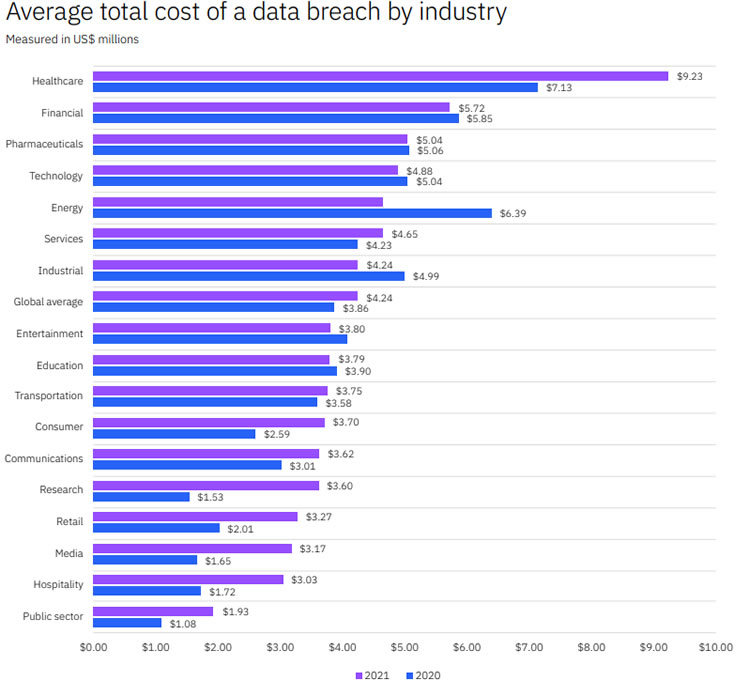
The Average Cost of a Healthcare Data Breach is Now $9.42 Million

IBM Security has published its 2021 Cost of a Data Breach Report, which shows data breach costs have risen once again and are now at the highest level since IBM started publishing the reports 17 years ago. There was a 10% year-over-year increase in data breach costs, with the average cost rising to $4.24 million per incident. Healthcare data breaches are the costliest, with the average cost increasing by $2 million to $9.42 million per incident. Ransomware attacks cost an average of $4.62 million per incident.

Source: IBM Security

The large year-over-year increase in data breach costs has been attributed to the drastic operational shifts due to the pandemic. With employees forced to work remotely during the pandemic, organizations had to rapidly adapt their technology. The pandemic forced 60% of organizations to move further into the cloud. Such a rapid change resulted in vulnerabilities being introduced and security often lagged behind the rapid IT changes. Remote working also hindered organizations’ ability to quickly respond to security incidents and data breaches.

According to IBM, data breaches costs were more than $1 million higher when remote work was indicated as a factor in the data breach. When remote work was a factor, the average data breach cost was $4.96 million compared to $3.89 million when remote work was not a factor. Almost 20% of organizations that reported data breaches in 2020 cited remote work as a factor, with the cost of a data breach around 15% higher when remote work was a factor.

To compile the report, IBM conducted an in-depth analysis of data breaches involving fewer than 100,000 records at 500 organizations between May 2020 and March 2021, with the survey conducted by the Ponemon Institute.

The most common root cause of data breaches in the past year were compromised credentials, which accounted for 20% of data breaches. These breaches took longer to detect and contain, with an average of 250 days compared to an overall average of 212 days.

The most common types of data exposed in data breaches were customers’ personal data such as names, email addresses, passwords, and healthcare data. 44% of all data breaches included those types of data. A data breach involving email addresses, usernames, and passwords can easily have a spiral effect, as hackers can use the compromised data in further attacks. According to the Ponemon Institute survey, 82% of individuals reuse passwords across multiple accounts.

Breaches involving customers’ personally identifiable information (PII) were more expensive than breaches involving other types of data, with a cost per record of $180 when PII was involved compared to $161 per record for other types of data.

Data breach costs were lower at companies that had implemented encryption, security analytics, and artificial intelligence-based security solutions, with these three mitigating factors resulting in data breach cost savings of between $1.25 million and $1.49 million per data breach.

Adopting a zero-trust approach to security makes it easier for organizations to deal with data breaches. Organizations with a mature zero trust strategy had an average data breach cost of $3.28 million, which was $1.76 million lower than those who had not deployed this approach at all.

“Higher data breach costs are yet another added expense for businesses in the wake of rapid technology shifts during the pandemic,” said Chris McCurdy, Vice President and General Manager, IBM Security. “While data breach costs reached a record high over the past year, the report also showed positive signs about the impact of modern security tactics, such as AI, automation and the adoption of a zero-trust approach – which may pay off in reducing the cost of these incidents further down the line.”

Security automation greatly reduces data breach costs. Organizations with a “fully deployed” security automation strategy had average breach costs of $2.90 million per incident, compared to $6.71 million at organizations that had no security automation.

Companies with an incident response team that had tested their incident response plan had 54.9% lower breach costs than those that had neither. The average data breach cost was $3.25 million compared to $5.71 million when neither were in place.

The cost of a data breach was $750,000 (16.6%) higher for companies that had not undergone any digital transformation due to COVID-19. Cloud-based data breach costs were lower for organizations that had adopted a hybrid cloud approach, with an average cost of $3.61 million at organizations with hybrid cloud infrastructure compared to $4.80 million for organizations with a primarily public cloud and $4.55 million for those that had adopted a private cloud approach. Data breach costs were 18.8% higher when a breach was experienced during a cloud migration project.

Organizations that were further into their cloud migration plan were able to detect and respond to data breaches far more quickly – on average 77 days more quickly for organizations that were at a mature state of their cloud modernization plan than those in the early stages.

Mega data breaches – those involving between 50 million and 65 million records – cost an average of $401 million per incident, which is more than 100 times the cost of breaches involving between 1,000 and 100,0000 records.

The post The Average Cost of a Healthcare Data Breach is Now $9.42 Million appeared first on HIPAA Journal.

Report: The State of Privacy and Security in Healthcare

2020 was a particularly bad year for the healthcare industry with record numbers of data breaches reported. Ransomware was a major threat, with Emsisoft identifying 560 ransomware attacks on healthcare providers in 2020. Those attacks cost the healthcare industry dearly. $20.8 billion was lost in downtime in 2020, according to Comparitech, which is more than twice the ransomware downtime cost to the healthcare industry in 2019.

With the healthcare industry facing such high numbers of cyberattacks, the risk of a security breach is considerable, yet many healthcare organizations are still not fully conforming with the NIST Cybersecurity Framework (NIST CSF) and the HIPAA Security Rule, according to the 2021 Annual State of Healthcare Privacy and Security Report published today by healthcare cybersecurity consulting firm CynergisTek.

To compile the reportThe State of Healthcare Privacy and Security – Maturity Paradox: New World, New Threats, New Focus – CynergisTek used annual risk assessments at 100 healthcare organizations and measured progress alongside overall NIST CSF conformance. 75% of healthcare organizations improved overall NIST conformance in 2020; however, 64% of healthcare organizations fell short of the 80% NIST conformance level considered to be the passing grade. Most of the improvements made in 2020 were only small.

As the graph below shows, 53 healthcare organizations improved NIST conformance year over year, 32 of those were considerably below the 80th percentile and 17 healthcare organizations saw NIST conformance decline year-over- year.

Year-over-Year Improvements in NIST CSF Conformance. Source: CynergisTek State of Healthcare Privacy and Security Report.

In order to improve resilience to ransomware and other cyberattacks, it is essential for healthcare organizations to improve their security posture. It will not be possible to stay one step ahead of threat actors if organizations do not take steps to improve NIST CSF and HIPAA Security Rule conformance.

While good conformance scores are a good indication of security posture, they do not necessarily reflect the extent to which healthcare organizations have reduced risk. For this year’s report, CynergisTek placed less emphasis on conformance scores and assessed the measures healthcare organizations had taken to identify which core functions of the NIST CSF appeared to be really driving long term security improvements, with the goal of identifying the best opportunities for both short- and long-term success.

The Identity function provides the foundation on which the rest of the core functions are based, but 73% of healthcare organizations were rated low performers in this function. Asset management and supply chain risk management were two of the key areas that need to be addressed. The healthcare supply chain is a universal issue and the weak link in healthcare. Many healthcare organizations struggle to validate whether or not third-party vendors meet specific security requirements. 76% of healthcare organizations failed to secure their supply chains.

The Protect function requires safeguards to be implemented to protect critical infrastructure and data. One of the main areas where organizations were falling short is protection of data using encryption. “An organization’s default for storing protected data of any kind and transmitting it should include encryption – it clearly does not”, explained CynergisTek. High performers achieved 90% conformance for protection of data at rest, whereas the rest of the sector was in the low 30th percentile.

In the Detect function, there was a major difference between high and low performers, but overall there were good levels of implementation; however, to be considered a high performer it is necessary to get the detect function substantially implemented and to ensure there is significant automation of security monitoring.

The Respond function concerns an organization’s ability to quickly implement appropriate activities when a cybersecurity event is detected, and this is an area where significant improvements need to be made. Only the highest performers are actively investigating notifications from detection systems, and only high performers were consistently and substantially mitigating incidents.

The recover function identifies activities required to return to normal operations after a cybersecurity incident. While there were gaps among the high performers, conformance was generally very good, but significant improvements need to be made by low performers. Around two-thirds (66%) of healthcare organizations are underperforming in recovery planning.

CynergisTek identified several aspects of security that healthcare organizations need to focus on over the coming 12 months:

  • Improve automation of security functions
  • Validate technical controls for people and processes
  • Perform exercises and drills at the enterprise level to test all components of the business
  • Secure the supply chain
  • Look beyond the requirements of the HIPAA Rules and further enhance privacy and security measures

The researchers found notable improvements had been made in organizations’ HIPAA privacy programs in 2020, with some healthcare organizations making exceptional progress. However, there is still room for improvement. CynergisTek identified several privacy areas that should be focused on in 2021.

These measures include implementing user access monitoring tools and engaging in proactive rather than reactive monitoring, addressing defective HIPAA authorizations, preventing violations of the Minimum Necessary Rule by defining criteria to limit PHI disclosure, updating insufficient privacy policies and procedures and ensuring the new policies are implemented, and addressing inappropriate Hybrid Entity designations.

The post Report: The State of Privacy and Security in Healthcare appeared first on HIPAA Journal.