Latest HIPAA News

October 2019 Healthcare Data Breach Report

There was a 44.44% month-over-month increase in healthcare data breaches in October. 52 breaches were reported to the HHS’ Office for Civil Rights in October. 661,830 healthcare records were reported as exposed, impermissibly disclosed, or stolen in those breaches.
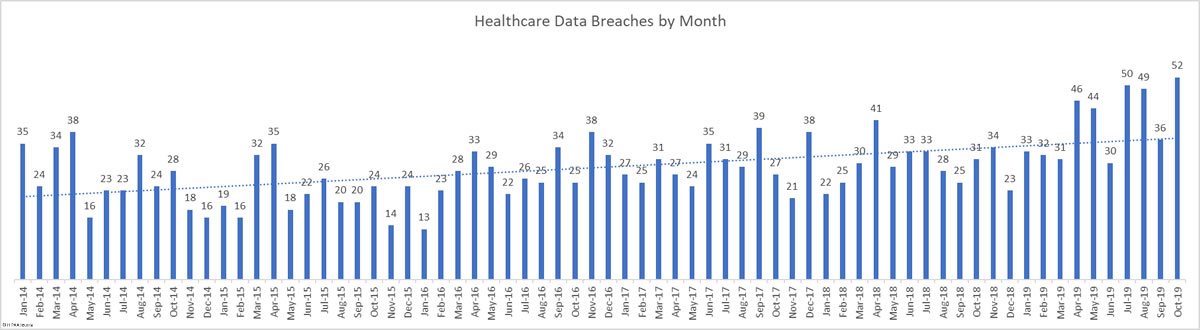
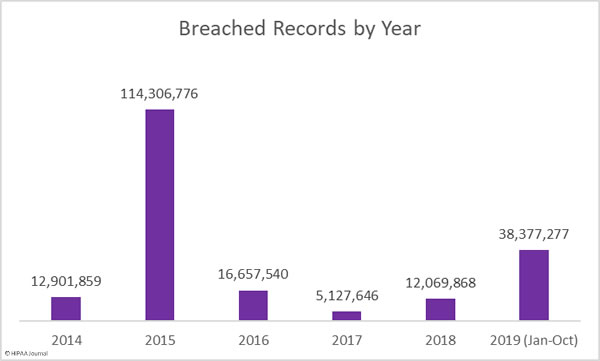
This month takes the total number of breached healthcare records in 2019 past the 38 million mark. That equates to 11.64% of the population of the United States.
Largest Healthcare Data Breaches in October 2019

Breached Entity Entity Type Individuals Affected Type of Breach
Betty Jean Kerr People’s Health Centers Healthcare Provider 152,000 Hacking/IT Incident
Kalispell Regional Healthcare Healthcare Provider 140,209 Hacking/IT Incident
The Methodist Hospitals, Inc. Healthcare Provider 68,039 Hacking/IT Incident
Children’s Minnesota Healthcare Provider 37,942 Unauthorized Access/Disclosure
Tots & Teens Pediatrics Healthcare Provider 31,787 Hacking/IT Incident
University of Alabama at Birmingham Healthcare Provider 19,557 Hacking/IT Incident
Prisma Health – Midlands Healthcare Provider 19,060 Hacking/IT Incident
South Texas Dermatopathology Laboratory Healthcare Provider 15,982 Hacking/IT Incident
Central Valley Regional Center Business Associate 15,975 Hacking/IT Incident
Texas Health Harris Methodist Hospital Fort Worth Healthcare Provider 14,881* Unauthorized Access/Disclosure

The largest healthcare data breach in October was reported by Betty Jean Kerr People’s Health Centers and was the result of a ransomware attack. At the time of issuing notifications, files that were encrypted in the attack remained locked. The decision was taken not to pay the ransom demand, but it was not possible to restore files from backups. Those files contained the health information of 152,000 patients.

The Kalispell Regional Healthcare data breach was due to a May 2019 phishing attack. An initial investigation did not uncover the extent of the breach. The forensic investigation revealed in August that the health information of up to 140,209 patients may have been accessed.

The Methodist Hospitals, Inc. data breach was also the result of a phishing attack. The incident was reported in October, but the initial email account compromise occurred in March 2019. Two accounts were breached for a total of four months.

South Texas Dermatopathology Laboratory is the last healthcare organization to report that its patients have been impacted by the data breach at the collection agency, AMCA. Its 15,982 records take the total number of individuals impacted by the AMCA breach to 26,059,725.

*Also of note is the data breach at Texas Health Resources. The breach makes the top 10 list of the most healthcare records exposed, but the breach was more far reaching than the table above shows. The Texas Health data breach involved a total of 82,577 records, but the breach was reported to the HHS’ Office for Civil Rights as 15 separate breaches, with one breach report submitted for each of its affected facilities. Had the incident been reported as a single incident, the month’s total would stand at 38 breaches – two more than September.

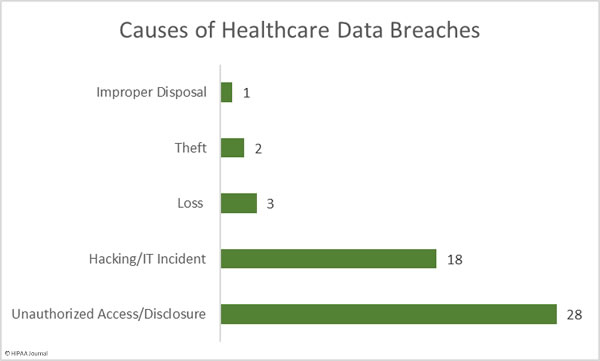
Causes of October 2019 Healthcare Data Breaches

There were 18 hacking/IT incidents reported in October involving 501,847 healthcare records. The average breach size was 27,880 records and the median breach size was 9,413 records.

There were 28 reported unauthorized access/disclosure incidents involving a total of 134,775 records. The mean breach size was 4,813 records and the median breach size was 2,135 records. Those incidents include the 15 separate breach reports from Texas Health Resources.

There were 5 loss/theft incidents involving 13,454 records. The mean breach size was 2,350 records and the median breach size was 2,752 records. One improper disposal incident was reported involving 11,754 records.
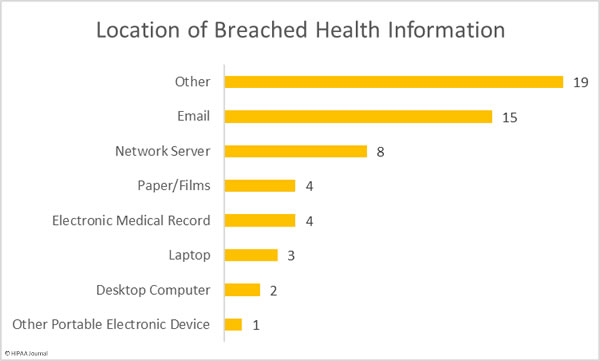
Location of Breached Health Information

Phishing continues to cause problems for healthcare organizations. Not only are healthcare providers struggling to block phishing attacks, they are also not detected quickly when they do occur. Several phishing attacks have been reported that have taken weeks to discover.

Multi-factor authentication can help to reduce the risk of stolen credentials being used by cybercriminals to access corporate email accounts, yet many healthcare organizations only implement this important security measure after a phishing attack has occurred.

This high number of “other” breaches is due to the mailing error at Texas Health, which accounts for 15 of the 19 incidents in the other category.

The majority of the network server breaches were due to ransomware attacks, which include the largest healthcare data breach of the month. That breach highlights just how important it is to ensure that a viable backup copy of all data is created, that the backup is tested to make sure data recovery is possible, and that at least one backup copy is stored on a non-networked device that is not exposed to the internet.
October 2019 Data Breaches by Covered Entity Type

Healthcare providers were the worst affected by data breaches in October with 45 reported incidents. Three breaches were reported by health plans, and four breaches were reported by business associates of HIPAA-covered entities. A further four breaches also had some business associate involvement but were reported by the covered entity.

October 2019 Healthcare Data Breaches by State

October saw healthcare organizations and business associates in 24 states report data breaches. With 15 breach reports coming from Texas Health, Texas was unsurprisingly the worst affected state with 17 incidents.

There were 4 breaches reported by entities based in Ohio, three breaches reported in California, and two breaches reported in each of Arkansas, Florida, Louisiana, Maryland, New Mexico, South Carolina, and Virginia. A single breach was reported in each of Alabama, Arizona, Georgia, Illinois, Indiana, Kentucky, Minnesota, Missouri, Mississippi, Montana, New York, Oregon, South Dakota, and Washington.

HIPAA Enforcement Actions in October 2019

A further two financial penalties for HIPAA violations were announced by the HHS’ Office for Civil Rights in October – One settlement and one civil monetary penalty.

OCR launched an investigation of Elite Dental Associates following a complaint from a patient who had some of her PHI publicly disclosed in response to a Yelp review. OCR found she was not the only patient to have had PHI disclosed in that manner. OCR also determined that the practice’s notice of privacy practices did not include sufficient information and was therefore not compliant with the HIPAA Privacy Rule. Elite Dental Associates agreed to settle its HIPAA violation case with OCR for $10,000.

OCR launched an investigation of Jackson Health System following the disclosure of PHI in the media. A photograph of an operating room display had been published which contained the health information of two individuals, including a well-known NFL star. The OCR investigation uncovered multiple Privacy Rule, Security Rule, and Breach Notification Rule violations spanning several years. OCR imposed a civil monetary penalty of $2,154,000 on Jackson Health System.

The post October 2019 Healthcare Data Breach Report appeared first on HIPAA Journal.
Smartwatch Data Act Introduced to Improve Privacy Protections for Consumer Health Data

The Stop Marketing And Revealing The Wearables And Trackers Consumer Health (Smartwatch) Data Act, has been introduced by Sens. Bill Cassidy, M.D., (R-Louisiana) and Jacky Rosen, (D-Nevada). The new legislation will ensure that health data collected through fitness trackers, smartwatches, and health apps cannot be sold or shared without consumer consent.

The Health Insurance Portability and Accountability Act (HIPAA) applies to health data collected, received, stored, maintained, or transmitted by HIPAA-covered entities and their business associates. Some of the same information is collected, stored, and transmitted by fitness trackers, wearable devices, and health apps. That information can be used, shared, or sold, without consent. Consumers have no control over who can access their health data. The new legislation aims to address that privacy gap.

The bill prohibits the transfer, sale, sharing, or access to any non-anonymized consumer health information or other individually identifiable health information that is collected, recorded, or derived from personal consumer devices to domestic information brokers, other domestic entities, or entities based outside the United States unless consent has been obtained from the consumer.

Consumer devices are defined as “equipment, application software, or mechanism that has the primary function or capability to collect, store, or transmit consumer health information.”

The Smartwatch Data Act applies to information about the health status of an individual, personal biometric information, and kinesthetic information collected directly through sensors or inputted manually into apps by consumers. The Smartwatch Data Act would treat all health data collected through apps, wearable devices, and trackers as protected health information.

There have been calls for HIPAA to be extended to cover app developers and wearable device manufacturers that collect, store, maintain, process, or transmit consumer health information. The Smartwatch Data Act does not extend HIPAA to cover these companies, instead the legislation applies to the data itself. The bill proposes the HHS’ Office for Civil Rights, the main enforcer of compliance with HIPAA, would also be responsible for enforcing compliance with the Smartwatch Data Act. The penalties for noncompliance with the Smartwatch Data Act would be the same as the penalties for HIPAA violations.

“The introduction of technology to our healthcare system in the form of apps and wearable health devices has brought up a number of important questions regarding data collection and privacy,” said Sen. Rosen “This commonsense, bipartisan legislation will extend existing health care privacy protections to personal health data collected by apps and wearables, preventing this data from being sold or used commercially without the consumer’s consent.”

The legislation was introduced following the news that Google has partnered with Ascension, the second largest healthcare provider in the United States, and has been given access to the health information of 50 million Americans. That partnership has raised a number of questions about the privacy of health information.

The Ascension data passed to Google is covered by HIPAA, but currently fitness tracker data is not. Google intends to acquire fitness tracker manufacturer Fitbit in 2020 and concern has been raised about how Google will use personal health data collected through Fitbit devices. The Smartwatch Data Act would help to ensure that consumers are given a say in how their health data is used.

The post Smartwatch Data Act Introduced to Improve Privacy Protections for Consumer Health Data appeared first on HIPAA Journal.

TigerConnect Survey Finds 89% of Healthcare Providers Still Use Fax Machines and 39% are Still Using Pagers

TigerConnect has released its 2019 State of Healthcare Communications Report, which shows that continuing reliance on decades-old, inefficient communications technology is negatively impacting patients and is contributing to the increasing cost of healthcare provision.

For the report, TigerConnect surveyed more than 2,000 patients and 200 healthcare employees to assess the current state of communications in healthcare and gain insights into areas where communication inefficiencies are causing problems.

The responses clearly show that communication in healthcare is broken. 52% of healthcare organizations are experiencing communication disconnects that impact patients on a daily basis or several times a week. Those communication inefficiencies are proving frustrating for healthcare employees and patients alike.

The report reveals most hospitals are still heavily reliant on communications technology from the 1970s. 89% of hospitals still use faxes and 39% are still using pagers in some departments, roles, or even across the entire organization. The world may have moved on, but healthcare hasn’t, even though healthcare is the industry that stands to benefit most from the adoption of mobile technology.

The HHS’ Centers for Medicaid and Medicare Services (CMS) is pushing for fax machines to be eliminated by the end of 2020 and for healthcare organizations to instead use more secure, reliable, and efficient communications methods. Given the extensive use of fax machines, that target may be difficult to achieve.

“Adoption of modern communication solutions has occurred in every other industry but healthcare,” said Brad Brooks, chief executive officer and co-founder of TigerConnect. “Despite the fact that quality healthcare is vital to the well-being and functioning of a society, the shocking lack of communication innovation comes at a steep price, resulting in chronic delays, increased operational costs that are often passed down to the public, preventable medical errors, physician burnout, and in the worst cases, can even lead to death.”

The cost of communication inefficiencies in healthcare is considerable. According to NCBI, a 500-bed hospital loses more than $4 million each year as a result of communication inefficiencies and communication errors are the root cause of 70% of all medical error deaths.

The communication problems are certainly felt by healthcare employees, who waste valuable time battling with inefficient systems. The report reveals 55% of healthcare organizations believe the healthcare industry is behind the times in terms of communication technology compared to other consumer industries.

One of the main issues faced by healthcare professionals is not being able to get in touch with members of the care team when they need to. 39% of healthcare professionals said it was difficult or very difficult communicating with one or more groups of care team members.

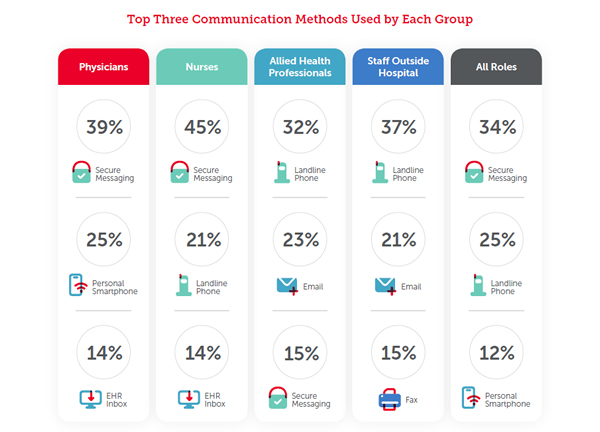
Fast communication is critical for providing high quality care to patients and improvements are being made, albeit slowly. Secure messaging is now the primary method of communication overall for nurses (45%) and physicians (39%), although landlines are the main form of communication for allied health professionals (32%) and staff outside hospitals (37%), even though secure messaging platforms can be used by all groups in all locations.

Even though there is an increasing mobile workforce in healthcare, healthcare organizations are still heavily reliant on landlines. Landlines are still the top method of communication when secure messaging is not available. Landlines are also used 25% of the time at organizations that have implemented secure messaging.

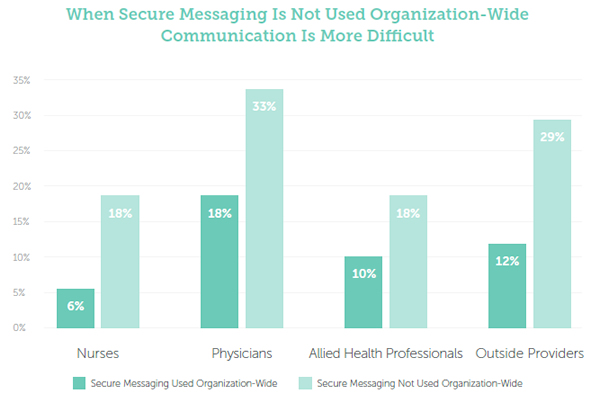
Healthcare organizations that have taken steps to improve communication and have implemented secure messaging platforms are failing to get the full benefits of the technology. All too often, secure messaging technology is implemented in silos, with different groups using different methods and tools to communicate with each other. When secure messaging is not used, such as when the platform is only used by certain roles, communication is much more difficult.

The communications problems are also felt by patients. Nearly three quarters (74%) of surveyed patients who had spent at least some time in hospital in the past two years, either receiving treatment or visiting an immediate family member, said they were frustrated by inefficient processes.

The most common complaints were slow discharge/transfer times (31%), ED time with doctors (22%), long waiting room times (22%), the ability to communicate with a doctor (22%), and the length of time it takes to get lab test results back (15%). Many of these issues could be eased through improved communication between members of the care team. The survey also revealed hospital staff tend to underestimate the level of frustration that patients experience.

Communication problems play a large part in the bottlenecks that often occur in healthcare. Communication problems were cited as causing delayed discharges (50%), consult delays (40%), long ED wait times (38%), transport delays (33%) and slow inter-facility transfers (30%). There is a 50% greater chance of daily communication disconnects negatively impacting patients when secure messaging is not used.

Hospitals that communicate with patients by SMS/text or messaging apps are far more likely to rate their communication methods as effective or extremely effective. 75% of hospitals that use text/SMS and 73% that use messaging apps rate communication with patients as effective or very effective, compared to 62% that primarily use the telephone and 53% whose primary method of communicating with patients is patient portals. The survey also showed that only 20% of patients want to communicate via patient portals.

It has been established that secure messaging can improve communication and the quality of healthcare delivery, but healthcare communication is often not a strategic priority. 69% of surveyed healthcare professionals that are not using a secure messaging platform said this was due to budget constraints, 38% said money was spent on other IT priorities, and 34% cited concerns about patient data security, even though secure messaging platforms offer afar greater security than legacy communications systems.

TigerConnect has made several recommendations on how communication in healthcare needs to be improved.

  • Prioritize communication as a strategy
  • Focus on improving communication to ease major bottlenecks
  • Integrate communication platforms with EHRs to get the greatest value
  • Standardize communication across the entire organization
  • Include clinical leadership in solution design
  • Stop using patient portals to communicate with patients and start using patient messaging in the overall communication strategy.

The survey provides valuable insights into the state of communication in healthcare and clearly shows where improvements need to be made. The full TigerConnect 2019 State of Communication in Healthcare Report is available free of charge on this link (registration required).

The post TigerConnect Survey Finds 89% of Healthcare Providers Still Use Fax Machines and 39% are Still Using Pagers appeared first on HIPAA Journal.

51% of Healthcare Providers Still Not Fully Complying with HIPAA Right of Access

The Department of Health and Human Services’ Office for Civil Rights is cracking down on noncompliance with the HIPAA Right of Access and for good reason. A recent report from Ciitizen has revealed more than half of healthcare providers (51%) are not fully compliant with this aspect of HIPAA.

This is the second such report from Ciitizen, the first having been released on August 14, 2019. For the latest report, an additional 169 healthcare providers were assessed for Right of Access compliance, bringing the total assessed providers to 210.

Acting with authorization from patients, Ciitizen made requests for copies of patients records. Each healthcare provider was then given a rating based on their response, from 5 stars being fully compliant and responding within 5 days, down to 1 or 2 stars. A 1- or 2-star rating meant that were it not for multiple escalation calls to supervisors, the provider would not have been compliant.

There is some good news in the report. More providers are complying and there is less inconsistency from employee to employee. A growing number of healthcare providers are also now providing seamless access to patient records, with the percentage having increased from 30% to 40%.

The high figure or noncompliance is not because of the failure to provide patients with copies of their medical records on request, it is mostly because there needs to be “significant intervention” before requests are processed in a compliant manner.

For instance, the main reason for a 1-star rating is patients are not being provided with copies of their medical records in the digital format of their choosing. Inconsistency is also an issue. Many patients will be provided with copies of their records within 30 days, but a significant percentage will experience problems, such as having to make contact by phone on multiple occasions.

The findings from the first report were found to be broadly comparable to the second, although a far higher percentage of providers received a 1-star rating in the second report. In Cohort I (n=51), 27% received a 1-star rating and 24% received 2 stars. In Cohort II (n-169), 51% received a 1-star rating and 5% received a 2-star rating.

This can be explained by the fact that fewer escalation attempts were made by telephone after the initial request was submitted with Cohort II. That meant that the 30-day time limit for providing records was exceeded on occasion.

For Cohort II, out of the providers that were given a 1-star rating, 86% failed to provide the records in the requested format, 20% exceeded the 30-day time frame for providing records, and 1% attempted to charge excessive fees. In Cohort I, the figures were 86% format failures, 2% fee issues, and 2% failed to send the records to the designee. All requests were processed within 30 days.

It is important to point out that copies of records were requested in a specific digital format. Ciitizen said 76% of providers receiving a 1-star rating would have received a 4- or 5-star rating if they had been allowed to send records in any digital format (CD, fax, or encrypted email).

Ciitizen chose to request a specific digital format to assess compliance and better reflect real world scenarios. For instance, many patients do not have access to a fax machine and may not have a laptop/computer with a CD drive.

Ciitizen believes the use of standard open APIs would help to ensure that records could easily be provided in the format requested by the patient.

Ciitizen points out that providers are now accepting request forms by mail, email, and fax, which makes it far easier for patients to obtain a copy of their records. To date, excessive fees have not been an issue but, in some cases, this was only due to Ciitizen successfully resolving attempts by providers to charge fees that are not permitted under HIPAA by escalating the issue to supervisors.

The detailed Ciitizen report can be viewed and downloaded on this link.

Penalties for Noncompliance with HIPAA Right of Access

The penalties for noncompliance are can be severe. Willful neglect of HIPAA Rules now carries a minimum penalty of $58,490 per violation, if no corrective action has been taken, and a maximum penalty of $1,754,698 per violation, per year. OCR calculates penalties based on the number of days the organization has not been in compliance, so the maximum possible penalty is substantial.

OCR has stated on multiple occasions that HIPAA Right of Access failures are one of its main enforcement priorities. Already this year, OCR has issued one financial penalty for noncompliance with this important aspect of HIPAA and it will not be the last.

Bayfront Health St Petersburg was fined $85,000 for HIPAA Right of Access failures in September 2019 and in 2011, Cignet Health of Prince George’s County was ordered to pay a civil monetary penalty of $4,300,000 for denying patients access to their medical records.

It doesn’t take a data breach for an investigation into patient rights violations to be initiated by OCR. The Bayfront Health St Petersburg financial penalty was in response to a single complaint from a patient who had not been provided with her medical records in a timely manner.

The post 51% of Healthcare Providers Still Not Fully Complying with HIPAA Right of Access appeared first on HIPAA Journal.

Google Confirms it has Legitimate Access to Millions of Ascension Patients’ Health Records

Following a report in the Wall Street Journal, Google has confirmed it is collaborating with one of the largest healthcare systems in the United States, which gives it access to a huge volume of patient data.

Google has partnered Ascension, the world’s largest catholic health system and the second largest non-profit health system in the United States. Ascension operates more than 2,600 healthcare facilities in 21 states, including 150 hospitals and over 50 senior living facilities.

The collaboration has given Google access to patient health information such as names, dates of birth, medical test results, diagnoses, treatment information, service dates, and other personal and clinical information.

The project – code name Project Nightingale – had been kept under the radar prior to the WSJ Report, which claimed that at least 150 Google employees have allegedly been able to access patient data as part of the project and that access to patient data had been granted without patients or physicians being informed. Both Google and Ascension made announcements about the Project Nightingale collaboration after the WSJ story was published.

In a November 11 press release, Ascension said it “is working with Google to optimize the health and wellness of individuals and communities, and deliver a comprehensive portfolio of digital capabilities that enhance the experience of Ascension consumers, patients and clinical providers across the continuum of care.”

Google explained in its announcement that it had previously mentioned the collaboration in July 2019 in its Q2 earnings call, in which it stated, “Google Cloud’s AI and ML solutions are helping healthcare organizations like Ascension improve the healthcare experience and outcomes.”

Google explained in its November 11 blog post that collaboration with Ascension is focused on A) Shifting Ascension’s infrastructure to the Google Cloud platform; B) Helping Ascension implement G Suite productivity tools and; C) Extending tools to doctors and nurses to improve care. Google also stated that some of the tools it is working on are not yet active in clinical development and are still in the early testing stage, hence the code name, Project Nightingale.

Another goal of the collaboration is to use Google’s considerable computing capabilities to analyze patient data with a view to developing software that leverages its AI and machine learning technology to deliver more targeted care to patients.

Ascension said the it will be “Exploring artificial intelligence/machine learning applications that will have the potential to support improvements in clinical quality and effectiveness, patient safety, and advocacy on behalf of vulnerable populations, as well as increase consumer and provider satisfaction.”

As a business associate of Ascension, Google has confirmed that access to patient data is legitimate and in full compliance with Health insurance Portability and Accountability Act (HIPAA) Rules. Google has signed a BAA with Ascension and has implemented appropriate safeguards to keep patient information secure and is in full compliance with all requirements of HIPAA.

Ascension has also confirmed that the partnership is “underpinned by a robust data security and protection effort and adherence to Ascension’s strict requirements for data handling.”

While patients may be concerned that Google now has access to some of their most sensitive data, it is not standard practice for healthcare organizations to announce collaborations with third-party companies that provide services that require access to protected health information. However, a proactive announcement rather than a reactive press release may have helped allay fears and concerns.

The post Google Confirms it has Legitimate Access to Millions of Ascension Patients’ Health Records appeared first on HIPAA Journal.

Sen. Warner Demands Answers from HHS Over Apparent Lack of Response to Major PACS Data Breach

U.S. Senator, Mark. R. Warner (D-VA) has written to the Director of the HHS’ Office for Civil Rights, Roger Severino, expressing concern over the HHS response to the mass exposure of medical images by U.S. healthcare organizations.

Sen. Warner is the Vice Chairman of the Senate Intelligence Committee and co-founder of the Senate Cybersecurity Caucus. This is the latest in a series of communications in which he has voiced concerns about cybersecurity failures that have compromised the personal and private information of Americans. In February, Sen. Warner demanded answers from HHS agencies, NIST, and healthcare associations about healthcare cybersecurity following the continued increase in healthcare data breaches.

His recent letter to OCR was in response to a September 17, 2019 report about the exposure of millions of Americans’ medical images that were stored in unsecured picture archiving and communications systems (PACS).

The report detailed the findings of an investigation by ProPublica, German public broadcaster Bayerischer Rundfunk, and vulnerability and analysis firm, Greenbone Networks, which revealed almost 400 million medical images could be freely downloaded from the internet without authentication.  Sen. Warner pointed out that at the time of writing the letter, “for all U.S. territories there are 114.5 million images accessible, 22.1 million patient records, and 400,000 Social Security numbers, impacting an estimated 5 million patients in 22 states.”

Sen. Warner stated in the letter that the exposure of the medical images not only has potential to cause harm to individuals, it is also damaging to national security. The types of exposed information could potentially be used by cybercriminals in phishing campaigns and for other malicious attacks, such as those aimed at spreading malware. Flaws in the DICOM protocol could be exploited to incorporate malicious code into medical images. Nation state actors or cybercriminal groups could have downloaded the images, inserted malicious code, and then uploaded the images without being detected.

One of the U.S. firms implicated in the ProPublica report was TridentUSA Health Services and one of its affiliates, MobileX USA. In September 2019, following publication of the report, Sen. Warner wrote to TridentUSA Health Services demanding answers about its cybersecurity practices and how the data of millions of Americans, which the company was responsible for keeping private, came to be exposed online and required no password or other means of authentication to access.

In his letter to OCR, Sen. Warner explained that TridentUSA Health Services, a HIPAA-covered entity, responded to his letter and stated it had passed an HHS Security Rule audit in March 2019. That audit was passed even though at the time of the audit medical images under its control were exposed online and could be freely accessed over the internet.

“As your agency aggressively pushes to permit a wider range of parties (including those not covered by HIPAA) to have access to the sensitive health information of American patients without traditional privacy protections attaching to that information, HHS’s inattention to this particular incident becomes even more troubling,” wrote Warner.

The exposure of PACS data was reported to US-CERT by the German Federal Office for Information Security. US-CERT made contact with Greenbone Networks and confirmed the exposed data had been received and said that the matter would be reported to the HHS. Greenbone Networks had no contact from HHS and no further contact from US-CERT.

The researchers in Germany also demonstrated to Sen. Warner that even on October 15, 2019, several US-based PACS have open ports that support unencrypted communications protocols. Those unsecured PACS could be accessed without authentication and a wide range of medical images could be viewed and downloaded, including X-rays and mammograms that contain sensitive patient information such as names and Social Security numbers. Those images and personal information were still accessible freely online on the date of writing the letter (Nov 8, 2019).

“As of writing this letter, TridentUSA Health Services is not included on your breach portal website and I have seen no evidence that, once contacted by US-CERT, you acted on that information in a meaningful way,” wrote Sen. Warner.

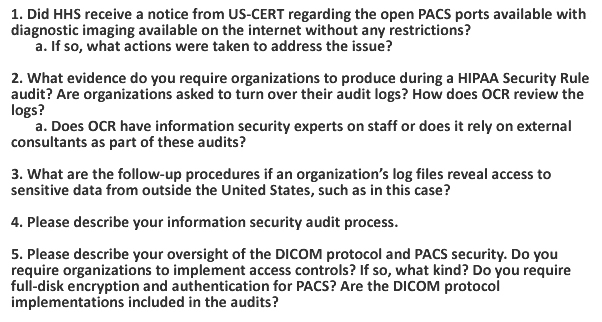
Sen. Warner has demanded answers to 5 questions:

The post Sen. Warner Demands Answers from HHS Over Apparent Lack of Response to Major PACS Data Breach appeared first on HIPAA Journal.

HHS Increases Civil Monetary Penalties for HIPAA Violations in Line with Inflation

The U.S Department of Health and Human Services’ has increased the civil monetary penalties for HIPAA violations to take inflation into account, in accordance with the Inflation Adjustment Act.

The final rule was issued and took effect on Tuesday November 5, 2019. This rule increases the civil monetary penalties for HIPAA violations that occurred on or after February 18, 2019. Under the new penalty structure, the increases from 2018 to 2019 are detailed in the table below:

Penalty Tier Level of Culpability Minimum Penalty per Violation

(2018 » 2019)

Maximum Penalty per Violation

(2018 » 2019)

New Maximum Annual Penalty

(2018 » 2019)*

1 No Knowledge $114.29 » $117 $57,051 » $58,490 $1,711,533 » $1,754,698
2 Reasonable Cause $1,141 » $1,170 $57,051 » $58,490 $1,711,533 » $1,754,698
3 Willful Neglect – Corrective Action Taken $11,410 » $11,698 $57,051 » $58,490 $1,711,533 » $1,754,698
4 Willful Neglect – No Corrective Action Taken $57,051 » $58,490 $1,711,533 » $1,754,698 $1,711,533 » $1,754,698

Penalties for HIPAA violations that occurred prior to February 18, 2019 have increased to $159 per violation, with an annual cap of $39,936 per violation category.

Earlier this year, the HHS’ Office for Civil Rights announced that it had reduced the penalties for HIPAA violations in certain tiers after a review of the wording of the HITECH Act. The maximum penalty for a HIPAA violation in the highest tier remained at $1.711 million, per violation category per year. Prior to the review, the maximum HIPAA violation penalty was $1.711 million in all four penalty tiers.

*The notice of enforcement discretion, announced on April 30, 2019, capped the maximum annual penalties at $10,000 (Tier 1), $100,000 (Tier 2), $250,000 (Tier 3), and $1,711,533 (Tier 4). The notice of enforcement discretion stated that the reviewed penalty tiers would also be adjusted in line with inflation. The multiplier used by OCR to calculate the cost-of-living increases was based on the Consumer Price Index for all Urban Consumers (CPI–U) for October 2019, which was 1.02522. That would make the new maximum penalties under the notice of enforcement discretion $10,252.20 (Tier 1), $102,522 (Tier 2), $256,305 (Tier 3), and $1,754,698 (Tier 4).

While OCR’s notice of enforcement discretion states that OCR will be adopting the new, revised penalties, this has yet to be made official and is pending further rulemaking. The notification of enforcement discretion creates no legal obligations and no legal rights, so OCR could therefore legally use the above maximum penalty amount of $1,754,698 per violation category, per year across all penalty tiers.

Full details of the new penalty structures have been published in the Federal Register for all agencies, including the FDA, ACF, HRSA, AHRQ, OIG, CMS, and OCR and can be viewed here (PDF).

The post HHS Increases Civil Monetary Penalties for HIPAA Violations in Line with Inflation appeared first on HIPAA Journal.

Texas Health and Human Services Commission Pays $1.6 Million HIPAA Penalty

The Department of Health and Human Services’ Office for Civil Rights (OCR) has imposed a $1.6 million civil monetary penalty (CMP) on Texas Health and Human Services Commission (TX HHSC) for multiple violations of Health Insurance Portability and Accountability Act (HIPAA) Rules.

TX HHSC is a state agency that operates supported living centers, regulates nursing and childcare facilities, provides mental health and substance abuse services, and administers hundreds of state programs for people in need of assistance, such as individuals with intellectual and physical disabilities.

OCR launched an investigation following receipt of a breach report from the Department of Aging and Disability Services (DADS), a state agency that was reorganized into TX HHSC in September 2017. On June 11, 2015, DADS reported a security incident to OCR which stated that the electronic protected health information (ePHI) of 6,617 individuals had been exposed over the internet. The exposed information included names, addresses, diagnoses, treatment information, Medicaid numbers, and Social Security numbers.

The information was exposed during the migration of an internal CLASS/DBMD application from a private server to a public server. A flaw in the software of the application allowed ePHI to be accessed over the internet without any authentication. As a result of the flaw, private and highly sensitive information could be found and accessed through a Google search.

TX HHSC was unable to provide documentation to demonstrate compliance with three important provisions of HIPAA Rules. OCR determined that TX HHSC had violated four HIPAA provisions.

  • 45 C.F.R. § 164.308(a)(1 )(ii)(A) – Failure to conduct a comprehensive organization-wide risk analysis to identify all risks to the confidentiality, integrity, and availability of PHI
  • 45 C.F.R. § 164.312(a)(1) – Failure to implement access controls. Credentials were not required to access ePHI contained in its CLASS/DBMD
  • 45 C.F.R. § 164.312(b) – Failure to implement audit controls that recorded user access on the public server, which prevented TX HHSC from determining who had accessed ePHI in the application during the time it was exposed.
  • 45 C.F.R. § 164.502(a) – The above failures resulted in an impermissible disclosure of the ePHI of 6,617 individuals.

Under HIPAA, financial penalties are determined based on the level of culpability. OCR determined that the violations fell short of willful neglect and constituted reasonable cause – the second penalty tier. For each of the above classes of HIPAA violation, the minimum penalty for a violation is $1,000 up to a maximum financial penalty of $100,000 per year. The risk analysis failures, access controls failures, and audit control failures spanned from 2013 to 2017, hence the $1.6 million penalty.

“Covered entities need to know who can access protected health information in their custody at all times,” said OCR Director Roger Severino. “No one should have to worry about their private health information being discoverable through a Google search.”

We initially reported on the HIPAA penalty in March 2019 when it appeared that a settlement had been reached between TX HHSC and OCR over the HIPAA violations. The 86th Legislature of the State of Texas had voted to approve the settlement; however, it would appear that the proposed settlement was rejected. OCR issued a Notice of Proposed Determination on July 29, 2019.

TX HHSC did not contest the findings of OCR’s Notice of Proposed Determination and waived the right to a hearing. OCR imposed the CMP on TX HHSC on October 25, 2019.

This is the second HIPAA penalty to be announced by OCR this week. A few days ago, OCR announced a $3 million settlement had been reached with the University of Rochester Medical Center to resolve HIPAA violations related to the loss of unencrypted devices containing ePHI.

The TX HHSC CMP is the seventh HIPAA penalty of 2019. The latest CMP brings the total HIPAA fines for 2019 up to $9,949,000.

The post Texas Health and Human Services Commission Pays $1.6 Million HIPAA Penalty appeared first on HIPAA Journal.

Lack of Encryption Leads to $3 Million HIPAA Penalty for New York Medical Center

The University of Rochester Medical Center (URMC) has paid a $3 million HIPAA penalty for the failure to encrypt mobile devices and other HIPAA violations.

URMC is one of the largest health systems in New York State with more than 26,000 employees at the Medical Center and various other components of the health system, including Strong Memorial Hospital and the School of Dentistry.

The Department of Health and Human Services’ Office for Civil Rights (OCR) launched an investigation following receipt of two breach reports from UMRC – The loss of an unencrypted flash drive and the theft of an unencrypted laptop computer in 2013 and 2017.

This was not the first time OCR had investigated URMC. An investigation was launched in 2010 following a similar breach involving a lost flash drive. In that instance, OCR provided technical compliance assistance to URMC. The latest investigation uncovered multiple violations of HIPAA Rules, including areas of noncompliance that should have been addressed after receiving technical assistance from OCR in 2010.

Under HIPAA, data encryption is not mandatory. Following a risk analysis, as part of the risk management process, covered entities must assess whether encryption is an appropriate safeguard. An alternative safeguard can be implemented in place of encryption if it provides an equivalent level of protection.

In this case, URMC had assessed risk and determined that the lack of encryption posed a high risk to the confidentiality, integrity, and availability of ePHI, yet failed to implement encryption when it was appropriate and continued to use unencrypted mobile devices that contained ePHI, in violation of 45 C.F.R. § 164.31 2(a)(2)(iv).

OCR’s investigation confirmed that the ePHI of 43 patients was contained on the stolen laptop and as a result of the theft, that information was impermissibly disclosed – 45 C.F.R. §164.502(a). OCR also determined that URMC had failed to conduct a comprehensive, organization-wide risk analysis – 45 C.F.R. § 164.308(a)(1)(ii)(A) – that included all risks to the confidentiality, integrity, and availability of ePHI, and covered ePHI stored on the lost and stolen devices.

Risks had not been sufficiently managed and reduced to reasonable and acceptable level – 45 C.F.R. §164.308(a)(l)(ii)(B) – and policies and procedures governing the receipt and removal of hardware and electronic media in and out of its facilities had not been implemented – 45 C.F.R. § 163.310(d).

In addition to the $3,000,000 financial penalty, URMC is required to adopt a robust corrective action plan to address all aspects of noncompliance identified by OCR. URMC’s compliance efforts over the next two years will be scrutinized by OCR to ensure continuing compliance.

“Because theft and loss are constant threats, failing to encrypt mobile devices needlessly puts patient health information at risk,” said OCR Director Roger Severino. “When covered entities are warned of their deficiencies, but fail to fix the problem, they will be held fully responsible for their neglect.”

This is the sixth financial penalty of 2019 that OCR has issued to resolve violations of the Health Insurance Portability and Accountability Act and it is the fourth enforcement action to cite a risk analysis failure.

The risk analysis is one of the most important elements of HIPAA compliance and a risk analysis failure is the most common HIPAA violation cited in OCRs enforcement actions.

OCR has released a risk assessment tool to help covered entities and business associates comply with this aspect of HIPAA. Further information on the HHS risk assessment tool is available on this page.

The post Lack of Encryption Leads to $3 Million HIPAA Penalty for New York Medical Center appeared first on HIPAA Journal.