Offering modern HIPAA compliant patient payment solutions provides a better customer experience for patients, encourages timely payment and is proven to bring financial savings and improved operational efficiency to any size of healthcare practice.
 Adding multiple up-to-date payment options leads to improvements in satisfaction and retention levels. For example, making it convenient for patients to pay from their phones by automatically communicating balances and payment options by text and email, practice staff will spend on average 30% less time on payment collection and posting. Plus the practice will see a significant reduction in its accounts receivable numbers.
Non-Payment Is Bad For Both Patients And Healthcare Providers
Non-payment is known to be one of the main reasons why patients switch healthcare providers. Patients can become anxious when they owe money and frustrated if they find it difficult to make a payment.
Digital patient payment solutions that can be easily integrated with all existing practise management systems make it more convenient for patients to settle their medical bills. They also bring a wide array of benefits to the practice, such as improved cash flow, reduced AR rates, and staff efficiency.
Recent studies show that younger patients are open to switching healthcare provider to one that offers finance and convenient digital payments.
Features Of Patient Payment Solutions
If you don’t have digital payment options available, consider upgrading to add a variety of choices that make it easier for patients to pay their bills. Some examples include:
1. Contactless Payments
 Contactless patient payment solutions are secure and can protect staff and patients’ health and safety by allowing patients to pay by touching their mobile device or card to a digital reader.
Offering contactless also means that if someone has forgotten their wallet, they can still make a payment with Apple Pay®, Google Pay™, SamsungPay® or a digital wallet.
Because contactless payments do not require patients to enter a PIN, swipe a card, or sign for a transaction, they decrease the time patients need to spend at the front desk, reducing queues and allowing your team to focus more of their valuable time on other tasks.
2. Patient Financing
Healthcare providers can encourage patients to seek medical care by offering patient financing as part of an upgraded payment solution. The option of manageable monthly payments empowers patients to access the essential treatment they need.
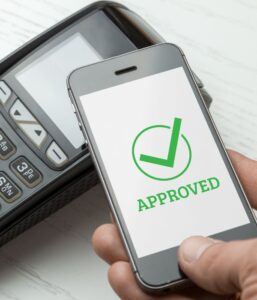 Multiple financing options are offered to patients just 30 seconds after applying, and the vast majority get approved.
Healthcare providers who offer patient financing will enhance their practice and are helping their patients who may otherwise pay surprise medical bills with expensive credit card debt.
Patient financing can strengthen cash flow and dramatically reduce accounts receivable numbers with zero risk to the practice, while at the same time increasing patient loyalty.
3. Online Payments
 Part of a modern payment solution suite is a secure online payment gateway, allowing patients to pay online 24 x 7. Optimized for mobile devices, it also works with laptops and desktop computers, allowing patients to make payments from home or on the go.
A payment link can be added to your website, to emails, texts, and any other patient communications. This means patients will have a seamless and smooth payment experience.
Being fully integrated with your practice management software payments will be automatically posted to the patient ledger or electronic health records. This reduces errors and helps staff to monitor transactions.
4. Card On File
Card on file is functionality that allows a practice, with consent from the patient, to store their payment information securely and conveniently in a secure HIPAA compliant vault hosted in the cloud. 43% of patients say they are comfortable with automatic payments to avoid repetitive manual data entry of their debit or credit card.
 When patients leave a payment method on file, it means one less step during future checkouts. This can even be done ahead of visits when a patient fills out a digital registration form. The front desk can make the payment for the patient at checkout with no need to dig around for cards and a payment receipt will be automatically sent by email.
A card update feature checks stored card information and if anything has changed, the payment information is automatically updated in the vault. This saves staff time keeping up with payment information.
The healthcare organization is also protected from chargebacks or legal disputes with card on file agreements that are built in to the system and are kept on file with a patient’s record, and which can be emailed or printed for patients’ own records.
5. Subscription Payments
 Card on file also enables healthcare providers to set up an automatically recurring payment to allow a patient to pay down a large out-of-pocket expense over several months. For many patients, having this interest-free option can make the difference between choosing to avail of medical care or not. This flexible payment option is a highly practical way for healthcare providers to receive more incoming payments and for patients to afford their treatment.
6. Increased Security & Fraud Prevention
With modern patient payment systems, data is never stored on the premises or servers of a healthcare provider. Instead, the application stores all customer data in a secure, encrypted, electronic vault which is compliant with all relevant standards such as PCI, DSS, and HIPAA. The practice is also protected from the cost of fraud. Risk management experts monitor transactions and maximize security in order to detect attempts at fraud.
Summary Of Benefits To Healthcare Providers
 Streamlining your payment processes with a patient payment solution that seamlessly integrates with your existing practise management systems brings many business benefits while also providing an improved patient experience.
- Reduced AR – Dramatically reduces accounts receivable numbers.
- Stronger Cash Flow – Better payment options, including flexible financing means patients are able to pay medical bills immediately.
- More Focus On Patients – Patient payment solutions bring greater staff efficiency allowing them to spend more time on patient care and less time on administration duties.
- More Patients – Practices that offer digital payments bring in more new patients and have higher retention levels.
- Increased Operating Margins – Practices that get paid more quickly and have less bad debts have lower accounting costs and higher margins.
Benefits Of Upgrading Payment Solutions For Patients
Empowering patients to pay bills from anywhere at any time with any internet connected device fosters patient loyalty and trust.
- Empowerment – Flexible and varied payment options mean patients can confidently access the treatments they need.
- Convenience – Multiple payment options provides a better, more convenient customer experience for patients.
- Affordability – Spreading the cost with regular subscription payments or financing allows patients to receive the care they need and budget appropriately.
Find Out More About Patient Payment Solutions
Find out more about patient payment solutions by filling in a form on this page. You will be contacted by a member of staff from Rectangle Health our page sponsor.
 You can ask questions, request a demonstration, or arrange a no risk evaluation, all with no obligation.
Since 1983 Rectangle Health has been providing financial technology solutions exclusively for healthcare organizations. Their fully HIPAA compliant solutions are used by over 60,000 healthcare providers in the U.S and they process over $6 billion of patient payments annually.
The HIPAA Journal has arranged a 25% reader discount on Rectangle’s list price for their patient payment solutions.
By supporting one of our sponsors, you are helping The HIPAA Journal to continue to provide our news service free of charge.
The post Improve Patient Satisfaction With Enhanced Payment Options appeared first on HIPAA Journal.
 Patient-centric functionality enhances patient communications with automation, including appointment notification and reminders, online patient scheduling, waitlist management with last-minute cancellation fulfilment, patient experience surveys, and many other features. These can significantly enhance your patients’ perception and experience of your practice.
 Highlighting the need to p
 Reduce No Shows – Up to a 90% improvement in missed appointments.
 Another
  When considering how to become HIPAA compliant, one of the simplest approaches is to adopt HHS’s “Seven Fundamental Elements of an Effective Compliance Program.” This will help you address compliance challenges identified in a HIPAA risk assessment. It can also be beneficial to take advantage of HIPAA compliance software that is built around The Seven Fundamentals in order to maintain a compliant workplace.